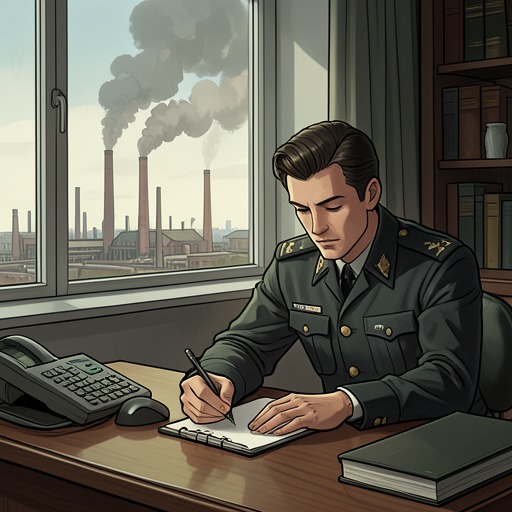
Politische Abteilung
The Zone of InterestThe Politische Abteilung, or Political Section, is the camp department through which the novel presents administrative decisions about prisoners and the coordination of camp affairs. Its role appears in practical exchanges: a proposed action concerning Polish prisoners, a meeting prompted by changes at the Buna-Werke, and the review of a report about industrial sabotage. These episodes connect the department to the machinery of persecution without suggesting that it alone directs the larger policy of extermination.
Identity and Institutional Setting
The Politische Abteilung is identified as a camp department headed by Fritz Mobius. In early November, Paul Doll makes an appointment with Mobius after perceiving a marked relaxation of work tempo at the Buna-Werke and a significant burst of progress. The meeting takes place in Bunker 13, a grey-brick building in the Stammlager whose boarded windows give it a sealed, blind quality. The setting makes administration difficult to separate from violence: while Doll waits, screams rise and fall from the cellars, pause, and resume after Michael Off descends again.
The novel also situates Mobius within a broader policing apparatus. He had formerly been a clerical worker at the headquarters of the Gestapa, which the narration distinguishes from the Gestapo and other police bodies. His subsequent advancement is attributed to a widely discussed talent for cruelty. This background characterizes the department’s leadership through the institutional proximity of paperwork and violence, rather than through a detailed account of its formal organization.
Prisoner Policy and Competing Administrative Pressures
One episode associates the Politische Abteilung with a proposed action against Poles. Mobius tells Doll that something must be done about them; when Doll asks how many, Mobius answers that the number has not been finalized but estimates a group of about 250. Doll initially finds the figure unremarkable, having become accustomed to the far larger numbers reported by Szmul at the Meadow. The exchange shows how scale has distorted Doll’s judgment, while the proposal itself remains at the stage of a file and an estimated number in the evidence presented.
The department’s work sits amid conflicting institutional demands. At home, Doll describes pressure from the Economic Administration Head Office to increase the labor force for the munitions industries, while the Reich Central Security Department presses for the disposal of as many evacuees as possible. He objects to a suggestion that able-bodied mothers be worked in the boot factory at Chełmek, pointing out the difficulty of separating them from their children at the ramp. This conflict exposes a system in which exploitation for labor and the removal of deportees operate as competing priorities, even as both belong to the same persecutory administration.
Reporting, Surveillance, and the Camp Economy
The Politische Abteilung also appears in relation to reports about activity at the Buna-Werke. In a later exchange, Mobius reads the first page of Rupprecht Strunck’s report and asks whether the person identified in it is the coordinator on the factory floor. Doll confirms that an NCO named Jenkins identified him and that Strunck then found his calendar in the tool cabin. The episode presents information moving through a chain of observation, identification, and written reporting; the department’s relevance lies in its place within this administrative response to suspected sabotage.
The earlier appointment with Mobius is prompted by a change in the factory’s pace and progress, linking the department’s scrutiny to the camp’s industrial function. This connection is set against the later account that not a kilogram of synthetic rubber or a millilitre of synthetic fuel was ever produced at the Buna-Werke. The contrast between administrative attention to the works and their eventual lack of output underscores the distance between bureaucratic oversight and productive success, without diminishing the human coercion that sustained the enterprise.
Position in the Machinery of Persecution
The department’s scenes form part of a larger administrative landscape, not a complete institutional portrait. Doll describes orders moving down a chain of authority, including an order attributed to Gruppenführer Blobel and, through him, the Reichsführer-SS. Elsewhere, a discussion of the extermination policy traces authorization at the highest level while emphasizing that killing could have proceeded by bullets and pyres even without gas chambers and crematoria. Those passages widen the novel’s frame beyond the Politische Abteilung: they show policy, camp administration, labor demands, and direct violence as connected but not interchangeable elements.
That distinction matters to the department’s significance. Its file, estimate, appointment, and report make persecution legible as ordinary administrative work, while the screams from Bunker 13 and the threatened separation of mothers from children reveal the human consequences beneath the paperwork. The Politische Abteilung is therefore presented less through a formal charter than through its position at the junction of decisions, surveillance, and coercive camp practice.