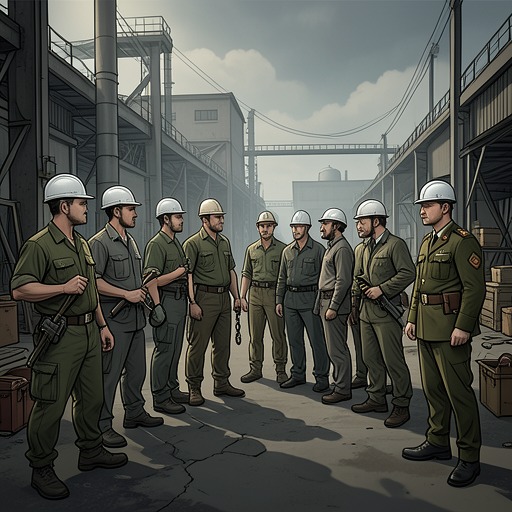
Rupprecht Strunck
The Zone of InterestRupprecht Strunck is an official involved in the Nazi administration of Buna-Werke and the camp, where he helps investigate a sabotage campaign against industrial equipment. His discoveries point to coordination inside the plant, but his wartime work also belongs to the system of exploitation that is later judged at Nuremberg: in 1948, he is sentenced to seven years for plunder and spoliation, slavery, and mass murder. The movement from identifying damage to machinery to being convicted for crimes against people makes his role an uneasy measure of what the industrial enterprise served and whom it destroyed.
Identity and Position
Strunck appears in the novel as an official with access to the political and industrial machinery surrounding Buna-Werke. During an emergency summit in the Political Department, he joins Paul Doll, Fritz Mobius, and Suitbert Seedig to address a crisis at the plant. The description of Strunck as a “very slightly gross old party” gives him a blunt, unpolished presence in a room concerned with technical evidence and institutional failure. The passage does not present him as an engineer examining a single malfunction: he speaks as someone trying to understand sabotage across the works and to locate its organization.
His position is also situated within a factory whose apparent productivity depends on layered coercion. From the Buna office window, the narrative shows prisoners driven through their work at unnatural speed, overseers shouting at one another, and IG Farben designers, engineers, and administrators picking their way past wounded, unconscious, and dead people with notebooks and measuring tapes. That view supplies the material setting for Strunck’s investigation: the plant’s machinery is monitored and maintained within an environment where human beings are treated as expendable. The contrast is not incidental to his later conviction for slavery and mass murder.
Investigation of the Sabotage
At the emergency meeting, Strunck reports that someone has mixed sand into engine grease to damage the gears. He describes the act as deliberate sabotage of the war economy, while Seedig adds further evidence: weakened rivets that could pop and pressure gauges skewed to give false readings. The details indicate more than accidental breakdown. They suggest that separate components have been altered so that machinery may fail later, during use, rather than immediately revealing the sabotage to those who assembled or inspected it.
Strunck draws a further inference from the pattern. There must, he argues, be dozens of participants, a coordinator on the factory floor, and an informant within Farben. His estimate of a broad operation is his own assessment at the meeting, not a confirmed count of those involved. The explanation that follows focuses on the timing: the saboteurs tampered only with equipment far from its scheduled first use. By the time a machine jammed, stalled, collapsed, or exploded, investigators would have difficulty tracing who had handled it. Strunck identifies the key enabling clue as a calendar of first-use dates that someone has passed to the saboteurs. The calendar turns the investigation from a search for isolated acts into a search for information moving through the factory.
From Report to Identification
The inquiry later produces a report bearing Strunck’s name. When Mobius reads its first page, he asks whether the person described is the coordinator on the factory floor. Doll confirms that he is: a non-commissioned officer named Jenkins identified him, and Strunck then found the coordinator’s calendar in a tool cabin. The episode gives Strunck a practical investigative role. He follows the lead from a suspected schedule of future machinery use to a physical document in the factory, while Jenkins supplies the identification that connects the evidence to a person.
The calendar matters because it explains how sabotage could be timed to evade immediate detection; its discovery in the tool cabin makes the investigation concrete. At the same time, the report does not transform Strunck into a detached observer of the camp’s violence. His work is directed toward protecting the industrial operation. Professor Entress tells Angelus Thomsen that Buna and synthetic fuel would not win the war but could prolong it, and that every additional day would carry consequences. In this setting, finding those who obstruct the machinery serves a war effort sustained by forced labor. Strunck’s competence in identifying sabotage is therefore presented alongside the human cost of the system he helps keep functioning.
Wartime Role and Postwar Judgment
Strunck’s relation to the investigation continues beyond the first emergency meeting. He is associated with the report that identifies the factory-floor coordinator, and the account later states that he is called out of early retirement. His retirement begins in September 1943; after the war, he is again brought into public view through prosecution. These details place the investigation within a longer institutional career rather than presenting it as a self-contained episode.
In July 1948, thirteen IG Farben executives and managers are convicted at Nuremberg; Frithuric Burckl is specifically excluded from that group. Strunck receives a seven-year prison sentence for plunder and spoliation, slavery, and mass murder. The sentence establishes the legal judgment attached to his postwar record, distinguishing it from the wartime question of who supplied the sabotage calendar or organized the campaign. The text does not say that Strunck participated in the sabotage, nor does it equate investigating it with the crimes for which he is convicted. Instead, the juxtaposition exposes the sharp difference between protecting industrial equipment from interference and being held responsible for the exploitation and mass violence that accompanied its operation.
The industrial promise itself ends in failure: not a kilogram of synthetic rubber or a millilitre of synthetic fuel is ever produced at Buna-Werke. Against that outcome, Strunck’s investigation has a grim double significance. He helps make a campaign against the factory’s machinery legible, tracing its timing through a first-use calendar; yet the works he is trying to defend never deliver the products they were meant to produce. His later conviction places that failed industrial project within a wider reckoning over the human crimes committed in its service.