SS Hygiene Institute
The Zone of InterestThe SS Hygiene Institute is a camp facility whose resemblance to a medical establishment sits uneasily beside the violence surrounding it. Its supervised laboratory work and prisoner doctors offer a veneer of clinical order, while an adjacent corridor and a room associated with repeated lethal injections reveal how medical procedure can be folded into the camp’s system of harm.
Medical Appearance and Prisoner Staff
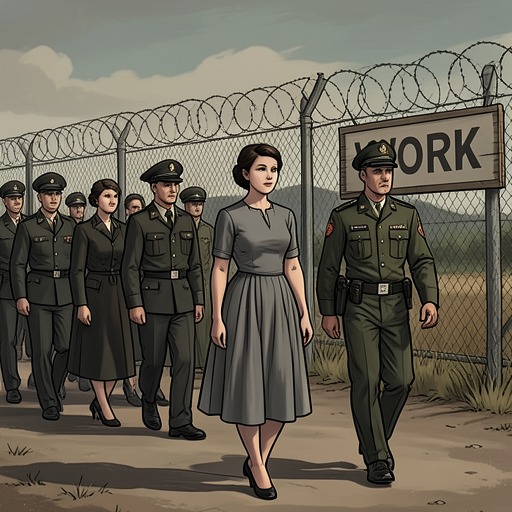
The SS Hygiene Institute is described as one of several sites where prisoner doctors, under close supervision, perform bacteriological work and research on experimental sera. Unlike the camp hospice or the surgical practices associated with Block 10, it bears persuasive outward similarities to an ordinary medical establishment. That contrast matters: the institute’s clinical character is not evidence of safety, but part of the unsettling proximity between medicine and coercion in the camp.
Miriam Luxemburg, a Polish-German prisoner doctor, has worked there for two years. Paul Doll meets her at the institute for an introductory conversation, then arranges their second meeting in a quiet stockroom elsewhere. Her status as a doctor gives her specialized knowledge and professional tasks, but the account makes clear that this work takes place under SS supervision, not in conditions of professional independence.
The Corridor and Room 2
The institute’s corridor carries a more sinister association. When Miriam says she does not know how to administer a cardiac injection of phenol, Doll considers suggesting that she practise there. He identifies the place as Room 2 and says that about sixty injections are carried out there per day. The figure turns a clinical room into evidence of routine, repeated killing: the method is discussed in the language of a practical skill, and its frequency is rendered as an ordinary daily count.
The episode exposes the boundary between the institute’s laboratory work and the camp’s lethal procedures as porous. The facility is not presented simply as a hospital or research centre; its medical knowledge and spaces exist within a regime that can direct expertise toward the destruction of prisoners.
Miriam Luxemburg and Alisz Seisser
Doll recruits Miriam for a clandestine procedure involving Alisz Seisser. He says the work must take place around midnight for security reasons and asks what she will need. Miriam requests clean towels and plenty of boiling water. Doll suggests that she might give Alisz a pill, but the exchange proceeds toward a procedure rather than that proposed alternative. When Miriam admits she does not know how to give a cardiac injection, Doll presses her about the technique; she answers that he should do it himself.
Doll remains present as Miriam performs the procedure, including the preparation, injection of local anaesthetic, dilation, and curettage. The account does not establish that the procedure occurs inside the institute; rather, the institute supplies the professional connection and context through which Doll uses Miriam’s medical expertise. Afterwards, he drives her back to the SS Hygiene Institute and hands over an additional four hundred Davidoff cigarettes, then asks how long it will take for Alisz to recover. The return journey and payment make visible the coercive, clandestine terms of this arrangement.
Narrative Significance
The SS Hygiene Institute is defined by a contradiction between recognizable medical practice and the camp’s violence. Clean towels, boiling water, laboratory work, and specialized knowledge retain their ordinary clinical associations, yet they appear beside a room where phenol injections are administered dozens of times a day and a prisoner doctor is drawn into a secret procedure arranged by Doll. The institution’s significance lies not in a detailed account of its architecture, but in this collision: medical spaces and expertise remain legible as such even as the camp subjects them to surveillance, coercion, and lethal use.