Selektion (screening)
The Zone of InterestSelektion (screening) is the sorting process conducted as deportees arrived at the camp: a pivotal stage between their removal from the train and their assignment to forced labour or death. The procedure presents mass violence as a matter of orderly assessment, but its categories cannot disguise what the sorting accomplishes. The novel sets the procedure’s cold arithmetic against the actual people on the ramp, the conflicts over whether prisoners should be worked or killed, and the bodies that remain after the transports have gone.
Place and Procedure
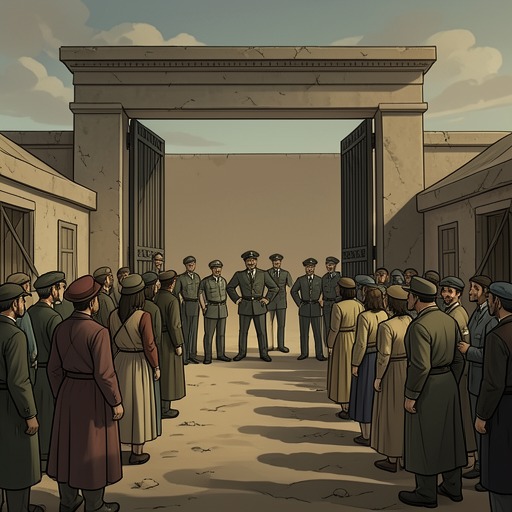
The ramp sequence joins several operations. Deportees are taken from the train, assessed in a selection, and then driven through the birch wood to the Little Brown Bower in Kat Zet II. Boris Eltz calls selection the eeriest part of ramp duty and invites Paul Doll to attend. The ordinary procedure depends on the arrival itself: a decision made after people have formed into lines may come too late for a particular intervention. For that reason, a rare effort to save a prisoner must be made while passengers are still leaving the train.
The procedure is presented through the organization assembled to receive one transport. Doll arrives with Wolfram Prufer, three labour managers, six physicians, disinfectors, Szmul and his twelve-man team, eight Kapos, a hosing crew, ninety-six troops under Boris Eltz, a heavy machine-gun unit, and two flamethrowers. Ilse Grese and her platoon are also called in, along with a septet of violinists. The numerical precision makes the operation look planned and complete; the armed force and specialized personnel reveal how much coercion and coordination stand behind the supposedly administrative act of sorting.
The practical assumptions are equally numerical. Doll refers to a rule of thumb of one thousand people per train, with as many as ninety per cent selected Left. But the arrival of Special Train 105 overturns the expected proportions. It carries barely one hundred people, most of them younger than ten or older than sixty; among the younger adults are people with visible impairments, including a man with a club foot and others using spinal braces or white sticks, and a pregnant woman. The categories of fitness and labour value are applied to individual bodies, but the scene makes plain how little a general rule can capture about the people subjected to it.
Labour, Death, and Administrative Conflict
Selection is not an isolated decision about individuals. It sits between competing institutional demands: the Economic Administration Head Office presses for more labour for the munitions industries, while security officials demand that deportees be disposed of. Doll describes himself as caught between the two. The contradiction is written into the workday at Buna-Werke: prisoners rise at three, march for ninety minutes, work until six, return at eight, and carry their casualties along the way. Suitbert Seedig asks how exhausted people under those conditions can produce useful work. He reports that they are still dying at a rate of one thousand a week.
Frithuric Burckl proposes a twenty-per-cent ration increase, not as a challenge to the system but because stronger prisoners might last longer. The same calculus appears in the discussion of calories: an adult at complete rest needs two thousand five hundred, while a heavy worker on eleven hundred calories may lose about three kilos a week. These figures expose the narrow terms in which administrators debate survival. More food may extend a prisoner’s usefulness; selection, meanwhile, decides who is not retained for work at all. The distinction between labour and death is therefore operational, not a difference in the underlying treatment of deportees as expendable.
A letter from Bayer makes that logic still more explicit. It reports that all 150 women sent for experiments have died and requests another group of the same number at the same price. Here the sorting and supply of people for exploitation extend beyond the ramp into the commercial and medical institutions connected to the camp. After the war, thirteen IG Farben executives and managers are convicted at Nuremberg, and Seedig receives an eight-year sentence for slavery and mass murder. The Buna-Werke produces neither a kilogram of synthetic rubber nor a millilitre of synthetic fuel. The planned economic justification thus ends in punishment for some participants and no production of the intended goods, without undoing the suffering inflicted on prisoners.
Staging and Concealment
The ramp can be made to look civil. In Boris’s recollection, it has been swept and hosed; the train arrives in a festive manner, its passengers disembark without whips or truncheons, and the speech is translated. The appearance of calm and courtesy lasts only until a lorry arrives carrying the day’s corpses from the main camp toward the Spring Meadow. That interruption exposes the relation between the orderly reception of new arrivals and the deaths already being processed nearby. Selektion belongs to a larger routine whose different stages can appear separate only when the evidence of their connection is kept out of sight.
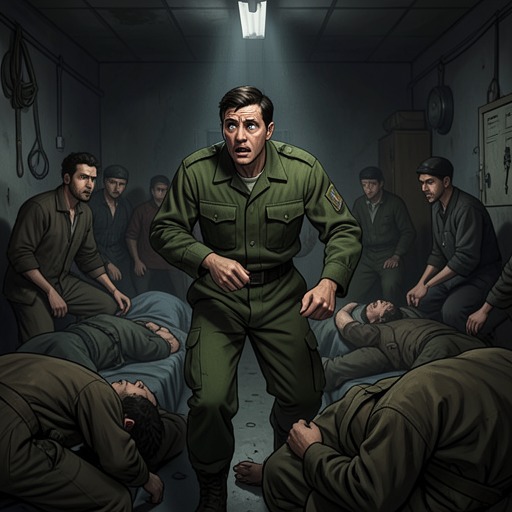
The treatment of those designated for death also depends on deception and forced participation. Szmul and the other Sonderkommando prisoners drag bodies from the shower room to the Leichenkeller, remove gold teeth, cut off hair, collect jewellery, and load the remains into the crematory retorts. Ashes are ground and dispersed in the River Vistula. At the ramp and in the disrobing room, they may reassure arrivals with false promises about work or transfer; if someone resists, they can bring that person to an NCO for punishment. Their forced role makes the operation’s violence visible while also showing how the institution compels prisoners to help maintain its pace and concealment.
From Local Routine to Extermination Policy
The novel places the procedure within the development of the extermination policy. A retrospective account identifies 31 July 1941 as a decisive point: a letter drafted by Adolf Eichmann and Reinhard Heydrich and signed by Hermann Göring authorized a total solution. At first, those involved may have contemplated removing Jews to remote, cold territory after a rapid victory over Russia. As that territorial plan receded and officials in Poland complained that they could not cope with newly annexed populations, pressure mounted. By August or September, the shift had reached women and children as well as men, whom mass shootings had already killed for months.
Professor Peters cautions against treating gas chambers and crematories as the essence of the crime. He describes them as ways to accelerate killing, economize, and spare the killers’ nerves; in his account, bullets and pyres would have served the same murderous intention. He cites the Einsatzgruppen’s killing of well over a million people by bullets. This perspective puts Selektion in its proper relation to the killing system: it is a sorting mechanism within a broader policy, not the source of the policy’s intent. The ramp’s statistics, assessments, and divisions of labour make extermination repeatable and administratively manageable, while the arrivals themselves expose the human reality those procedures attempt to reduce to numbers.