Sonderkommando prisoners
The Zone of InterestSonderkommando prisoners are the coerced workers compelled to labor amid mass murder: handling the recently dead, assisting the camp’s operations, and confronting the destruction of the people and culture around them. Their testimony makes that position more than a function in the machinery of killing. It records the bodily damage of the work, the desecration built into its setting, and the strained efforts to preserve agency and memory when almost every ordinary means of connection has been taken away.
Forced Labor and the Machinery of Killing
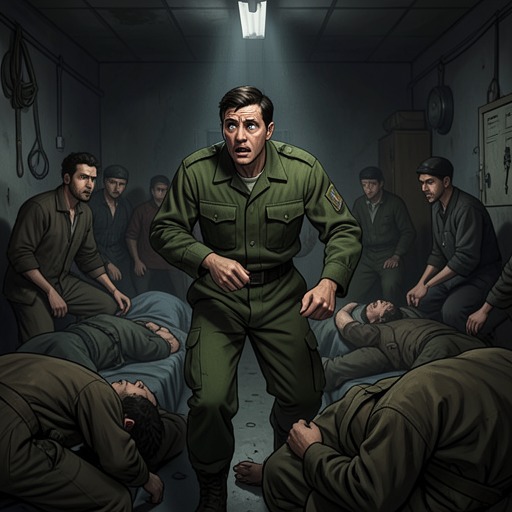
The account of the prisoners’ work is concrete and intimate. The narrator recalls spending his first thirty days in the Lager exploring the orifices of recently dead people in collaboration with the German search for valuables. In a later scene, when Paul Doll visits him in the morgue, he is supervising two work details: the barber Kommando, whose members use shears, and the oral Kommando, whose members use a chisel or small, heavy hammer and a blunt hook to control the jaws. The SS dentist sleeps on a bench nearby. The instruments and the sleeping dentist make the work appear at once organized and grotesquely routine; the prisoners are required to continue their tasks in the presence of death.
The prisoners’ coerced labor also sits within a conflict between competing administrative priorities. In his private thoughts, Doll describes pressure from the Economic Administration Head Office to increase the workforce for the munitions industries, alongside pressure from the Reich Central Security Department to dispose of evacuees. A proposal to make able-bodied mothers work in a boot factory at Chełmek prompts him to imagine the practical difficulty of separating them from their children at the ramp. His reaction exposes how institutions sort people according to labor value and killing policy, while his own objection is expressed as a challenge to the proposal’s feasibility, not as a rejection of the system that produces it.
Desecration and the Damaged Senses
The prisoners describe not only forced work but a setting saturated with deliberate profanation. A Star of David is placed on the ceiling of an airtight chamber; the foot rags issued to the prisoners are scraps of prayer shawls; and Transit Route IV, a slave-built highway from Przemsyl to Tarnopol, lies over the crushed rubble of synagogues and Jewish gravestones. The so-called Goebbels Calendar makes the violence recur against the Jewish calendar: no holy day passes without an Aktion, and the sharpest measures are reserved for Yom Kippur and Rosh Hashana. These details connect the prisoners’ daily surroundings to a broader assault on religious life and the physical traces of Jewish communities.
In the narrator’s account, taste is the only one of the five senses the prisoners can partly control. Sight, hearing, smell, and touch have been ruined; he describes handling bodies—carrying, dragging, shoving, seizing—without feeling a human connection to what his hands do. The image is of prosthetic hands: functional limbs severed from the sense of contact. Eating offers a limited form of choice, but it cannot provide lasting relief. Once food is swallowed, the taste of defeat returns, compared to wormwood. The bitter image binds bodily survival to the prisoners’ awareness that they have been trapped in a war directed against Jews and made radically one-sided by their captors’ power.
Debate, Resistance, and Traumatic Memory
The prisoners’ meetings include repeated debate over alleviation and what, if anything, they can do to affect the transports. One proposal is to sow panic each time by moving along the ramp and whispering of murder. Its advocate argues that even if the effort seems futile, it could slow the process and corrode the perpetrators’ nerves: the killers are mortal. The account records this as a debated tactic, not as an action known to have been carried out. Its importance lies in the small opening it imagines: an attempt to interrupt the process and make its agents feel fear, even when the prisoners cannot control the larger machinery.
That effort to speak and act coexists with trauma that follows the narrator beyond the work. He describes a recurring dream in which he returns to a kitchen, tells a woman what happened, and watches her turn away, shaking her head. He does not tell her about the first thirty days of work among the dead, or about the time of the silent boys. The dream ends there, but its unbearable quality makes him wake as soon as it begins; he gets out of bed and paces because he is afraid to sleep. The omission is part of the testimony: experiences named as unspeakable remain present in the dream’s limits and in the narrator’s fear of its return.
Policy Context and Narrative Significance
A conversation between Angelus Thomsen and Professor Entress’s colleague Konrad Peters places the prisoners’ experience against the development of the killing policy. Peters dates what he calls the crime without a name to July 31, 1941, describing a letter drafted by Eichmann and Heydrich, sent to Goring, and returned with his signature. In Peters’s account, an earlier possibility of expelling Jews to a remote, barren region receded after a quick victory over Russia failed to provide the expected territorial solution. Pressure from officials in Poland and competition among plenipotentiaries followed, and by August or September the shift to killing women and children as well as men had become a decisive moral breakthrough. This is Peters’s explanation within the novel’s dialogue, not an impersonal account detached from a speaker.
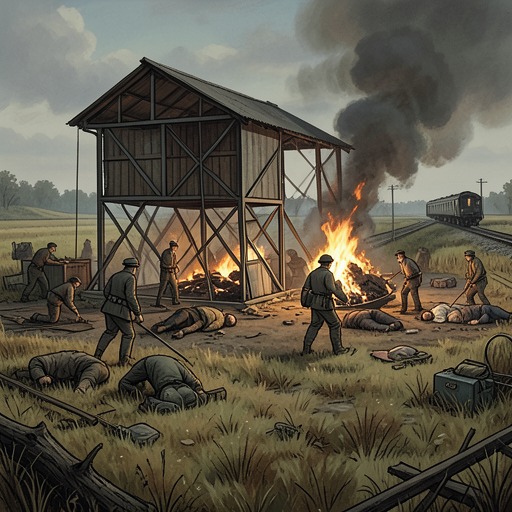
Peters also argues that gas chambers and crematoria were methods for accelerating murder, economizing, and sparing the killers’ nerves, rather than the source of the murderous intent. Bullets and pyres, he says, would ultimately have served the same purpose; he cites the Einsatzgruppen’s killing of well over a million people by bullets and imagines the same method applied to millions of women and children. His distinction between purpose and technique sharpens the prisoners’ predicament: the form of the killing could be made more industrial, but the violence did not depend on industrial equipment. Read alongside the morgue work, the bureaucratic struggle over labor, and the prisoners’ damaged senses, this argument makes their testimony bear witness both to the system’s operations and to the will that sustained them.