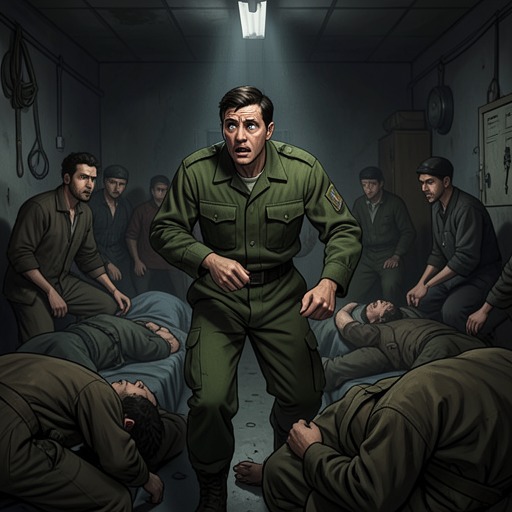
Sonderkommando rescue of young prisoners
The Zone of InterestThe Auschwitz Sonderkommando’s rescue of young prisoners is presented as a narrow but consequential act of survival within the camp’s machinery of mass death: members of the Special Squad save, on average, one young male life per transport. The rescue must happen as people leave the train, before they are sorted into selection lines; once that process begins, the chance has passed.
A reason to go on living
The narrator places rescue among three reasons for continuing to live. Bearing witness is the first; exacting mortal vengeance is the second. Saving or prolonging a life is the third, and the most crucial. These purposes do not erase the prisoners’ situation or resolve its moral contradictions. The narrator calls the Auschwitz Sonderkommando the saddest and most disgusting men, while insisting that its members do no harm. Against that unbearable self-description, the rescue offers a concrete reason to persist: a life can still be preserved.
The act is measured without being made secure. Sometimes the prisoners save no one; sometimes they save two. Across transports, the average is one. The narrator insists that even 0.01 per cent is not 0.00: a fraction that might look negligible from outside remains, for the person spared, the difference between life and death.
The moment before selection
The timing is decisive. The rescue has to be carried out while the deportees are leaving the train. By the time selection lines form, it is already too late. The account therefore locates the intervention at a brief threshold between arrival and sorting, when the condemned have not yet been absorbed into the selection process. It gives no detailed mechanics beyond that constraint, but makes clear that hesitation or delay closes the opportunity.
The prisoners whisper to the young men that they are eighteen years old and have a trade. The appeal addresses them as people with an age and a skill, rather than as anonymous figures in a transport. Its hushed delivery belongs to the danger and urgency of the moment; the words are part of an attempt to keep a young person alive before selection renders the possibility unavailable.
Witness, guilt, and the measure of a life
The rescue does not turn the narrator into a figure who can claim innocence or victory. The account remains bound to the Sonderkommando’s paradoxical position: its members are trapped inside an atrocity, yet the narrator maintains that they do no harm and describes saving lives as a reason to continue. Witness and rescue thus occupy different but connected roles. One bears testimony to what the world already knows; the other acts, in a fraction of the time available, to prevent one more death.
The repeated arithmetic—none, sometimes two, an average of one—refuses both triumph and futility. The number is small beside the scale of the transports, but the narrator will not let smallness become zero. The rescue’s significance lies in that insistence: under conditions that severely restrict what can be done, the possibility of saving even one young prisoner remains an urgent and decisive measure.