Special Train 105
The Zone of InterestSpecial Train 105, also called the Golden Arrow, is the passenger train whose arrival briefly lends the camp the appearance of an ordinary place of transit and hospitality. Its fine carriages and vulnerable passengers make Paul Doll’s staged welcome seem plausible, while the corpses carried past the arriving group reveal what that performance is designed to hide.
Schedule, Warning, and Preparation
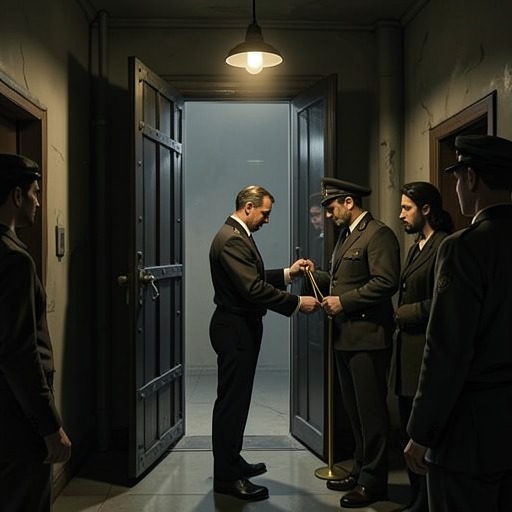
An official telegram from Berlin gives the train’s itinerary: it leaves Bourget and Drancy on June 25, passes through Compiègne, Laon, Reims, and the frontier, and is scheduled to reach KZA(I) at 19:03 on June 26. The projected two days in transit lead Doll to expect a relatively gentle journey for the deportees. A second telegram, sent from Paris by his old friend Walther Pabst, warns him to exercise extreme caution and says his abilities will be tested to their limit. Doll initially treats the warning as a practical joke, but prepares extensively all the same.
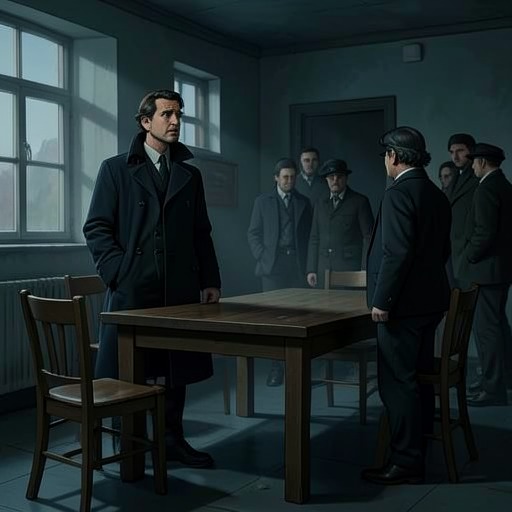
The detail of that preparation reflects Doll’s taste for numbers and for the appearance of orderly command. At the ramp he assembles Wolfram Prufer, three labour managers, six physicians, disinfectors, and a team of twelve prisoners led by Szmul, three of whom speak French. Eight Kapos and a hosing crew are present, as are ninety-six troops under Captain Boris Eltz, an eight-person heavy-machine-gun unit, and two flamethrowers. Senior Supervisor Ilse Grese arrives with her platoon. Doll has also called for a seven-piece group of violinists from Innsbruck. This inventory makes the reception look carefully controlled; it also places overwhelming force and music side by side before the passengers have even stepped down.
A Passenger Train, Not the Expected Transport
At 19:01, as the rails begin to tremble, the train appears in the distance. Doll watches it approach through binoculars. Instead of the usual freight cars, he sees passenger carriages, including three classes of cars in yellow and terracotta. The head doctor, Baldemar Zulz, jokes about French taste, and Doll joins in the banter. Their exchange gives the officers’ gathering a collegial surface, but Doll notes that the troops are already taking positions along the siding. The train brakes and stops with a hiss.
The arrival does not match the camp’s usual expectations. Doll describes a rule of thumb of around 1,000 people per train, with up to 90 percent selected for the left-hand side. Special Train 105, by contrast, contains barely 100 passengers. Its first disembarking group consists not of uniformed servicemen or gendarmes but of civilian stewards wearing white armbands. Then a boy of about eight or nine in a sailor suit steps down, followed by an elderly man in an astrakhan overcoat and a very old woman leaning on an ebony cane with a pearl handle. More passengers emerge from the other carriages.
The passengers’ visible ages and conditions make the expected selection seem almost beside the point. Doll observes that all but a few are under ten or over sixty, and that even the younger adults appear to him already destined for the gas. He singles out a thirty-year-old man with a club foot, a pregnant young woman, and other passengers with spinal braces or white sticks. These descriptions frame the convoy through the camp’s machinery of selection: age, disability, and pregnancy register not as incidental biographical details but as signs of what the authorities will do to the people who bear them. Doll’s initial relief at the unexpectedly small transport does not alter their fate.
The Welcome and Its Cover Story
Doll addresses the arrivals through a loudhailer with a promise of recuperation and farm work. He says they will first be taken for a warm shower and then shown to their rooms; their luggage, he assures them, will be waiting at the guest house. He promises tea, cheese sandwiches, and a hot stew. Eltz repeats the substance of the speech in French. The carefully chosen comforts—warmth, lodging, food, work—turn the train’s civilized appearance into part of a deception. The passengers are invited to understand the journey as temporary care rather than deportation to their deaths.
The welcome is staged against the familiar violence of other arrivals. Doll contrasts this train with boxcars, arc lights, shouting, dogs, truncheons, and whips, and imagines a more dignified reception as if it could be a genuine alternative. The birch wood and the evening light help sustain that appearance, even as the characteristic smell of the camp remains. His fantasy of a humane procedure is therefore inseparable from his role in the system that makes the promised recovery and farm placement false.
The Lorry and the Collapse of the Scene
The performance breaks when a rusted lorry crosses the rails. Its green tarpaulin lifts briefly, exposing its cargo: the day’s corpses from KL1 on their way to the Spring Meadow. The sight prompts a collective reaction from the new arrivals. Baldemar Zulz raises his arms as if to ward it off; Eltz turns sharply toward Doll. The officers’ calculated reception now faces the possibility that the passengers will understand where they have arrived.
Doll responds with a silent gesture to the musicians rather than an order to the armed men. At first, the violinists’ music only doubles the helplessness of the passengers’ cries. Then the melody takes hold as the truck clears the crossing and disappears down the road. The column resumes its walk through the birch wood. Music does not undo the revelation; it helps the staged procession continue after the evidence of mass death has passed from view.
Boris later recounts the scene in similar terms: the ramp had been swept and hosed, the sunset was pretty, the passenger train looked festive, and the people disembarked without whips or truncheons. Then the lorry arrived, carrying the daily burden of corpses from the Stammlager to the Spring Meadow. Boris remembers about a dozen bodies slumped over the tailboard, starved and covered in filth, rags, wounds, and boils. His account confirms the contrast between the orderly passenger arrival and the camp’s routine traffic in death. When asked about selection, he says there was none: the arrivals were already certain to be gassed.
Special Train 105 thus concentrates the contradiction between appearance and function. Its passenger cars, numbered classes, and elderly and child passengers evoke ordinary travel, while the camp’s reception turns that ordinary form into a tool of concealment. The lorry makes the concealed reality visible for only a few seconds; the music and resumed procession restore the surface of order without changing what awaits the passengers.