Special Train 105's arrival and liquidation
The Zone of InterestSpecial Train 105 arrives at the camp as a transport that appears, at first, unexpectedly small and easy to manage. Paul Doll has prepared a show of force and a carefully staged welcome; the passengers are mostly children and elderly people, and there is no genuine selection because they are already destined to die. The reception leads them from the ramp through the birch wood toward sealed doors, while a truck carrying corpses briefly tears through the illusion of a civilized arrival.
Warning and Preparation
Doll initially has reason to expect a soft transport: the evacuees are to spend only two days in transit. A second message from Paris changes the mood, warning him that Special Train 105 will test his abilities to the limit. Doll treats the warning as a reason to prepare, arranging a substantial contingent rather than relying on the smaller force usually required for a light transport.
His preparations are specific and excessive. At the ramp he assembles Wolfram Prufer, three labour managers, six physicians, disinfectors, Szmul and his twelve-person team, eight Kapos, a hosing crew, and ninety-six troops under Boris Eltz. An additional eight-person unit brings a heavy machine gun, and the force includes two flamethrowers. Ilse Grese and her platoon are also present. Doll even calls up seven accomplished violinists, preferring them to the usual collection of makeshift instruments. His inventory of personnel and equipment turns the ramp into a carefully controlled stage, though the transport will prove much smaller than the preparations suggest.
As the train approaches, Doll watches it arrive along the long spur. Its carriages appear to be passenger cars, in three classes, rather than the cattle cars associated with transports from elsewhere. When it stops, the first people off are bewildered middle-aged stewards in civilian suits, marked by white armbands. Then come the passengers: a boy of about eight or nine in a sailor suit, an elderly man in an astrakhan coat, and a bent old woman leaning on an ebony cane, followed by the others.
A Transport Already Condemned
The shipment contains barely one hundred people, not the thousand Doll had expected. Most are under ten or over sixty. The few younger adults are also visibly vulnerable: one man has a club foot, a pregnant woman is among the arrivals, and other passengers use spinal braces or white sticks. Their ages and conditions make the usual calculations of selection beside the point. Boris later states that there was no selection: every passenger was already certain to be sent to the gas.
The old woman separates herself from the hesitant crowd and limps toward Doll with startling speed. She asks whether he is in charge, and he confirms that he is. While the luggage is gathered and the travellers are formed into a column, members of Szmul’s team move among them with courteous greetings in French. Doll addresses the arrivals over a loudhailer, presenting the camp as a place where they can recuperate before going to farm work. He promises accommodation, a warm shower, tea and cheese sandwiches, and a hot stew. Boris translates the gist of the speech into French. The promise of work and hospitality masks the purpose of the procession: the passengers are being directed toward their deaths.
The Truck and the Rupture of the Welcome
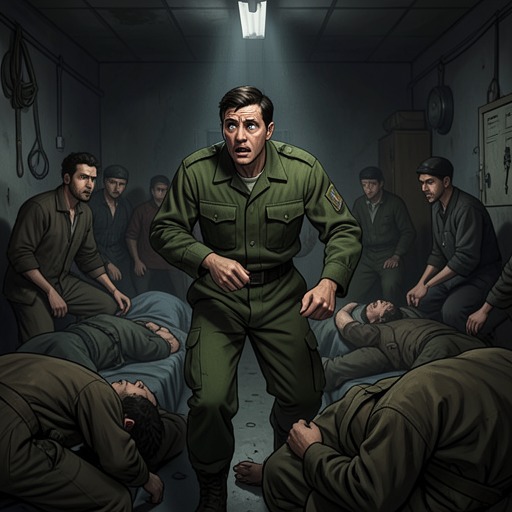
The carefully managed welcome is interrupted by a lorry crossing the rails. Its tarpaulin lifts as it jolts to a halt, exposing its cargo for a few seconds: the day’s corpses from the main camp, on their way to Spring Meadow. The sight is not unusual to Doll, but the arriving Parisians respond with a howl; Baldemar Zulz reflexively raises his arms, and Boris turns toward Doll. The lorry makes the camp’s ordinary dead visible to people whom the speech has just invited to imagine a dignified reception.
Doll responds not by stopping the procession but by directing the musicians to play. At first, the violin melody only reinforces the passengers’ helpless cry. Then it gathers force as the truck pulls free of the crossing and disappears down the road. The travellers continue through the birch wood. Their movement resumes, but the music cannot undo what they have seen; it serves instead as an improvised means of carrying the deception forward.
Sealed Doors and the Camp’s Daily Reality
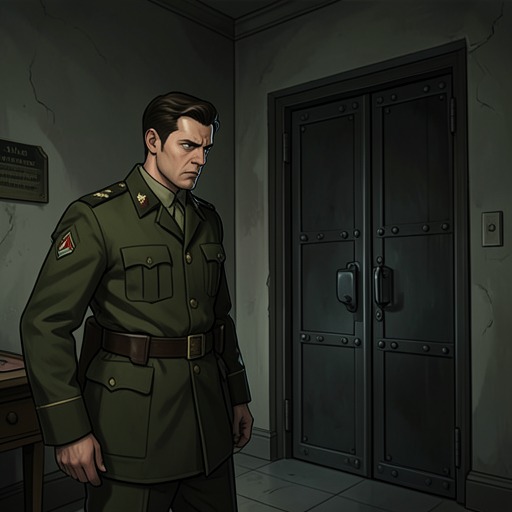
The procession passes peeling birch bark and the Little Brown Bower, with its picket fence, flowerpots, and geraniums and marigolds. It then reaches the undressing room and chamber. When Prufer signals that the doors have been screwed shut, Doll turns away. The combination of reassuring domestic detail and secured doors makes the route’s destination legible without turning the killing into a spectacle. The later account of the transport confirms that these passengers were all destined for the gas.
The corpses on the lorry belong to a larger system of routine disposal. Boris describes them as a daily accumulation transported from the main camp to Spring Meadow, their bodies starved, wounded, and filthy. At Buna, Doll’s attention repeatedly settles on the business-suited IG Farben designers, engineers, and administrators who pick their way past wounded, unconscious, and dead prisoners with notebooks and measuring tapes. The transport’s orderly handling and the industrial visitors’ work proceed alongside the bodies, joining administrative normality to mass death.
Deception, Smell, and Retrospective Judgment
The reception’s promise of cleanliness and comfort is undercut by the smell that pervades the camp. Doll acknowledges that arrivals notice it, and elsewhere he complains that the water table has been breached and the smell will become unbearable. The stench is not a separate misfortune from the killing: corpses are moved across the camp landscape, and the environmental consequences of mass death persist beyond the moment of violence. In his later questions, Doll asks why the camp makes the snow brown and why the meadow churns and spits. The transport’s polished passenger cars, staged hospitality, and birch-lined path cannot keep that material reality out of view.
The episode also exposes the gap between competing administrative demands. Doll describes pressure to increase labour for the munitions industries while other authorities press for the disposal of evacuees. Special Train 105 makes that conflict brutally concrete: these passengers are not treated as a labour force to be preserved, and the language of recuperation and farm work is a lie used to direct them through the camp. The scene’s progression—from the warning, to Doll’s numerical preparations, to the false welcome, the exposed corpses, and the sealed chamber—shows how violence is organized through both coercion and performance. Its final image is not a battle or a public execution, but a door closed after a carefully conducted reception.