Spring Meadow
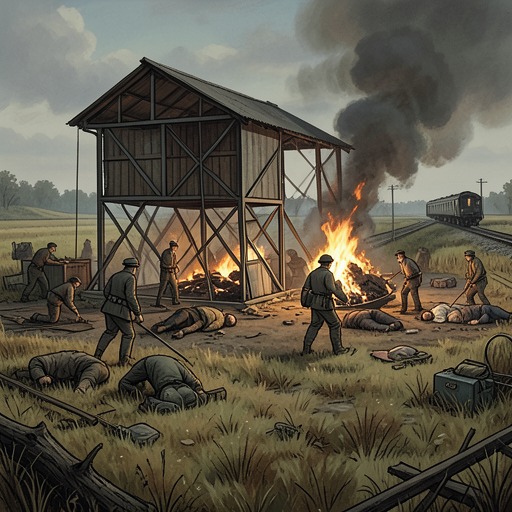
The Zone of InterestSpring Meadow is the open-air burning ground where the camp’s machinery of death becomes a physical landscape: a field that pops, splatters, and hisses, whose smoke and stench reach beyond its immediate boundary. It is also a site of accounting. The narrative’s eventual total of 107,000 bodies makes the meadow not just a place of disposal, but the measure of a crime whose perpetrators try to convert human beings into quantities and processing problems.
Setting and First Encounter
The meadow lies in Sector 4IIIb(i), beyond a mound where camp personnel gather to look out over the field. When Paul Doll returns there after having last visited in July during Heinrich Himmler’s inspection, he finds that the killing ground announces itself before it comes into view. The burning can be heard from roughly ten metres away: popping, splatting, hissing. Its sound makes the place impossible to experience as distant or abstract, even as Doll insists on looking without sentimentality.
The open field is at once a location and an exposure. Doll claims that thoughts of Germany and the trust placed in him by its leader hold human weakness at bay; he frames the killing as a choice between kindness to Jews and cruelty to Germans. That justification sits beside the sounds and smells of the meadow, which make the violence materially present. The location exposes the distance between the perpetrator’s self-description as a normal man and the work he oversees.
Fire and the Work of Disposal
The meadow’s operation is shaped by the problem of making bodies burn. The process begins with modest accumulations and wooden planks, but these efforts make little headway. Szmul, the Sonderkommando leader, offers a series of suggestions that prove crucial to the work. The account treats this practical knowledge as indispensable: the people forced to handle the dead become necessary to a process designed to erase them, while their expertise does not lessen their coercion or danger.
The narrative places the meadow within a broader history of extermination rather than presenting its fires as an isolated technical development. In a later conversation, Konrad Peters describes gas chambers and crematoria as means to accelerate killing, economize, and spare the killers’ nerves—not as the source of the will to murder. He points to the Einsatzgruppen’s mass shootings and argues that bullets and pyres could have accomplished the killing without industrial installations. Spring Meadow’s fires thus register both the practical improvisation of corpse disposal and the prior decision to kill.
Logistics, Institutional Pressure, and Cost
The meadow’s work is entangled with transport and bureaucratic calculation. Doll calls the handling of Special Train 105 a financial disaster, tallying the use of a full Storm with flamethrowers and the costly deployment of the Little Brown Bower. He compares that expenditure with the cheaper method used by Ilse Grese to deal with a woman carrying an ebony cane. His concern is not the human cost, but whether the operation can be justified in financial and administrative terms.
Other remarks reveal how the camp’s competing priorities shape the treatment of deportees. The Economic Administration Head Office presses Doll to increase the available labour force for munitions production, while the Security Service presses for the disposal of evacuees. Doll complains that proposals to work able-bodied mothers to exhaustion fail to account for the difficulty of separating them from their children at the ramp. These pressures do not describe the meadow alone, but they locate it within a system that sorts people between forced labour and death.
The institutional language of efficiency also reaches into the landscape. Local officials report that water from the area is undrinkable even after repeated boiling, that pieces have begun to ferment, and that the water table has been breached. Doll anticipates that the smell will become overwhelming. During a drive back, he repeatedly stops to sniff the air and finds the stench worsening. His description turns environmental contamination into an accumulating consequence of the camp’s operations, while his attention remains fixed on its inconvenience and management.
Counting the Dead
Szmul eventually gives Doll a body count for Spring Meadow. Doll initially treats the figure as excessive and asks whether it should be divided by two; Szmul replies that he has already made that adjustment. The resulting total is 107,000. The figure includes people from transports received before cremation began, as well as prisoners who died of natural causes in the main camp during the winter of 1941–42, when the coal-fired crematorium near the Ka Be was out of service for an extended period.
The count changes the scale of Doll’s thinking. Elsewhere, when told that a planned operation involving about 250 Poles would be extensive, he finds the number small beside the astronomical totals Szmul has reported from the meadow. That contrast shows how the accumulation of deaths has distorted the perpetrators’ sense of proportion: hundreds can seem minor in the shadow of a count in the hundreds of thousands. The number is presented not as a neutral statistic, but as an outcome assembled from transports, camp deaths, and failures of existing disposal capacity.
Stench, Memory, and Significance
Spring Meadow recurs as an image of the camp’s physical and moral disorder. In a later moment of reckoning, Doll asks why the meadow was made to churn and spit, why the snow turns brown, and why the place reeks so sharply. He links its flies, vermin, disease, and contamination to a world in which even conception and pregnancy promise death for both woman and child. The questions break through his official language of obedience and positive outcomes, without becoming a repudiation that would undo his complicity.
The meadow’s significance lies partly in this collision between abstraction and matter. Its dead are counted, its burning is assessed for efficiency, and its costs are debated; at the same time, its sounds, smell, and polluted surroundings refuse to remain bookkeeping entries. The field makes the material consequences of extermination unavoidable, while the people responsible continue to speak in the languages of duty, economy, and processing. Spring Meadow is therefore both a killing ground and a record of what those languages attempt to conceal.