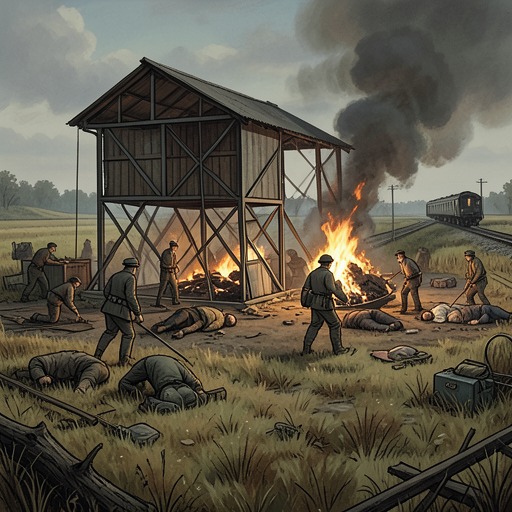
Spring Meadow cremation pyre
The Zone of InterestThe Spring Meadow cremation pyre is presented not as a simple fire but as an evolving piece of machinery: a single, continuously burning structure whose design and feeding system were adjusted to consume human remains on a vast scale. Under Szmul’s direction, Sonderkommando prisoners assembled it from warped railway tracks and operated it with ladders, hoists, and wheeled towers. Paul Doll’s account renders this apparatus in concrete technical detail, then exposes the moral horror concealed by its language of efficiency: bodies are moved, stripped, burned, reduced to ash, and dispersed, while the work is organized as a process to be improved.
From makeshift fires to a continuous pyre
The pyre emerged from an initial failure to make bodies burn effectively. The first accumulations were modest and used wooden planks, but they made little progress. Doll identifies Szmul as the person whose suggestions changed the operation, and presents the recommendations as practical instructions preserved for future reference rather than as a moment of revelation. The change begins with a demand for one pyre instead of several. It must then burn continuously, twenty-four hours a day. These principles make the fire less a temporary expedient than a permanent installation, designed to maintain its operation without interruption.
The third recommendation makes the system’s dependence on its victims’ remains explicit. Liquefied human fat is to be used to aid combustion. Szmul organizes runoff gutters and teams to ladle the fat back into the fire; the arrangement also saves a considerable amount of gasoline. Doll treats that saving as a point to pass on to officials, placing the pyre within an administrative world where fuel use and operational improvements are recorded alongside mass killing. The detail does not merely describe how the fire burns. It shows the machinery of murder being refined through the recovery and reuse of human remains.
A structure built for loading and feeding
Under Szmul’s direction, the Sonderkommando prisoners construct a ziggurat-like framework from warped railway tracks. Doll describes it as comparable in size to the cathedral in Oldenberg, a scale that makes the structure seem monumental even as it serves a function of destruction. The pyre’s architecture is at once recognizably modern and unsettlingly archaic in his account: watched from the mound, it calls to mind slave-built Egyptian pyramids. The comparison sets technological organization against ancient forced labor, refusing to let modernity appear as moral progress.
The framework is loaded with wide ladders and hoists. Once the workers have placed material on the great lattice, they withdraw to wheeled towers and feed the fire by tossing in pieces, at times by the bucketful. The towers rock like siege engines from the Dark Ages. This sequence makes the pyre legible as a system with distinct stages and equipment: a structure to load, platforms from which to work, and a fire that must be continually fed. It also reveals the bodily distance the apparatus creates. Workers can retreat to their towers, but the process still requires them to handle the pieces and keep the fire supplied.
The pyre within the machinery of disposal
The account places the pyre within a larger chain of handling. Thick leather belts drag remains from the shower room to the corpse cellar. Gold-stopped teeth are extracted with pliers and chisels; women’s hair is cut off with shears; earrings and wedding bands are removed. The remains are stacked six or seven to a consignment and hoisted toward the retorts. After burning, the ashes are ground into powder and carried away by truckloads to be dispersed in the River Vistula. The pyre is therefore not an isolated blaze but one stage in an organized procedure that strips, burns, processes, and disposes of bodies.
Doll describes the Sonderkommando prisoners as performing these tasks with indifference, although the people whose bodies they process are their comrades in race and siblings in blood. His condemnation sits beside his own attention to throughput, fuel savings, and the technical difficulty of the heat. That tension is central to the pyre’s representation: the narrative records the practical mechanics without allowing practical language to make the violence ordinary. Even a problem such as the fire being too hot to approach is presented as an operational difficulty within an atrocity.
Smoke, scale, and the limits of industrial killing
The fire’s effects exceed the structure itself. Flames and fumes make even the clearer air ripple and writhe, like gauze pulsating in the wind. At night the railway tracks glow red. Doll says that, even with his eyes closed, he keeps glimpsing a gigantic black toad with illuminated veins. The image converts the pyre’s visible framework into something monstrous and difficult to escape: the fire persists in perception beyond the moment of looking. Smoke, heat, and the red-lit lattice are not decorative atmosphere; they are the sensory signs of a killing system that cannot be reduced to a clean technical diagram.
The pyre also belongs to the broader policy and purpose discussed elsewhere in the narrative. In a conversation in the Tiergarten, Professor Peters describes gas chambers and crematories as methods for accelerating the process, economizing resources, and sparing the killers’ nerves, rather than as the source of the perpetrators’ intent. He argues that bullets and pyres would have achieved the same end because the killers had the will to murder. This perspective clarifies the pyre’s significance without mistaking its engineering for the origin of the crime: the installation gives mass killing an organized and sustained means of execution, but the desire to destroy precedes the apparatus. Its continuous fire embodies both the practical adaptation of the camp system and the terrible fact that no technology was necessary to create the will behind it.