Szmul
The Zone of InterestSzmul is the Sonderkommando leader whose practical skill helps sustain the camp’s cremation operation, and whose account makes the squad’s paradoxical position impossible to mistake for ordinary work. He is at once a prisoner serving the machinery of death, a father whose sons were among the silent boys, and a witness to a system that profanes Jewish life even as it forces its victims to keep functioning.
Identity and Position
The first-person account places Szmul within the Sonderkommando, also called the SK or Special Squad, and describes its members as the saddest men in the Lager. The narrator goes further, calling himself the saddest among them by a measure that is supposedly demonstrable: he is the oldest number, the earliest number assigned to the group. The language turns a bureaucratic designation into an index of duration. His number marks how long he has been caught inside a role that the account presents as both unbearable and inescapable.
The narrator calls the squad disgusting even though, as he argues, its members do no harm and may on balance do a little good. That claim does not absolve or simplify their position; it sharpens its paradox. Their work is conducted largely among the dead, with heavy scissors, pliers, mallets, buckets of petrol refuse, ladles, and grinders. The tools give the account a concrete, procedural texture, while the narrator’s repeated insistence on sadness and disgust makes clear that the work cannot be separated from the coercion under which it is performed.
The squad also moves among the living. Its members greet and direct arrivals in French, telling one man to hang up his suit and remember his number, and offering another a hanger for his coat while commenting on its astrakhan trim. The courteous, practical language sits beside the work among corpses: receiving people and helping them manage their belongings becomes part of the same imposed routine. The contrast shows how the Sonderkommando is made to inhabit both sides of the camp’s process, without control over either.
Labor and Technical Ingenuity
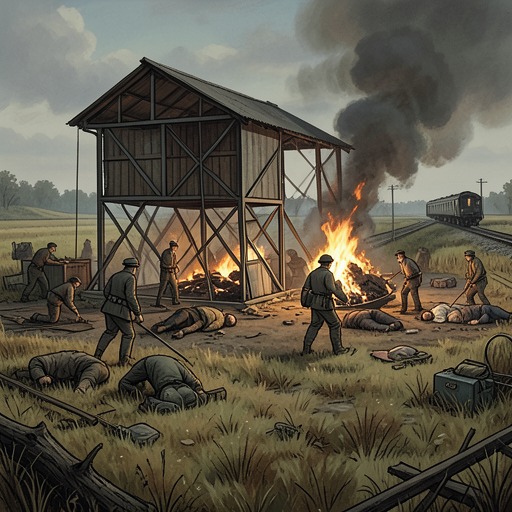
Szmul’s particular importance emerges in the account of the pyre. The operation begins with modest accumulations and wooden planks and makes little progress. The narrator credits Szmul with a series of suggestions that prove key, recording at least two: there must be a single pyre, and it must burn continuously, twenty-four hours a day. The account does not present these proposals as abstract expertise. They arise from the practical demands of a process that the prisoners are compelled to keep going, and their effectiveness gives Szmul a kind of operational authority within a situation that offers him no freedom.
That usefulness attracts recognition from Paul Doll, but the recognition is inseparable from threat. When two hoist-frame plinths collapse, the narrator is down in a dent in the dunes, trying to bang the pieces back together, as Paul Doll arrives in an open-topped jeep. Doll thanks the Sonderkommandoführer for his initiative and dedication to their shared cause, calling him invaluable; then he says they could probably manage without him. The praise and the warning arrive together. Szmul’s competence can make him essential to the machinery for a time, but it cannot protect him from the authority that decides whether he remains useful.
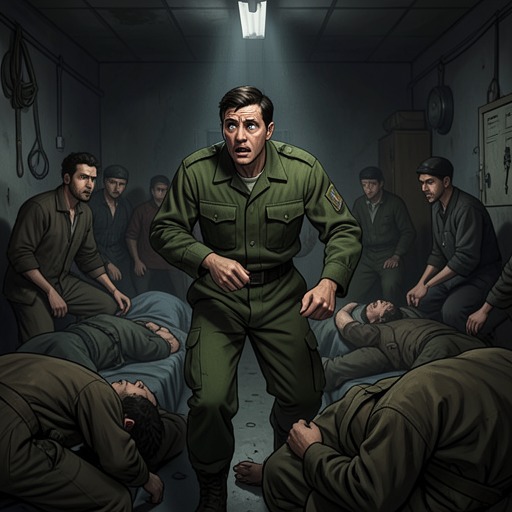
His work later appears in a different setting. When Paul Doll next comes to see him, Szmul is in the morgue supervising the barber Kommando and the oral Kommando. The barbers use shears; the men working on the mouths use a chisel or small, heavy hammer, with a blunt hook to control the jaws. In the corner, an SS dentist sleeps on a bench. This scene extends the account of Szmul’s responsibilities beyond the pyre, placing him among teams assigned distinct tasks on the dead. The sleeping dentist’s presence offers no release from that labor; it makes the scene’s ordinary supervision more disturbing.
The Living, the Dead, and the Ritual of Reception
After a major Aktion, the squad typically receives a fifth of vodka or schnapps, five cigarettes, and a hundred grams of sausage made from bacon, veal, and pork suet. The narrator says that the men are not always sober, but are never hungry and never cold at night. They sleep in a room above the disused crematory, near the Monopoly Building, where sacks of hair are cured. Food, warmth, alcohol, and sleep are described not as signs of safety but as the conditions attached to continued labor. Even the sleeping place remains bound to the evidence and by-products of the dead.
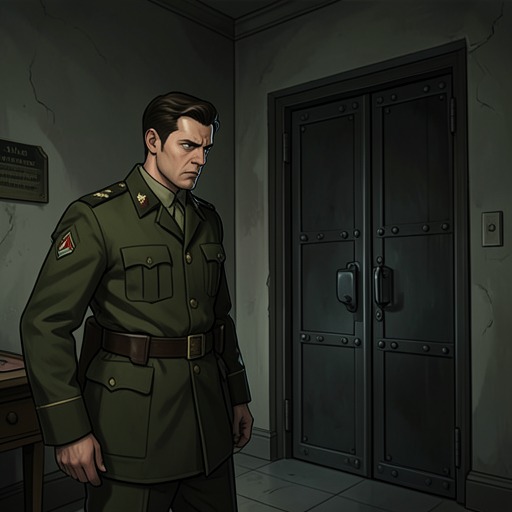
Later, the narrator says that he no longer goes out to the Meadow often, and neither does Szmul. Szmul sometimes checks around midnight that everything is processing as it should, then returns to his duties as a greeter. The change in routine divides his work between the cremation site and the ramp: when the narrator wants to speak with him, he has to find him there. After the first train has been dealt with, Szmul sits on a suitcase in the glare of an unattended arc lamp, eating a wedge of cheese. That small pause in the work is also a point of confrontation: Paul Doll approaches from behind and asks why Szmul was on the first transport out of Litzmannstadt(Łódź).
Paul Doll’s questions connect Szmul’s present position to an earlier deportation. Szmul says that he went on the first transport to Germany, supposedly expecting to find paid work, and that he took his sons, Chaim, fifteen, and Schol, sixteen, both tall and broad like their mother. The account identifies the boys as among the silent boys. When Paul Doll asks whether Szmul was at Chełmno during the time of the silent boys, Szmul answers no, and the narration explicitly identifies that answer as a lie. Paul Doll remarks that no Jew gets out of Chełmno and speculates that Szmul was kept because he spoke German; he then asks whether Szmul knows Chaim Rumkowski. The exchange makes Szmul’s survival inseparable from what he has lost, without disclosing any further answer to Doll’s question.
Witness to Profanation and Loss
Under the heading Breathe Deeply, Szmul describes the squad as mocked and profaned. An airtight chamber bears a Star of David on its ceiling; the foot rags issued to the prisoners are scraps of prayer shawls. A slave-built highway from Przemsyl to Tarnopol lies over the crushed rubble of synagogues and Jewish gravestones. The details extend the violence beyond killing: sacred signs, garments, places of worship, and the calendar itself are made to serve or mark the system that persecutes the Jews.
The narrator calls the schedule of actions the Goebbels Calendar, saying that no holy day passes without an Aktion and that the sharpest measures are reserved for Yom Kippur and Rosh Hashana, the Days of Awe. This calendar turns religious time into a recurring structure of persecution. It also gives Szmul’s witness a wider reach than the account of his individual duties: the squad’s forced labor is set within a campaign that targets Jewish people and their practices at once.
Szmul’s story ultimately brings the enormous machinery of the camp back to the scale of one family. He had taken two adolescent sons on a transport that he expected would lead to paid work; they became silent boys. The account supplies no recovery or consolation, only the blunt aftermath: after all that, all this. Across the scenes, Szmul’s ingenuity, assigned work, and survival do not resolve the contradiction of his position. They show how a prisoner can be made indispensable to a process of destruction and still remain subject to it, while bearing witness to the lives and sacred world it destroys.