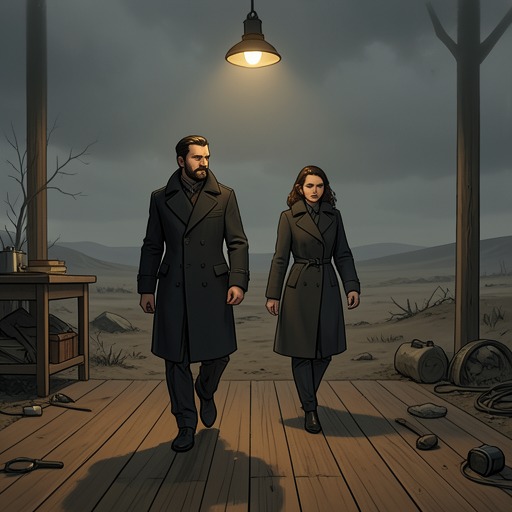
Szmul—Shulamith
The Zone of InterestSzmul—Shulamith is a marriage made legible to the reader through threats rather than shared scenes. Separated from Shulamith, Szmul is made to hear where she is hiding, how she survives, and when she may be killed; Paul Doll converts this knowledge into a weapon, holding out reunion and threatening death in the same breath. Their bond is therefore presented not as an intimate history the narrative can freely recount, but as something exposed and controlled by the machinery of persecution.
Marriage Under Coercion
Doll identifies Shulamith as Szmul’s wife and repeatedly addresses her as his. The evidence establishes their marriage and separation, but does not narrate when or how they were parted, or give Shulamith a speaking scene. Instead, the relationship reaches the reader through Szmul’s position as a captive under Doll’s authority and through Doll’s taunts about the absent woman. That imbalance shapes every detail: Szmul cannot act on what he learns, while Doll can decide whether the information becomes a promise or a threat.
Doll makes the loss personal by asking whether Szmul had been happy with Shulamith and whether their love had been a love whose month was ever May. He also suggests that Szmul has declined in her absence and directs sexual humiliation at him, asking whether she had enjoyed sex with him. The interrogation thus treats their private life as material Doll can handle at will. His questions do not reveal Shulamith’s own feelings; they expose the coercive conditions under which Szmul is forced to endure another man’s account of his marriage.
Szmul’s responses are strikingly limited. When Doll describes Shulamith’s appearance, work, hiding place, and threatened fate, Szmul shrugs. When Doll makes the threat explicit, Szmul answers only that he understands. The restrained gestures and short replies offer no account of what Szmul feels, but show how little room he has to answer on his own terms. His silence is not evidence that the marriage matters little; within these exchanges, it is the form his powerlessness takes.
Shulamith's Hidden Life
Doll describes Shulamith as a dark-haired woman with a white streak down the middle of her hair, and says she is Szmul’s wife. He claims that she is employed as a skilled seamstress at Factory 104, adorning Wehrmacht uniforms with swastikas. At night, according to Doll, she returns to an attic above a bakery on Tlomackie Street. These details place her survival in a sharply divided routine: labor at a factory by day, concealment in a cramped hiding place at night.
The attic is also the detail that returns when Doll later speaks to Szmul. He says Shulamith is still there, then asks where her protection is. His phrasing makes clear that knowing her address does not mean Szmul can reach her or keep her safe. The repeated location instead tightens the threat: Shulamith remains physically present in hiding, but her continued safety is presented as dependent on power held elsewhere.
Doll’s account is the only information about Shulamith’s circumstances in these encounters. The narrative does not independently confirm the conditions of her work or show her at the attic, and it does not disclose what she knows of Szmul’s situation. That limitation matters. She is not granted a voice in the exchange; she is made its absent, endangered subject, while Szmul must receive information about his wife from the man who controls the threat against her.
Doll's Threat and the Politics of Protection
Doll frames the possibility of seeing Shulamith again as something he might arrange through an authority in Litzmannstadt. He couples that prospect with a sneer about her lacking the protection that could keep her safe. The offer is not a plan for reunion on equal terms: Doll holds the relevant authority, and he presents access to Shulamith as a favor he may grant or withhold. By making protection sound like a personal connection rather than a right, he turns the couple’s separation into an instrument of control.
He later supplies a date and a lethal consequence. Shulamith, he says, will be taken on May 1, which he calls the third anniversary of the sealing of the Jewish ghetto. He tells Szmul that she will be killed that day in Łódź unless he countermandes the order that morning. The threat gives their separation a deadline, but not a path to reunion: Doll makes Shulamith’s survival contingent on his own future decision. The date is at once a bureaucratic appointment and a private cruelty directed at Szmul.
Doll’s leverage belongs to a wider system in which people are reduced to administrative categories and competing institutional demands. In his private thoughts, he describes pressure from the Economic Administration Head Office to increase labor strength for the munitions industries and from the Reich Central Security Department to dispose of evacuees. His description repeats the regime’s dehumanizing claim that Jews constitute a fifth column; it does not provide a justification for that claim. Elsewhere, the discussion of the extermination policy traces the turn toward killing women and children as well as men. Against that background, Doll’s threat is not merely an individual insult: the power to separate, transport, exploit, or kill is the political reality that makes his supposed offer of protection effective.
The Relationship's Narrative Significance
The relationship is revealed in fragments, with a recurring movement from information to menace. First Doll identifies Shulamith and hints at a possible reunion; then he repeats that she remains in the attic; later he specifies her work, hiding place, removal date, and threatened death. Each return adds concrete knowledge while reducing Szmul’s ability to treat knowledge as help. The narrative makes the gap between knowing where someone is and being able to protect her the central fact of their separation.
The scenes also place marital intimacy under the pressure of a persecutor’s language. Doll turns love into an object of interrogation, jokes about Szmul’s absence from his wife, and makes their sexual life part of his humiliation. Yet the relationship cannot be reduced to Doll’s account of it: the narrative confirms the marriage and Szmul’s separation, but does not claim access to Shulamith’s thoughts. Her absence is itself consequential. The reader encounters her through the danger she faces and the details Doll wields, while the bond survives in Szmul’s restrained presence before the man who threatens her.
No reunion or outcome for Shulamith is established in these passages. Doll’s threat remains a threat, and the evidence does not say whether he countermanded the order or whether Shulamith was killed. The unresolved ending preserves the coercion at the heart of the relationship: Szmul is forced to wait on a decision he does not control, while the woman he loves remains both vividly located and unreachable.