Szmul's buried writings
The Zone of InterestSzmul's buried writings are both a record of life in the camp and an attempt to outlast it. Near the end of his life, Szmul plans to hide everything he has written in a Thermos flask beneath a gooseberry bush. The writings’ contents are not disclosed in this passage; their significance lies in the act of leaving a trace when their author expects to die.
The planned deposit
Szmul places the concealment at the end of a day that has not yet come: he says it will happen at dusk, not that morning or afternoon. On his way to what he understands to be his final outcome, he intends to bury his writings in the flask beneath the bush. The account gives no later confirmation that the hiding place was reached or that the papers were recovered, so the deposit remains an intention rather than a documented discovery.
The choice of a Thermos flask and a specific spot beneath a gooseberry bush makes the plan concrete without making it safe. The writings are to be hidden in the ground, outside the ordinary reach of readers, while the passage leaves their survival uncertain. Their anticipated afterlife depends on this small act of concealment, not on any assurance that someone will find them.
Memory, authorship, and survival
Szmul describes his memory as total and fixed on the present: he remembers everything that has happened to him since he arrived at the camp. To remember an hour would take an hour, and a month would take a month. This insistence gives the writings an immense implied scope, but the text does not reproduce them or specify their subjects. It instead makes the burden of remembering itself central: Szmul cannot forget, and at the end he imagines that his memories must be dispersed.
Burying the pages turns that impending dispersal into a deliberate act. Szmul says that there is only one possible outcome and that he wants it; through the decision to leave his writings, he asserts that his life belongs to him. The statement does not undo the conditions that have brought him to this point. It marks a limited but consequential choice within them: his body may die, but he can still try to determine what remains of his account.
Writing as a remainder
Szmul's conclusion is that, because he has buried what he wrote, not all of him will die. The claim rests on a distinction between the mortal author and the words he leaves behind. It is not a promise that the writings will be read, nor evidence that they survive. Rather, it is the meaning Szmul gives to the attempt: writing and concealment offer the possibility of a remainder where physical survival is no longer expected.
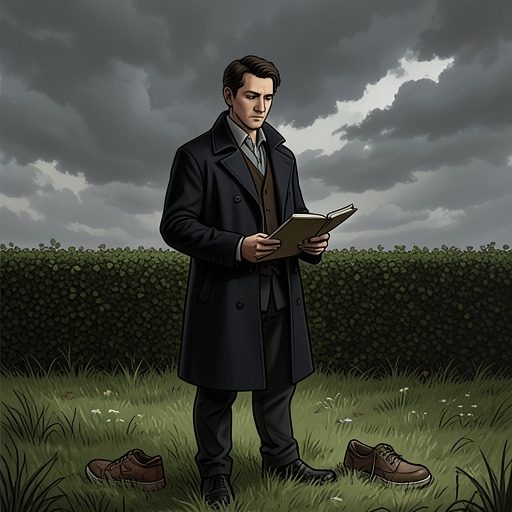
The novel also presents a separate act of testimony through Josef, a Czech Jew from Brno who wrote a document and buried it in a child's galosh beneath the hedgerow bordering Paul Doll's garden. The prisoners debate whether to exhume it and eventually decide, by a show of hands, to bring it out temporarily and read it. Josef's eight-page manuscript is not Szmul's writing and is not said to be in the same hiding place. The parallel is in the vulnerable material form of witness: in both cases, a written account is hidden in the camp landscape, and the prospect of its being encountered depends on others.
The archive and the limits of recovery
The later narrative offers no account of anyone recovering Szmul's flask or reading its contents. That silence preserves the difference between the hope expressed in the burial plan and a confirmed historical afterlife. The writings matter even without a narrated discovery: the act of hiding them gives form to Szmul's effort to keep his experience from ending entirely with him.
Elsewhere, Hannah Doll's postwar search for a maiden name shows a different, frustrating encounter with documentary traces. In Rosenheim, she spends a week pursuing records across eighteen boroughs and manages to consult only three ledgers, without learning what she sought. This episode does not concern Szmul's papers, but it sharpens the novel's attention to what records can and cannot recover. Against the uncertain archive of the postwar world, Szmul's hidden writings stand as a witness entrusted to the earth, with survival imagined but never guaranteed.