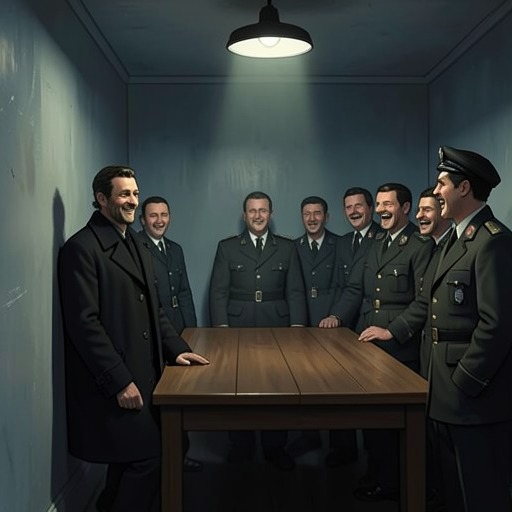
The claim “I knew nothing about it”
The Zone of InterestThe claim “I knew nothing about it” names a postwar alibi whose breezy familiarity collides with the novel’s record of orders, killing, and responsibility. It surfaces as a joke about Germany’s new national anthem, yet the narrator cannot place himself safely outside that chorus: he, too, calls himself reformed, while remembering his own complicity and the people whose lives were entangled with the camp. The phrase’s force lies in that gap between professed ignorance and the evidence the narrative has already put before the reader.
A national refrain and a private reckoning
In the postwar office of the American occupation administration, the narrator’s colleagues joke that ‘Ich Wusste Nichts Uber Es’ is the new national anthem, glossing it as ‘I Didn’t Know Anything About It’. The joke gives denial a public voice: a whole country appears to speak in the first person, turning ignorance into a shared refrain. But the narrator immediately complicates the easy division between those who deny and those who know. Germans, he says, were meant to emerge as reformed characters after the war, and he counts himself among them; nevertheless, he cannot construct a self-sufficient inner life.
His description of that failure makes the phrase more than a charge against other people. In the camp, he had felt doubled, as though one self acted while another stood apart; after the war, he feels halved. His recurring memories of Hannah Doll do not seem to him like an unfinished story so much as one that had scarcely begun. The national claim of ignorance therefore sits beside an intensely personal knowledge: he remembers the circumstances of his past and cannot convert survival or postwar respectability into a coherent self. He says he did not try to relieve that emptiness by joining anything, but this distinction does not amount to an acquittal.
Knowledge inside the command structure
The narrative repeatedly shows that criminal action is organized through identifiable instructions and roles. Paul Doll tells a subordinate that an order comes from Horst Blobel and therefore from the Reichsführer-SS. The chain of authority is explicit; the order is not an event without authors or institutional direction. Elsewhere, Doll addresses Szmul as a bearer of secrets, but turns that language into an accusation about violence: ‘Afraid to die. But not afraid to kill.’ His words recognize that the prisoner has been forced into a role in the killing process, even as Doll retains the power to command and threaten him. Naming another person’s knowledge does not release the speaker from responsibility for the system that created it.
The novel also places claims and evasions against documentary traces. Rupprecht Strunck’s report identifies a coordinator on the factory floor; an NCO named Jenkins had pointed him out, and Strunck found his calendar in the tool cabin. The scene makes responsibility legible through testimony and a concrete object, rather than through a general appeal to what people could or could not have known. The calendar, the report, and the chain of identification stand in sharp contrast to a blanket denial that leaves no room for specific acts or records.
Accountability after the war
The postwar outcomes further distinguish evasion from legal judgment. Paul Doll was moved sideways to a clerical post at the Inspectorate of Concentration Camps in June 1943, reinstated as commandant in May 1944, captured in March 1946, tried at Nuremberg, and delivered to the Polish authorities. In his final statement he wrote, ‘In the solitude of my cell I have come to the bitter realisation that I have sinned gravely against humanity.’ The admission comes only after arrest, trial, and transfer; it cannot be confused with the earlier posture of an entire public claiming not to know.
The trials of IG Farben personnel likewise attach consequences to particular responsibility: thirteen executives and managers were convicted at Nuremberg in July 1948, including Suitbert Seedig, sentenced to eight years for slavery and mass murder, and Rupprecht Strunck, sentenced to seven years for plunder and spoliation, slavery, and mass murder. The scale of conviction does not make the national refrain disappear, but it gives the question of responsibility names, actions, and penalties. Even the narrator’s rueful distance from that refrain is unsettled by his own memory of having been doubled in the camp and halved afterward. The claim of ignorance offers a clean break; the narrative instead insists on the residue that remains when the war is over and the self still cannot be made whole.