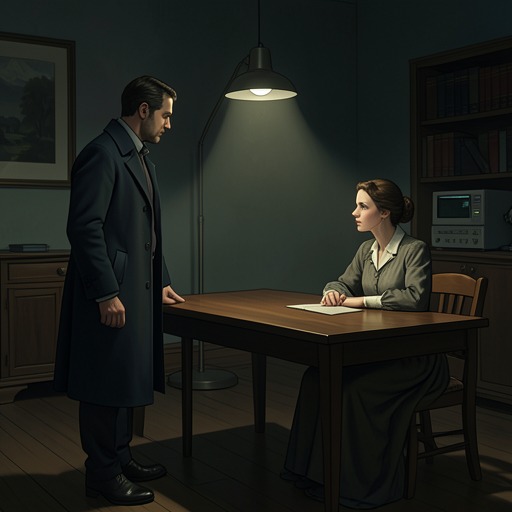
The concentration camp as a mirror
The Zone of InterestThe concentration camp as a mirror is the book’s governing metaphor for self-knowledge under conditions of extreme coercion. A fairy tale about a mirror that shows the soul rather than the face becomes a way to describe the camp: it exposes what people are, while removing the possibility of looking away. The image reaches particular force through the Sonderkommando, whose forced work and precarious survival make self-recognition neither abstract nor freely chosen.
The magical mirror and its test
The image begins with an old story: a king commissions his favourite wizard to make a mirror that reveals the soul instead of a reflection. The distinction matters. A reflection offers an appearance that a viewer can inspect; this mirror claims to show the person beneath appearance, the self one might prefer not to know. Its power is measured not by what it displays to others but by whether anyone can bear to look.
The wizard cannot face it, nor can the king or his courtiers. The king’s offer of a chestful of treasure to any citizen who can look for sixty seconds without turning away makes the encounter into a public test, but the reward does not produce a successful viewer. No one in the peaceful land can sustain the gaze. The story therefore makes recognition a trial of endurance: the obstacle is not a lack of access to the truth, but the difficulty of remaining in front of it.
The camp as an inescapable mirror
The Sonderkommando narrator applies the tale directly to the concentration camp, identifying the camp as the mirror with one decisive difference: “You can’t turn away.” The fairy-tale test permits a retreat, even if everyone fails it; the camp does not offer that distance. Its revelation is imposed through lived circumstances, not sought as an experiment or accepted for a prize. The image turns self-knowledge into a condition of confinement.
That difference also changes the meaning of the mirror’s apparent impartiality. A magical object might seem simply to show what is already there. The camp, by contrast, places people within a system that constrains their choices and then makes the resulting choices visible to them. The metaphor does not suggest that everyone has equal freedom in the encounter. It insists that the place exposes people to themselves while denying them the ordinary means of escape from what they see. The camp is at once the setting of the revelation and the force that makes looking away impossible.
The Sonderkommando and the burden of seeing
The narrator calls the Sonderkommando the saddest men in the camp, then intensifies the claim by describing them as the saddest men in history and himself as the saddest among them. His lowest, oldest number gives this self-description a concrete measure: his position is marked not only by feeling but by how long he has been there. He also calls the group the most disgusting, presenting their situation as paradoxical rather than reducing it to a simple judgment.
Their work makes the image of the mirror inseparable from knowledge and survival. They must cremate their predecessors, and the same task will continue for those who follow. The narrator says that a Sonderkommando prisoner’s life cannot ordinarily be prolonged beyond two or three months. Because they know what happens to the bearers of secrets, continuing to live means continuing as a Geheimnisträger, a bearer of secrets. The mirror thus reflects not a private, timeless essence but a self encountered inside a repeating system of forced work, knowledge, and anticipated death.
Szmul’s exceptional length of service sharpens this pattern. He is described as the longest-serving undertaker in the concentration-camp system, virtually a Prominent, and even the guards grant him some respect. Yet that exceptional standing does not free him from what he knows will happen to bearers of secrets. The details make the mirror’s revelation more than an inward discovery: it shows the compromised conditions under which a person persists, and how little protection recognition or status can provide.
Self-knowledge, honor, and judgment
The narrator contrasts his own idea of honor with the Sonderkommando prisoners’ apparent desire to persist. He claims that honor matters more than life or death, while describing their persistence as an animal or even mineral desire to continue. But the passage also complicates the confidence of that judgment. He concedes that no one can truly take another person’s place, and recalls the camp’s warning that people do not know themselves. The mirror does not offer an easy assurance that an observer can know how they would act under someone else’s conditions.
The narrator’s conclusion is that people may not know themselves until they enter the Zone of Interest, which tells them who they are. The image therefore refuses to make self-knowledge a comfortable virtue: knowing oneself comes through exposure to circumstances that strip away the option of remaining an imagined, untested self. The fairy-tale mirror makes everyone turn away; the camp makes turning away impossible. That contrast gives the motif its ethical force. It asks what is revealed when people are trapped inside a system of coercion, while warning against treating another person’s constrained survival as though it were a choice made from a position of freedom.