The productive-destruction contradiction
The Zone of InterestThe productive-destruction contradiction is the collision between using prisoners as an exploitable workforce and treating their destruction as a political objective. The novel gives that collision a managerial vocabulary: labor capacity, calories, transport, and replacement sit beside selection, mass death, and extermination. The result is not a stable compromise between production and killing. It is a system in which the language of efficiency helps administer exploitation even as political priorities frustrate the possibility of sustaining the people being exploited.
Competing Objectives
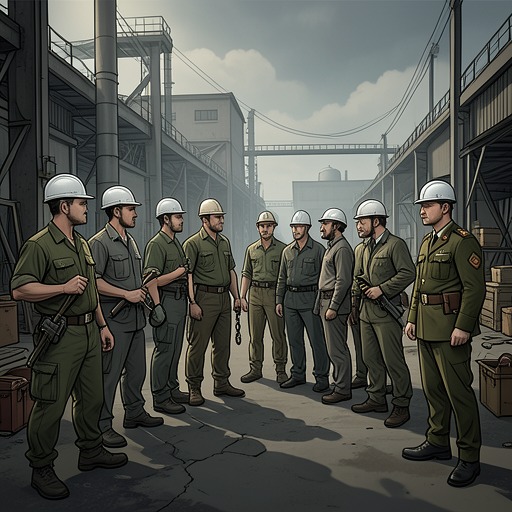
At the Buna-Werke, the practical demands of forced labor are visible in the prisoners’ daily routine. Reveille comes at three; the march to the factory takes ninety minutes; the workday ends at six, and workers return at eight, carrying their casualties. Suitbert Seedig asks how much work can be obtained from people already exhausted before the shift begins. His question treats the prisoners’ physical condition as a production problem, but the casualties make plain the human cost that the calculation tries to manage.
The disagreement is not simply between humane and cruel administration. Frithuric Burckl, speaking for the industrial interest, proposes a modest increase of twenty per cent in rations so that prisoners will have more strength and last longer. Seedig reports that they are still dying at a rate of one thousand a week. Paul Doll, however, insists that the camp must not lose sight of its political objective; he presents himself as aligned with the Reichsführer-SS and rejects what he calls pampering. Angelus Thomsen reinforces the distinction between commercial practicality and political purpose. Their exchange exposes the limit placed on industrial calculation: improved feeding may be useful, but only within boundaries set by the camp’s ideological mission.
The Logic of Extraction
Burckl later makes the economic arithmetic more explicit. An adult at complete rest, he says, needs 2,500 calories daily; in some Polish ghettos the ration is 300, in the Stammlager eight hundred, and at Buna eleven hundred, if the prisoners are lucky. A heavy worker on that allowance loses about three kilograms a week. Against that attrition, Burckl proposes selecting a core of roughly 2,500 workers, stopping the beatings and the enforced running trot, and providing adequate food and shelter within limits. The inducement is a full stomach and a night’s rest; the intended result is efficient collaboration, as exemplified by Szmul.
This plan does not challenge the system’s coercion. It seeks to preserve a selected group’s capacity to work by reducing some of the violence that wastes it. Burckl describes the prisoners as a people it is opportune to exploit and considers how to do so ergonomically. His commercial perspective recognizes that bodies cannot produce indefinitely when starved, beaten, and driven beyond their strength. Yet the proposal remains contingent: the workers are selected, their treatment is calibrated to output, and their survival matters as a means of extraction rather than as an end in itself.
A letter from Bayer makes the logic more stark. The pharmaceutical company reports that a transport of 150 women arrived in good condition, but all died during experiments that produced no conclusive results; it requests another group of the same number and at the same price. The administrative language converts death into a failed experiment and the dead into a replaceable consignment. Doll’s response, asking how much women cost, brings the exchange’s commercial valuation into the open. Here exploitation and killing are not sequential alternatives: the women are used in an industrial experiment, and their deaths generate a request for replacements.
From Factory Floor to Policy
At his office window in Buna, Thomsen watches prisoners move in lines and scrums at a speed their strength cannot bear. The scene also includes Kapos, SS noncommissioned officers, and company foremen shouting down the chain of command. But the figures that hold his attention are the business-suited designers, engineers, and administrators from IG Farben plants in Frankfurt, Leverkusen, and Ludwigshafen. Carrying leather-bound notebooks and retractable measuring tapes, they pick their way past the wounded, unconscious, and dead. The image places technical observation and industrial planning beside the bodily consequences they measure around rather than prevent.
The contradiction also appears in Doll’s private account of his divided responsibilities. The Economic Administration Head Office presses him to increase labor strength for the munitions industries, while the Reich Central Security Department presses for the disposal of evacuees. He complains that a proposal to work able-bodied mothers in a boot factory ignores the difficulty of separating them from their children at the ramp. The competing instructions do not cancel one another; they make the same population both a potential labor force and a target for removal. Doll’s reasoning still reproduces the regime’s dehumanizing language, but his frustration registers the operational strain created when extraction and deportation demand incompatible uses of people.
The term Produktive Vernichtung crystallizes this tension. Burckl invokes the political cornerstone of productive destruction, then counters that destruction is not productive. His objection is not a repudiation of exploitation: he remains a businessman seeking an efficient way to use prisoners. It identifies instead a practical contradiction within the policy itself. A labor force consumed faster than it can be made productive cannot satisfy an industrial demand for sustained output.
Destruction as the Governing End
The novel sets the administrative struggle over labor against the history of the mass murder policy. In a conversation in the Tiergarten, Thomsen describes the authorization of July 31, 1941, as a decisive moment in the development of what he calls the crime without a name. He recounts an earlier possibility of sending Jews to remote, barren territory after a quick victory over Russia, then a shift as territorial solutions receded and officials in Poland confronted the numbers of people under their control. The crucial change was the extension of killing from men to women and children. In this account, policy develops through both high-level authorization and pressure from officials seeking a solution to an administrative problem; neither level makes the resulting destruction an accidental by-product of labor policy.
Professor Peters further insists that gas chambers and crematories were means of accelerating and economizing the killing, and of sparing the killers’ nerves, rather than its essential cause. Bullets and pyres could have carried out the same intent. He cites the Einsatzgruppen’s killing of well over a million people by bullets as evidence that the will to destroy did not depend on a particular industrial technique. This perspective sharpens the distinction at the heart of the contradiction: production may influence how prisoners are treated or killed, but it does not displace the political commitment to their destruction.
The postwar record gives the industrial project its own measure of failure. Thirteen IG Farben executives and managers were convicted at Nuremberg in July 1948; Suitbert Seedig received an eight-year sentence for slavery and mass murder. Yet not a kilogram of synthetic rubber or a millilitre of synthetic fuel was ever produced at the Buna-Werke. The factory’s unrealized output does not undo the labor and killing organized in its service. Instead, it leaves the central irony exposed: a system that treated human beings as productive assets exhausted them, while the promised industrial product never appeared. The contradiction is therefore both a conflict within Nazi administration and a way the novel reveals the violence concealed by the language of economic necessity.