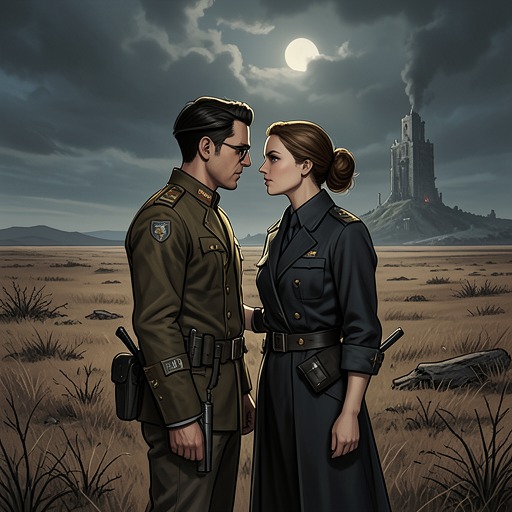
Thomsen's letter to Hannah
The Zone of InterestThomsen's letter to Hannah is both a piece of clandestine risk management and an intimate self-disclosure. Angelus Thomsen gives Hannah Doll a rehearsable account of their dealings, advice for facing Paul Doll, and a warning about her plan to hasten his psychological collapse. Then the letter changes register: Thomsen describes how watching Hannah sleep revived feelings he believed he had surrendered, and confesses a desire that belongs, in his own formulation, to a future elsewhere. Its practical instructions and exposed tenderness remain inseparable from the danger of its existence.
A message passed under surveillance
Thomsen passes the letter to Hannah at the riding school. Its opening business is grim news: Dov Cohn has been transferred, along with a Kapo named Stumpfegger, who had taken an interest in him and may have been his confidant. Thomsen stresses that the transfer occurred six weeks earlier and that he had thought Dov well equipped to survive. The delay itself makes the news harder to absorb: the letter brings Hannah information about a loss that has already happened, rather than warning her before it.
Thomsen links that report to what Hannah has told him about her marriage. He says he no longer feels obliged to show even minimal respect to her husband as the father of Paulette Doll and Sybil Doll. His judgment is grounded in Paul Doll's willingness to eliminate three people, including a child, after a single injury to his prestige—an act Thomsen describes as having begun with kindness. The contrast is stark: an ostensibly minor affront has become grounds for lethal retaliation. Thomsen adds that his uncle affords him some protection, while Hannah has none. The letter's tenderness therefore begins not in safety but in an explicit recognition of their unequal exposure.
A rehearsed account of their dealings
The central practical purpose is to retroactively normalize the history of Thomsen and Hannah's contact. He has considered the problem methodically and tells her to memorize a specific sequence. In the account they are to maintain, Hannah's first letter, brought to Thomsen by Humilia, asked him for a favor and said she could be found on Fridays at the Summer Huts. At their meeting there, he agreed—reluctantly, the story goes—to make inquiries about Dieter Kruger, because the request distracted him from his mission at the Buna-Werke.
The second communication, the letter Hannah is holding, is to serve as Thomsen's report. He assumes that Paul Doll knows about the first letter and probably knows about the second as well, since the pair have been observed. If Doll questions Hannah, Thomsen advises her to disclose their contact freely rather than deny it, but to refuse to tell him what Thomsen discovered about Kruger. Thomsen says he will now make the inquiry, and expects that Hannah's husband will do so too. The cover story thus turns surveillance into something they can acknowledge while keeping the intended result—the information about Kruger—out of Doll's hands.
The instructions also change the terms of their contact. From this point, Thomsen says, they cannot meet except in communal settings, and there can be no more letters. The document is therefore designed to explain earlier contact while also ending the private written channel that makes such contact legible to others. Its carefully ordered account is an act of concealment, but not a claim that they have not been watched.
Hannah's plan and the danger of retaliation
Thomsen is uneasy about Hannah's plan for the home front: to do everything in her power to hasten Paul Doll's psychological collapse. He distinguishes between the danger as it stands and the danger her plan may create. At present, he says, Doll has no reason to strike at her; if the plan succeeds, he will need no reason. That warning gives the letter's advice a severe double edge. It helps Hannah manage what Doll might discover, but it does not promise that managing appearances will protect her from a man whom Thomsen has already described as capable of killing over compromised prestige.
Thomsen leaves the decision to Hannah, acknowledging that she seems resolved. The letter neither endorses her strategy without reservation nor attempts to take the choice away from her. Instead, it records his apprehension alongside her determination. Its account of their past is something he wants them both to repeat; her future course, he says, remains hers to choose. That difference matters: the cover story is jointly prescribed, while the risk of carrying out the plan falls most heavily on Hannah, whom Thomsen has already identified as having no protection comparable to his own.
Confession after the instructions
After the tactical section, Thomsen tells Hannah she can stop memorizing. He suggests that she might even forget the coming confession, or skip to its final short paragraph. The shift makes the letter feel divided against its own purpose: after constructing a disciplined story for possible questioning, Thomsen turns to what he calls a statement from the heart. He recalls the elevation to the Reich Chancellery of a political killer and the resulting retreat of emotion, sensibility, and delicacy from his life. His habit of repeatedly telling himself to let things go is condensed by Auden's eight-syllable phrase, Saying Alas / To less and less. The cited poem gives a name to the narrowing of what Thomsen has allowed himself to feel.
He locates the reversal in a particular memory: Hannah asleep in a gazebo or half-made pavilion, while he watched her for sixty or seventy minutes. In that interval, he says, the things he had waived and ceded returned to consciousness, along with self-detestation at how soiled and shrunken he had allowed his heart to become. When Hannah opened her eyes, he was experiencing something like hope. The memory turns an otherwise practical letter into an account of emotional recovery, but not a simple declaration of rescue: Thomsen says he is starting again from nothing, and describes himself as newly beset by first principles, asking how ordinary things—a hand, a woman's shoe, ants, suns—can be taken for granted.
That renewed attention is set against the sight of bald, large-headed figures moving in lines of five back to slavery while a band plays. Thomsen's language places the inward return to feeling beside the camp's coerced movement, without allowing one to cancel the other. His love for Hannah is expressed through physical attraction and imagined kisses, yet the woman he describes in those dreams is not of the present: she lives in the future and elsewhere. He associates this distance with the poem The Exiles and the thought that even the sane are inner exiles. Desire is present, but it is framed by displacement and by a future the letter cannot secure.
Destruction and the letter's double function
The letter closes its intimate disclosure with a command: Hannah is to destroy it beyond retrieval. The instruction completes the earlier ban on further letters and makes the document's vulnerability part of its meaning. It has to be detailed enough to teach Hannah the cover story, yet must not survive where it could expose the two correspondents. Its two functions pull in opposite directions: it preserves a carefully designed account in Hannah's memory while demanding the destruction of the written evidence itself.
As an object, the letter holds together what its contents cannot reconcile. It is a practical instrument for managing observation, an acknowledgment of Hannah's isolation and danger, and a confession of love that imagines intimacy only in a future elsewhere. The turn from memorization to forgetting, and from a rehearsed account to an instruction to destroy the page, makes its form echo its circumstances. Thomsen tries to give Hannah words she can use if questioned, then asks her to erase the only material record of the words he has written to her.