Trial and execution of Paul Doll
The Zone of InterestThe Trial and execution of Paul Doll close the novel’s account of a commandant whose administrative career moved between the routine management of forced labor and the machinery of mass murder. After a temporary demotion, Doll returned to command; the postwar account then records his capture, trial, transfer to Polish custody, and execution. His final statement acknowledged grave responsibility, but came after the institutional violence he had administered had already taken its toll.
Command and Responsibility
Doll’s authority is shown against the material conditions imposed on prisoners. Suitbert Seedig describes a day beginning with reveille at three, followed by a ninety-minute march to the Buna-Werke; workers finish at six, return at eight, and carry their casualties. He reports that prisoners are still dying at a rate of one thousand a week. In the same discussion, Frithuric Burckl argues for a modest twenty-per-cent increase in rations so that the laborers will have more strength and last longer. The exchange exposes the economic logic surrounding the camp: prisoners are treated as a workforce to be maintained for production even as their bodies are depleted by the system.
Doll’s own language elsewhere makes the divide between administrative function and moral knowledge harder to sustain. Addressing a prisoner, he recognizes the man’s capacity to kill and says that such people have their uses. The remark does not describe the later trial, but it belongs to the portrait of a commander who can perceive violence plainly while continuing to work within its machinery.
Demotion and Return to Command
In June 1943, Doll was demoted sideways to a clerical post at the Inspectorate of Concentration Camps in Berlin. The narrative places this reassignment in a city under increasingly frequent bombing, but does not present it as a reckoning with his conduct. In May 1944 he was reinstalled as commandant. The movement from command to paperwork and back again makes his removal temporary rather than a break with the system he served.
Capture, Trial, and Execution
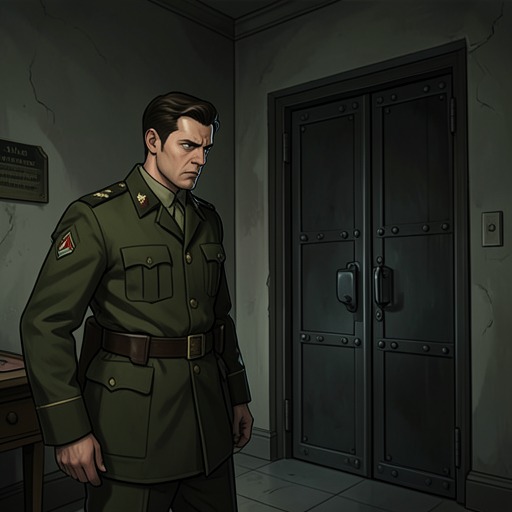
Doll was captured in March 1946, tried at Nuremberg, and delivered to the Polish authorities. The account does not dwell on courtroom proceedings; it moves directly from the sequence of custody and trial to his fate. On April 16, 1947, he was hanged outside Bunker 11 at Kat Zet I. The place of execution returns his death to the camp landscape in which his authority had operated.
In his final statement, Doll wrote, ‘In the solitude of my cell I have come to the bitter realisation that I have sinned gravely against humanity.’ The admission is neither a detailed account of his acts nor an undoing of their consequences. Its force lies in the contrast between the language of personal recognition and the long period in which his office had been part of an organized system of coercion and killing.
Postwar Accountability
Doll’s fate appears alongside the outcomes for other figures connected with the camp and its industrial exploitation. In July 1948, thirteen IG Farben executives and managers were convicted at Nuremberg; Suitbert Seedig received an eight-year sentence for slavery and mass murder, while Rupprecht Strunck received seven years for plunder and spoliation, slavery, and mass murder. Frithuric Burckl was not among those executives. The account also notes that the Buna-Werke produced not a kilogram of synthetic rubber or a millilitre of synthetic fuel. These separate outcomes do not equate the defendants’ roles or sentences, but they place Doll’s execution within a broader postwar reckoning with camp command, forced labor, and the companies that sought to exploit it.