Walpurgisnacht as a motif
The Zone of InterestWalpurgisnacht as a motif links a calendar date to the novel’s unstable boundaries between life and death, concealment and revelation. First it marks the deadline surrounding Szmul and the threat against Shulamith; later, Hannah’s account of the night gives the date a wider meaning, as a time when the ordinary world seems to open onto darkness. The motif’s force comes from that double use: Walpurgisnacht is at once a date Doll can weaponize and an image through which the characters try to understand what has happened to them.
A date turned into a countdown
Doll makes Walpurgisnacht part of his timetable for death. Asking Szmul whether knowing his “time of departure” feels different, he calculates that April 30 is twenty-three days away. The correction from the sixth to the seventh makes the count feel immediate and deliberate: the calendar is not background but a measure of the time remaining. Doll later repeats the deadline, addressing Szmul as the date approaches and asking whether it is Walpurgisnacht. The name becomes a refrain attached to a death date.
That countdown is bound to Doll’s order concerning Shulamith. Under Crematory IV, Doll has Szmul practise drawing a weapon from his sleeve and thrusting it into a sack. He then specifies that Shulamith is to be collected at noon on May 1 unless he cancels the order by telephone that morning. In this arrangement, Walpurgisnacht is the night before the threatened execution: a boundary in the calendar that separates a reprieve still theoretically possible from the violence Doll has scheduled. The precision of the hour and the conditional telephone order make the threat bureaucratic as well as personal.
Doll’s repeated invocation of the night accompanies an explicitly coercive bargain. He tells Szmul that the only way to keep his wife alive is to kill Doll’s wife, Hannah. The motif therefore gathers several forms of suspended fate into one date: Szmul’s own anticipated departure, Shulamith’s threatened death, and the demand that Szmul commit another killing to alter that outcome. Walpurgisnacht does not offer a supernatural escape from these choices. In Doll’s hands, it names the appointed edge of a trap.
The garden as a staged threshold
The motif returns in Doll’s invitation to Hannah. He calls her into the garden to watch Roman candles and presents Szmul’s supposed birthday gift as the occasion, saying that the prisoner worships her. The invitation is framed as an ordinary domestic kindness: Hannah may come outside, smoke, and receive a present. Doll also says that he has something to tell her about Thomsen. That combination of diversion, promised disclosure, and apparent celebration places Hannah inside a scene whose real danger is not openly announced.
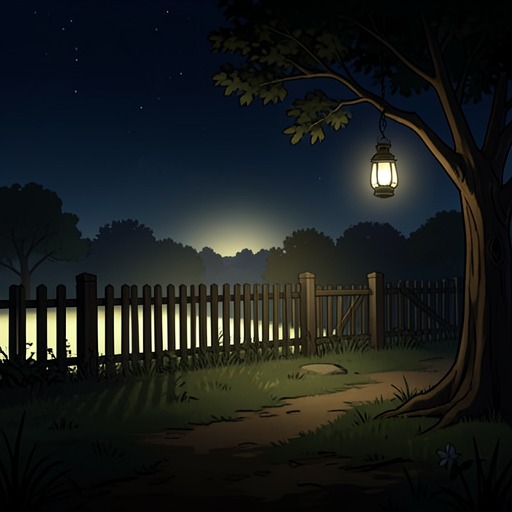
Hannah later reconstructs the encounter as taking place at the edge of Walpurgisnacht. In the gathering twilight, fireworks rise beyond the garden, while Szmul stands on the other side of the fence in his prisoner’s stripes. He draws a long, narrow-crosspiece weapon from his sleeve. Hannah describes the atmosphere as unlike anything she had experienced or read about, with everything uncertain and pretended. The boundary is literal—the fence between the garden and the prisoner—but also theatrical: Doll’s invitation makes the meeting look like a birthday gesture even as his earlier order has made Szmul’s weapon part of a coercive test.
When Doll kicks open the gate and urges Szmul forward, Szmul stands his ground, opens his shirt, and puts the point against his own chest. This remembered gesture brings the motif’s meanings together without resolving them into a simple supernatural image. The garden is a place of fireworks and social ritual, but also the site where a prisoner confronts the possibility of violence. The night’s uncertainty is manufactured by human actions: Doll’s concealed purpose, the weapon Szmul has hidden in his sleeve, and Hannah’s incomplete understanding of what she is witnessing.
The boundary between worlds
In the postwar conversation, Hannah explains that the girls had been excited not only by the bonfire, fireworks, and roast potatoes but by a book that frightened them with the idea of Walpurgisnacht. They understood it as the time when one could cross between the seen and unseen worlds, or between light and darkness. Her account places the motif within remembered youthful fascination with a frightening threshold, then sets that earlier imaginative boundary beside the night she experienced under Doll’s control. The remembered folklore does not explain away the scene; it supplies a language for its strange mixture of display, danger, and uncertainty.
Hannah also recalls a friend who described the Third Reich as one long Walpurgisnacht. In that formulation, the boundary is no longer merely between visible and invisible worlds, but between life and death. The friend’s observation makes the date carry historical and political weight: a period of rule becomes an extended night in which the distinction between the living and the dead seems to have vanished. Hannah connects April 30 with the death of Adolf Hitler, referring obliquely to the figure in the Wilhelmstrasse who ended his own misery. The date thus joins the immediate threat to Shulamith and Szmul’s confrontation with the larger collapse of the regime.
Recollection and recurrence
Hannah’s later account changes the emphasis of the motif. During the countdown, Walpurgisnacht is chiefly Doll’s deadline, repeated as he asserts control over whether Shulamith will live. In memory, the same night becomes a framework for interpreting an experience that had seemed unreal while it was happening. The distinction matters: the scene’s “uncertainty” does not make the danger imaginary. It registers how the staged birthday, the fireworks, the fence, and Szmul’s drawn weapon made it difficult for Hannah to know what kind of encounter she had entered.
The motif’s recurrence binds calendar time to traumatic recollection. April 30 is calculated in advance, invoked during the coercion beneath Crematory IV, and later recalled through the garden scene and the stories Hannah once read. Its movement from countdown to memory also preserves the contrast between ritual appearance and lethal purpose: Roman candles and a birthday present on one side, an execution order and a weapon on the other. Walpurgisnacht gives these episodes a shared shape, a night at the boundary where the darkness is not an unseen supernatural realm but a violence made to appear, for a moment, like ceremony.