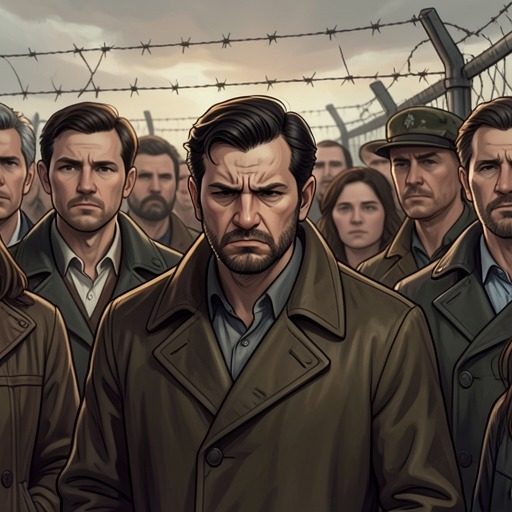
We went along
The Zone of Interest“We went along” is Thomsen’s blunt formulation of complicity: resistance reduced to delay does not amount to refusal, and a sense of personal obstruction cannot erase participation. The phrase links his self-assessment and his identification with Konrad Peters to the machinery of persecution and mass murder they discuss.
The phrase as self-indictment
In his account, Thomsen calls himself and the more exalted Peters obstructive fellow-travelers. Their obstruction has a small, physical vocabulary: they drag their feet, scuff carpets, and scratch parquet. But the refrain returns despite these gestures. “We went along” is repeated until it sounds less like an excuse than a verdict. The sentence admits both a limited resistance and its limit: they slowed the process where they could, but did not stop going along with it.
Thomsen extends the admission beyond the two men, estimating that hundreds of thousands, perhaps millions, behaved similarly. The scale enlarges the phrase without absolving its speakers. “We” makes their conduct part of a broad social pattern, but does not dissolve individual responsibility into the crowd.
Complicity inside the bureaucracy
The expression gains force from Thomsen’s position within competing administrative demands. At home, he considers the pressure from the Economic Administration Head Office to increase labor for the munitions industries alongside the Reich Central Security Department’s demand to dispose of more deportees. A teletype proposes working able-bodied mothers to exhaustion in a boot factory at Chełmek; Thomsen objects that its author should come to the ramp and try separating mothers from their children. His indignation is real, but it takes place within an apparatus whose demands he is still weighing and managing. The image of being caught between opposing pressures therefore describes a constraint without making him an outsider to the system.
That distinction clarifies the phrase’s moral register. Dragging one’s feet can register reluctance, yet it remains a form of accommodation when the larger course continues. Thomsen’s narration does not present bureaucratic friction as a decisive break with persecution; it places such friction beside the admission that he and others went along.
From administrative decisions to mass murder
In a later discussion with Peters, Thomsen dates what he calls the crime without a name to July 31, 1941. He describes an authorization sent to Göring, drafted by Eichmann and Reinhard Heydrich, and framed as the Führer’s wish for a total solution. In Thomsen’s account, the policy’s possible form was not immediately fixed: the regime may still have imagined removing Jews to a cold, barren region beyond the Urals or in the Arctic, where extermination would take place more slowly.
Thomsen then describes pressure from officials in occupied Poland, where the annexation of three million additional Jews intensified the perceived problem of numbers. As the prospect of a territorial solution receded in August and September, he identifies a further radicalization: killing extended beyond men, already being murdered, to women and children. The chronology makes “we went along” more than a general confession of passivity. It sits beside an account of how policy shifted under both central authorization and pressure from below.
Means, will, and the limits of delay
Peters challenges the idea that the industrial means of killing were its essential cause. Gas chambers and crematoria, he argues, accelerated murder, economized effort, and spared the killers’ nerves; bullets and pyres would ultimately have served the same purpose. He points to more than a million people already killed by the Einsatzgruppen with bullets. The contrast between industrial machinery and other available methods makes the underlying will—not any particular technology—the decisive fact in his argument.
Read beside this account, the refrain’s modest gestures acquire a sharp irony. Scuffing a carpet or delaying a demand may distinguish reluctant administrators from eager ones, but it does not undo the course they permit to continue. “We went along” holds that distinction in view without letting it become an alibi: obstruction existed, and so did participation.