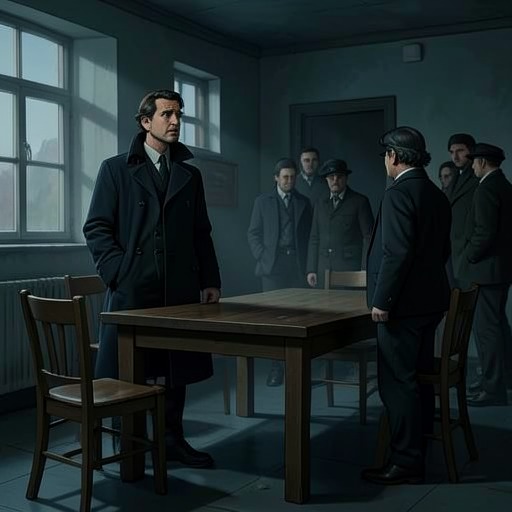
Witold Trzeciak
The Zone of InterestWitold Trzeciak is remembered as the inseparable childhood companion of the narrator’s Chaim and encountered again as a solitary, disabled boy arriving at the camp. The reunion lasts only minutes: Witold asks after his friend, is assured that he will see him, and dies before that promise can be kept. His missing surgical boot, left among the deportees’ discarded medical aids, gives his final request a concrete urgency; the scene’s terrible force lies in the distance between the care the narrator tries to offer and the death the camp imposes.
Identity and Early History
From 1934 to 1937, Witold and the narrator’s Chaim were so close that the narrator remembers them as being like twins. They spent weekends together at either family’s home. At the slightest excuse—a frightening story, a black cat glimpsed beneath a ladder, Halloween, or Walpurgis Night—they would sleep in the same single bed. These particular, ordinary recollections establish more than childhood intimacy: they give Witold a life of shared habits and familiar fears before the narrative presents him as a prisoner marked by physical vulnerability.
In 1938, Witold’s parents divorced. He became a determined young commuter between his father in one city and his mother in another, continuing the journeys until well after the invasion. The account does not make the divorce a simple explanation for his later fate; instead, it records the altered geography of his childhood and his persistence in crossing it. In 1939 he was twelve. That age, placed beside his later arrest and death, sharpens the contrast between the boy who once moved between two homes and the prisoner who arrives alone.
Arrival and Recognition
At the camp, the narrator sees a boy walking strangely and painfully, unmistakably by himself. Witold’s clubfoot makes each step difficult. The surgical boot that should have helped him has been left on the platform in the pile of trusses, braces, and prostheses taken from the arriving deportees. His disability is therefore presented not only as a bodily condition but as a need made more severe by the camp’s handling of people and their belongings: the object that might support his movement is separated from him at the point of arrival.
The narrator calls, “Witold?” and then repeats the name. After an instant of emptiness, Witold’s face flares with gratitude and relief. He recognizes the narrator as Mr Zachariasz and immediately asks where Chaim is, explaining that he had gone looking for him. His first concern is not an account of his own journey but the hoped-for reunion. The narrator answers that Chaim is there and invites Witold to come with him.
Witold explains that he had been arrested at a station for vagrancy and taken to Pawiak Prison. He and the person with him thought they would be shot, but their captors changed their minds. He also asks about a woman who, he has heard, went too; told that she went on foot, he says her brother took her. The brief exchange leaves much of the family’s fate unstated, but makes clear that Witold has been separated from people he is trying to find and has already passed through arrest and the threat of execution before reaching the camp.
A Promise the Camp Cannot Keep
The narrator leads Witold down a path lined with flowerpots to a white wicket gate, holding his arm and shoulders as he speaks to him. He tells him that Chaim is with his brother, working on the home farm and in the fields, and suggests Witold may get the same job. The reassurance presents a possible future in terms Witold can understand: reunion, work beside familiar people, and the prospect of using his boot in the fields. Witold asks directly, “What about my boot? I’ll be needing my boot for the fields.” The question brings the missing object back into the scene, even as the narrator tries to offer him food and the promise of a hot meal.
The narrator says that cheese sandwiches will come straight away, that a hot meal will follow, and that he will have Chaim come and find Witold. Witold answers, “Oh, that’d be good.” The narrator then marks this as his last utterance. The exchange turns the promise of reunion into an especially painful measure of what cannot happen: the boy is given a moment of welcome and an image of future work, but not the chance to reach the friend he has sought.
Death and Narrative Significance
Paul Doll sees the body being dragged behind the ambulance and asks what happened. The narrator describes Witold as a troublemaker because he kept asking for his surgical boot. Doll acknowledges that something had seemed wrong with the boy, then tells the narrator to meet him in the garden on Friday at six, as night falls. Witold’s need is thus recast in the camp’s language as misconduct; the simple insistence on the aid he requires becomes the explanation offered for his treatment. The passage does not specify the precise means of his death, and the account’s restraint leaves the killing present through its aftermath rather than an invented description of its mechanics.
Witold falls as if in a swoon. Krebbs steps back. In less than a minute, Witold is dead; about twenty seconds later, the narrator says, he is gone. The compressed timing stands against the longer recollection of weekends, journeys, and shared beds. The narrator reflects that there are fewer things to say goodbye to, less life and perhaps less love, and less memory to scatter. That thought does not make Witold’s life negligible. It exposes the brutal arithmetic by which the camp’s repeated deaths seem to leave ever less behind, while the remembered particulars—the childhood bed, the painful walk, the lost boot, and the final request—insist on what has been taken.