the city of Berlin
The Zone of InterestThe city of Berlin is both a center of Nazi power and a place where the consequences of war become impossible to keep at a distance. The narrative moves from offices, secret messages, and decisions about deportees to the first great bombardment and the altered life of the streets. Its significance lies in that collision: the institutions directing violence remain at work even as the violence of the wider war reaches the capital itself.
Administrative and Political Center
The city of Berlin appears as the seat of overlapping authorities whose demands shape the narrator’s work. The Economic Administration Head Office presses for more labor in the munitions industries, while the Reich Central Security Department presses for the disposal of evacuees. In a moment of private reflection, the narrator understands himself as caught between those competing pressures. His language exposes the murderous premises beneath administrative calculation: Jews are treated as a supposed security threat, while their capacity for labor is simultaneously counted as a resource.
A teletype brings the conflict down to a specific proposal: Gerhard Student of the Economic Administration Head Office wants able-bodied mothers put to work in a boot factory at Chełmek. The narrator objects that Student should come to the ramp and try separating the women from their children. His protest does not undo the system, but it reveals the human circumstance that bureaucratic plans omit. The city’s offices are not detached from the camps; they are where labor demands and deportation policy meet, and where the people subject to those policies are reduced to competing categories of use and disposal.
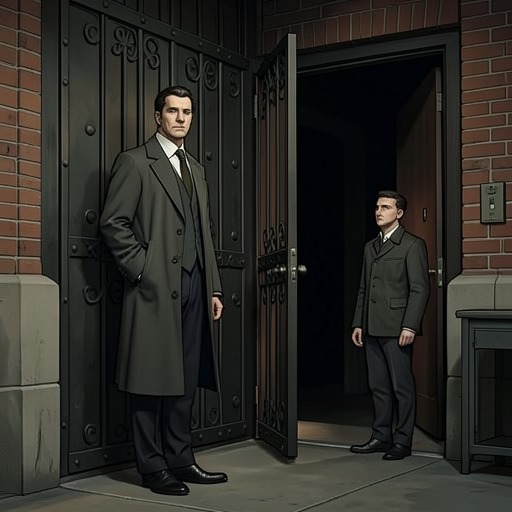
Political authority is also made personal. The narrator receives a prearranged telephone call from a secretary in Berlin, who relays a message from the Reichsleiter. When another character asks whom he means, the answer is Martin Bormann, identified in the surrounding conversation as the narrator’s uncle. The exchange locates power in a network of access, family ties, secretaries, and couriers as well as in formal titles. A courier is expected at the narrator’s apartment in the Old Town, prompting him to leave a gathering and receive the visitor. The capital’s authority travels through private rooms and personal obligations as readily as through official channels.
Messages, Appointments, and the Wider War
A message from Paris warns Paul Doll to be extremely cautious concerning Special Train 105, telling him that his abilities will be tested to their limits. The narrator’s account presents preparation as an answer to that warning: he has made his arrangements, and by early evening the participants are ready. Though the message originates outside the city, it belongs to the network of communications that surrounds the Berlin-based authorities and their actions. The train is not just a timetable entry; the warning makes its arrival an anticipated crisis.
The political conversations associated with the capital also reveal how far official confidence has become detached from military reality. Paul Doll predicts a victorious German return from the Volga and from the cities formerly called Moscow and Leningrad, followed by the disarmament of the Wehrmacht by the SS. Such talk sits beside the narrator’s growing awareness that the war is approaching the city. The contrast is not merely between two opinions: Berlin’s political circles continue to perform certainty while the conditions sustaining that certainty are breaking down.
The Bombardment and Its Immediate Aftermath
Before the major attack, the city had experienced nuisance raids in late 1940 and early 1941, followed by a lull through 1942. The narrative sets Berlin’s relative safety against the destruction already suffered by Cologne, Hamburg, Bremen, Munich, Mainz, and the Ruhrgebiet. Residents nevertheless know that the respite cannot last. After the Day of the Luftwaffe, with its parades and ceremonies, the first multi-squadron bombardment arrives on the night of March 1–2.
The sirens wake the narrator, who puts on a dressing gown and joins a drinks party in the wine cellars of Hotel Eden. For an hour and a half, the guests remain amid what the account calls decadent levity. Then the sound of the attack transforms the room’s mood: its approach seems like that of a blind, stumbling giant, each step marked by a thunderclap. Those sheltering below ground imagine several possible deaths—being atomized, scorched, crushed, smothered, or drowned. The assault then veers away to the east. The sudden change from anticipated death to survival does not make the danger unreal; it leaves the people in the cellar measuring how close it came.
The destruction beyond the cellar is counted in human and physical terms: hundreds dead, thousands injured, perhaps a hundred thousand homeless. The streets are carpeted with crackling glass beneath a fume-laden, sulphur-yellow sky. The account calls this the war coming home to the place where it began, and specifically to the Wilhelmstrasse. The capital’s role as the seat of power is thus reversed into a point of exposure: the war that its government has carried elsewhere now strikes the government’s own city.
A Changed City and Its Narrative Significance
After the bombing, the narrator notices that the streets’ movements and dispositions feel wrong. The absence becomes clear only after half an hour: there are no young men. The visible groups include lightly guarded work crews of laborers from subjugated lands, municipal police, and SS. Young men appear only on crutches, in handcarts, or in rickshaws; in the pubs around Potsdamer Platz, empty sleeves, empty trouser legs, and smashed faces register the bodily cost of the war. The city’s population is not presented as an undifferentiated crowd. Its streets disclose who is absent, who is forced to labor, and who has returned injured.
A month later, the Wilhelmstrasse is described as bomb-damaged but efficiently repaired, and the narrator is again in an office at the Chancellery. Repair restores the operation of the administrative center without erasing the damage. During his stay, he walks through the working-class suburbs of Friedrichshain and Wedding, eats at a hotel, and reads Thomas Mann in his room. These activities continue within a city whose ordinary routines have been drastically narrowed by war, and whose relative privilege is visible in the unrationed food he can sometimes obtain, including oysters and lobster.
The streets also show the war through those who remain. From a car, the narrator sees women of every age busy with small necessities—an envelope, shoelaces, a toothbrush, glue, a button. Their husbands, brothers, sons, and fathers are hundreds or perhaps thousands of miles away, and at least a million are already dead. This everyday activity does not soften the loss; it gives the loss its scale by placing ordinary errands beside the missing men. In another temporal frame, Berlin is described as under blockade, with little peace and no freedom in the Russian mandate to its northeast and rumors of mass graves. Across these different moments, the city is more than a political backdrop: it is where official power, civilian routine, absence, destruction, and the uneasy return of normal administration occupy the same streets.