Blake McGrath
The light house: A love storyBlake McGrath is the novel’s great artist in retreat: once celebrated as America’s Rembrandt, he abandons painting and the public world after the drowning of his six-year-old daughter, Chloe, then faces blindness just as Connie Dixon reawakens his desire to create. Living under the name Bill Mason on an isolated coast, he initially treats grief, solitude, and failing sight as the end of his identity; by the conclusion, however, he has survived as both a man and an artist, ready to return to the easel and paint emotion rather than repeat the career that trauma had taken from him.
Identity and Artistic Reputation
Blake’s hidden identity is the first major fact around which his character is organized. The old man identifies the recluse as Bill Mason, while Connie Dixon gradually recognizes that she has found Blake McGrath. The revelation is confirmed directly when Blake says, "I’m Blake McGrath." His assumed name is therefore not merely a local nickname but part of his withdrawal from the artistic life that once made him famous.
Before his seclusion, Blake was described as America’s most famous contemporary artist. Gallery curators around the world acclaimed him, and he held special exhibitions at the Louvre and the National Gallery in London. The title America’s Rembrandt establishes the scale of his reputation: he is not an obscure painter waiting to be discovered, but a figure whose name carries institutional authority and almost national symbolic weight. Connie’s sudden realization that she has found him transforms the isolated coastal house into the concealed location of a vanished public legend.
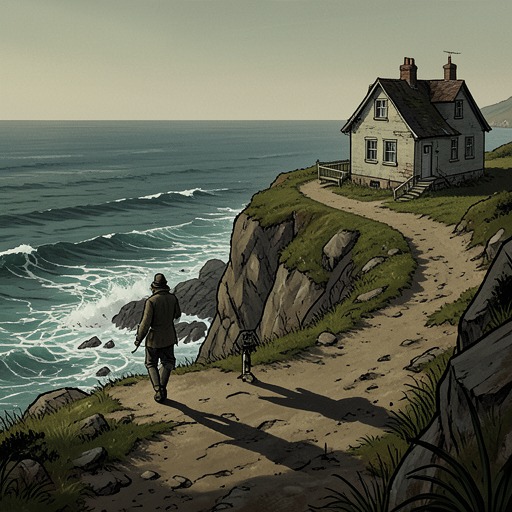
The house itself preserves the tension between concealment and visibility. Locals call it the light house because every light remains on through both night and day, and fishermen can see the Mason house from miles out to sea. Blake has hidden his name and abandoned the world, yet he keeps the building illuminated as though some part of him still expects a return. The lights eventually acquire a private purpose connected to Chloe, but they also make his isolation paradoxical: the man who refuses society has created a beacon that continually announces his presence.
Withdrawal, Grief, and the Sea
Blake has lived for seven years on the rugged, isolated coastline. The first two years there were the happiest of his life because the sea invigorated and inspired him. During that period, each new painting seemed better than the last, and he approached a rare point of satisfaction with his own work. The coast was therefore initially a place of artistic freedom and fulfillment, not simply a refuge from pain.
That relationship changes after Chloe drowns. Blake explains that the sea gave him his career and then turned cruelly against him by taking his daughter, so he abandoned his art and turned his back on the world. The ocean becomes both muse and source of trauma, carrying the bitter irony that the force responsible for his greatest achievements is also the force he associates with irreversible loss. His refusal to paint any longer is consequently more than a professional hiatus: it is a repudiation of the medium and landscape through which his identity had been formed.
His grief remains active rather than concluded. Blake and Ned go to the beach at sunset to send a rose out to sea, while Ned returns every night to sit on the empty beach until sunrise, waiting for Chloe. Blake also leaves the lights on so that she may find her way home. These repeated actions preserve a continuing bond with the dead rather than allowing Chloe to become only a past memory. The ritual gives grief a schedule, a place, and physical objects—the rose, the beach, and the lights—while also exposing the painful impossibility of the return he imagines.
Blake’s relation to Chloe is expressed as a love he has been unable to complete through speech. He tells Connie that Chloe was one of the two great loves of his life, the other being painting, and identifies her death as the wound that has governed everything since. His eventual farewell is therefore not a casual gesture of closure. He says that he needs to tell Chloe goodbye because it is the one thing he could never bring himself to say, then addresses her as his darling girl and assures her that her father has always loved her. The final phrase, "My little girl lost," condenses both the fact of her disappearance and the enduring emotional identity through which he has continued to mourn her.
Connie Dixon and the Return to Art
Blake’s reunion with Connie Dixon unsettles the sealed life he has built around absence. When he admits that he never thought he would see her again, his guarded manner reveals vulnerability beneath the brusque isolation. He agrees to allow an exhibition of his old paintings when Connie establishes her gallery, but he imposes a condition. The arrangement reconnects him to the public art world while preserving his control over the terms of reentry.
The condition is inseparable from his physical crisis. Blake tells Connie, "Connie, I’m going blind," and describes painting her as his last chance for redemption. The portrait is at once an artistic task, an emotional confession, and an attempt to recover a self that has been suspended since Chloe’s drowning. He does not initially return to painting because his old career has become comfortable again; he returns because Connie gives him a subject untouched by the sea and because the threat of blindness makes the work urgent.
His renewed practice begins with fear as well as anticipation. He feels enthusiasm in his fingers and anxiety at the prospect of taking up brushes again, resurrecting skills sharpened by years of work and directing them toward a challenge untainted by his memories. He resolves never again to paint the ocean, but he can imagine painting once more, perhaps only for one final attempt at perfection before blindness closes over him. The refusal of seascapes marks a boundary around trauma, while the decision to work again marks the first breach in his self-imposed exile.
The portrait develops over fourteen days. At first Blake proceeds methodically, but his skill returns, his touch becomes deft again, and each brushstroke carries his passion. He covers the canvas after every session, refusing to let Connie see it before completion. His secrecy reverses the earlier concealment of his identity: now concealment protects the fragile process of making rather than hiding shame. When the portrait is finished, he experiences grudging satisfaction and pride and acknowledges its beauty. The work becomes evidence that artistic ability has not vanished, even though the conditions under which he once practiced have been transformed.
Blindness and Transformation
On the last day of summer, Blake wakes to discover that his world has become darkness and that he is utterly blind. The event devastates both him and Connie, collapsing their shared future into immediate uncertainty. His first response is not serene acceptance. He gropes for an old cane supplied by eye specialists and wields it like a sword, turning an instrument of adaptation into an emblem of anger and resistance.
Blindness initially appears to confirm Blake’s harsh interpretation of his life. He has treated the loss of sight as punishment for ignoring his gift, imagining that a power beyond himself has come seeking revenge. Yet the later course of his actions challenges that interpretation. At the gallery, he uses his cane and moves slowly around the walls, counting paces and memorizing distances. The scene shows him rebuilding participation through spatial memory and deliberate practice rather than being reduced to passivity. His blindness changes how he works in the world, but it does not abolish his agency.
The same reversal appears in his response to art. Blake says that he once believed blindness was the end of his artistic career and painted Connie’s portrait because he wanted redemption. At the gallery, however, he announces that he will begin painting again—not to recover the old life exactly, but because without art some part of him will continue to yearn to be heard. He rejects both seascapes and portraits as his next subjects and declares, "I’m going to paint emotion." This decision turns blindness from a final negation into a demand for a transformed artistic language.
His declaration is spontaneous even to him. He has not discussed the plan with Connie, and the impulse arrives as a sudden rush of passion from silence. The public announcement therefore matters as an act of self-discovery: Blake does not simply report a settled plan but discovers, before the gallery audience, that his artistic identity has survived in altered form. His return is not a restoration of the famous painter who once exhibited in major institutions. It is a new practice founded on inward perception, emotional knowledge, and the insistence that art can still speak without sight.
Narrative Role and Ending
Blake’s story binds the novel’s central oppositions together: fame and concealment, the sea as inspiration and destroyer, grief as imprisonment and continuing love, and blindness as devastation and artistic transformation. The hidden Bill Mason identity makes his return to public recognition a revelation, while the repeated lights and sunset rose ritual show that his past cannot simply be discarded. He must carry Chloe’s memory forward without allowing the ritual of waiting to determine the whole of his future.
Connie Dixon is crucial to that movement. Blake says that her love, laughter, passion, and persistence lifted him from the darkness of despair and showed him the joys of life again, adding that he doubts he would still be alive without her. His relationship with her does not erase Chloe or solve grief by replacing one love with another. Instead, it gives him a human connection strong enough to coexist with mourning and to make renewed work imaginable.
The ending presents Blake as neither cured nor returned to his former condition. He remains blind, and the ocean remains inseparable from the trauma of Chloe’s death. Yet he has said goodbye to his daughter, acknowledged his love for Connie, mapped the gallery with his cane, completed the portrait, and chosen a future at the easel. The final judgment is therefore deliberately double: as a man, Blake McGrath has survived; as an artist, he is about to make a comeback. His redemption lies not in recovering sight or forgetting loss, but in converting both into the conditions of a different form of creation.