Blake and Connie's reconciliation
The light house: A love storyBlake and Connie's reconciliation is the decisive turning point after the phone call that makes Blake believe Connie has manipulated him to acquire his paintings. The episode begins in accusation and emotional violence, but ends when Connie names the history she had concealed, Blake understands that she has not betrayed him, and both choose renewed intimacy over the fear and secrecy that had governed their relationship.
The Misunderstanding and Its Stakes
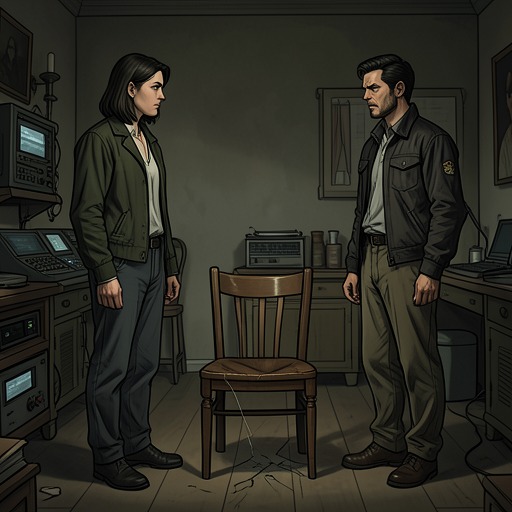
Blake encounters Connie in the studio rigid with tension, his shoulders bristling, breath ragged, and fists clenched. He tells her, "You betrayed me," then interprets everything between them as a calculated attempt to gain possession of his canvases. In his wounded reading, her interest in his work has converted love into exploitation: she has been manipulating him, he believes, so that she can get her hands on the paintings. The accusation is especially destructive because Blake has already entrusted Connie with both his art and the private history behind it.
His anger turns that fear into a gesture of repudiation. He tells Connie to take the paintings and empties his pockets of their few loose coins, offering her everything he possesses. The objects become a bitter inventory of supposed betrayal rather than gifts. He says that she now has the only two things he ever held precious: his trust and his secrets. By treating those inward possessions as if they could be seized like canvases, Blake reveals that the real stakes are not commercial. He believes the relationship has made him defenseless, and he tries to recover control by surrendering its material tokens.
Connie does not retreat cleanly. She cries out Blake's name, presses herself against his chest, and tries to make him hear that the call was not what he thinks. Blake initially holds her away and orders her to leave the house and his life. The scene therefore makes reconciliation physically and emotionally precarious: Connie seeks contact while Blake converts touch into another possible form of deception, and both are close to losing the relationship before its truth has been spoken.
Connie's Disclosure
Connie explains that the caller was Duncan Cartwright, her former boss at the gallery, who had used her sexually for four years. Her account changes the meaning of the call and also exposes the structure of the life from which she has been trying to escape. She had left home for New York City hoping to become an artist, but she had no money. Duncan recognized her ambition, encouraged her painting, and paid her bills until the resulting debt made her dependent on him; he then demanded repayment through sex.
The disclosure is not presented as a single past insult but as a sustained process of coercion. Duncan came to Connie's apartment and used her while she felt she had no choice. He promised exhibitions but never delivered them, and eventually told her she was not good enough to exhibit, offering her work as a dealer instead. The supposed opportunity kept her inside the system that had taken her artistic dream away. Connie's shame is visible as she recounts it, yet she also acknowledges the desperation that made her willing to endure exploitation in order to continue pursuing art.
She clarifies that the call concerned her old paintings, not Blake's work or their relationship. Connie had given Duncan a painting two years earlier for his birthday, and he still possessed her earlier pieces at the gallery. He wanted them removed and threatened to burn them. His further questions about whether she missed him and his taunts about sex were an attempt to reopen the old humiliation, not evidence that Connie wanted to return to him. Her explanation separates the threat against her artistic past from the future she is trying to build with Blake.
Recognition and Reconnection
Blake's response changes as the evidence becomes clear. The hard expression on his face begins to break, and a wave of relief replaces the immediate certainty of betrayal. He understands that Connie has not betrayed him; the repeated realization matters because his entire reaction has been organized around the opposite belief. His remaining question is why she kept the truth from him, not whether she has been scheming against him.
Connie admits that she should have told him. Blake had shared the tragedy of Chloe's death and the ritual through which he and Ned continued to mourn her, while Connie had withheld the coercion that shaped her own past. Her confession therefore creates a more equal exchange of vulnerability. She had feared that her history would affect their future, but speaking it aloud allows Blake to see the difference between secrecy born of shame and deception undertaken for gain.
When Blake asks whether she wants the paintings, Connie answers that she wants only him. She approaches tentatively, and he moves toward her before either consciously decides to do so. They meet in the middle of the studio and cling to one another like survivors of a danger that nearly destroyed them. Their physical reunion is not merely a romantic reward after the misunderstanding; it is the action by which they test whether trust can be inhabited again after both have exposed what they most feared losing.
That night they make love while the wounds of the ordeal remain fresh. The encounter is described as frantic and intensely emotional, with touch and speechless contact functioning as a rediscovery of the bond rather than an erasure of what happened. Their exhaustion afterward marks a temporary restoration: the relationship has not become free of grief or history, but it has survived the accusation because the hidden facts have finally been brought into the open.
From Reconciliation to Renewal
The reconciliation does not end Blake's grief over Chloe. His nightly connection with her remains visible in the sunset ritual, when he and Ned go to the beach and send a red rose into the sea; Ned later waits on the empty beach until sunrise. Blake has left the lights on at the house so Chloe might find her way home. These practices show that recovery is not abandonment of the dead. Instead, Connie's presence begins to coexist with a mourning that had previously left Blake isolated inside the past.
The next morning, while Connie returns to Hoyt Harbor to collect her clothes and personal belongings, Blake dusts Chloe's bedroom and changes the sheets. The ordinary act carries unusual weight: after sharing the pain of Chloe's death with Connie, he feels some burden lift and senses his former self rising from despair. The sorrow remains and will continue to seep through him, but it no longer has to remain entirely private or immobilizing.
Their renewed relationship also develops through practical cooperation. When they arrive at the gallery, Blake uses a cane and carefully maps the space by counting paces and memorizing distances while Connie deals with the catering staff. His blindness still changes how he moves through the world, but it does not prevent participation. The reconciliation thus leads toward a shared public life in which Connie's work as a gallery organizer and Blake's artistic identity can occupy the same space.
At the gallery opening, Blake publicly credits Connie with lifting him from despair through her love, laughter, passion, and persistence. He says that he had believed going blind was the end of his art career, and that he painted Connie's portrait because he wanted redemption. He then announces that he will return to the easel, not to repeat his former seascapes or simply produce more portraits, but to paint emotion. The promise gives the reconciliation an artistic consequence: restored trust becomes part of the condition under which Blake can imagine a future for his work.
Narrative Significance
The event reverses the book's recurring pattern of possession and control. Duncan Cartwright treated Connie's dream, money, body, and paintings as resources he could control; Blake, in his panic, briefly mistakes Connie for another person seeking to possess what is his. Connie's disclosure breaks that chain by distinguishing exploitation from love and by refusing to let her silence define the meaning of her actions.
The reconciliation also links two forms of grief. Blake carries Chloe's drowning through the beach, the rose, Ned's vigil, and the house lights, while Connie carries the loss of her artistic future under Duncan's coercion. Neither character is healed by forgetting. They move forward by witnessing one another's pain, recognizing the forces that produced their isolation, and making room for attachment without demanding that the past disappear. Their restored bond therefore functions as both romantic resolution and a change in the conditions of artistic life: Blake can begin painting again because trust, rather than secrecy and fear, has become possible.