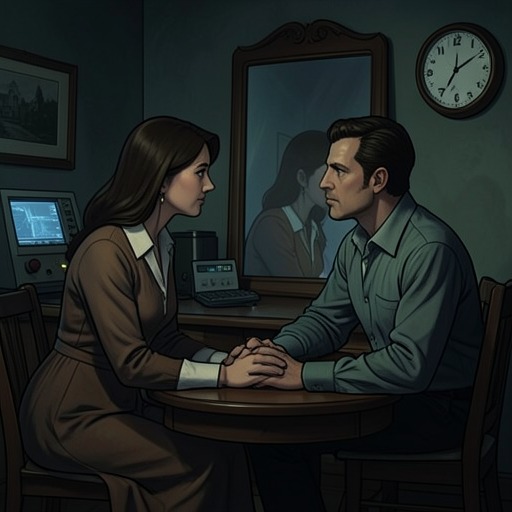
Blake and Connie's storm consummation
The light house: A love storyBlake and Connie's storm consummation marks the moment when their hesitant intimacy becomes an acknowledged bond. What begins with a renewed kiss in the house moves through resistance, pursuit, and finally mutual consent on the beach, while the storm externalizes the emotional force that both characters have struggled to contain. The scene is therefore not merely a sexual encounter; it changes the meaning of Blake's seaside home, Connie's stay in Hoyt Harbor, and the future they can imagine together.
Causes and Emotional Background
Connie has come to Hoyt Harbor to escape debt, despair, and a life that seems to be draining away her freedom. She is searching for answers without yet knowing that the coastal town will redirect her life. Her early response to the setting is almost reverential: she calls it a piece of paradise. Blake responds with the opposite judgment, saying that the place feels like a prison. That contrast establishes the emotional distance between them. Connie sees a possible beginning in the coast, whereas Blake remains trapped inside the memories that make the landscape unbearable.
The house itself embodies Blake's suspended existence. Locals call it the light house because every light remains on day and night, allowing fishermen to see the Mason house for miles out to sea. Later, Blake explains that he keeps the lights burning so Chloe can find her way home. His nightly connection to the beach is equally ritualized: he and Ned send a rose into the sea at sunset, while Ned waits on the empty shore through the night for Chloe. These practices show that Blake's life is organized around continued attachment to his dead daughter rather than participation in the present. The consummation becomes significant because Connie enters that sealed emotional world without erasing its grief.
Before the beach scene, attraction has already become difficult for both of them to deny. Music briefly loosens Connie's reserve as she dances freely in the house, while Blake watches her with restrained delight. When the storm seems to subside, he turns off the radio, takes her wrist, and pulls her close. They stare at one another and kiss again. Their bodies communicate an intensity that language cannot safely contain, but Connie still tries to impose a boundary: she wants Blake, yet not there and not yet. The scene's tension lies in the gap between desire and control, not in the absence of desire.
Course of the Encounter
Blake answers Connie's hesitation with another fierce kiss and lifts her into his arms. Carrying her through the doorway, he takes her outside into the storm-torn night. Ned remains on the porch without moving as Blake descends toward the beach, a silent witness to the crossing from domestic space into the elemental landscape that has governed Blake's life. Drizzle becomes driving rain; thunder rolls across the sky; and the soaked couple reach the hard sand while the waves pound the shore.
On the beach, Blake removes his wet shirt and stands exposed beneath the storm. Lightning, rain, and the sea transform his physical presence into an image of force rising from the water, but the scene also recalls his vulnerability to that same ocean. The coast is both the place of Chloe's loss and the place where Blake can finally risk a new attachment. Connie's response is active rather than passive: she encourages him, pulls him down, and returns his kiss with a passion that has been building through their earlier encounters.
They make love in the crashing tempest. The narration joins bodily sensation to the storm's rhythm, presenting lightning as flashes that fix the experience in Blake's memory and describing their movement as an elemental rhythm joined to the sea and the larger universe. Their union is mutual: Connie meets Blake's urgency, and the scene emphasizes the welcoming warmth and shared intensity between them. The storm does not simply surround the lovers; it gives physical form to the pressure that has accumulated between guarded people who have been drawn together by loneliness, curiosity, and reciprocal recognition.
Afterward, the storm begins to clear and stars appear. They lie together beneath the open sky, and Blake kisses Connie tenderly while she curls into his arms. Her astonishment at the intensity of the experience shows that the encounter has exceeded her previous understanding of desire. The final image is not one of separation but of lingering closeness, tenderness, and shared astonishment after the violence of the weather has passed.
Immediate Consequences
The consummation changes the value of Blake's house and beach. Before it, the home is a prison illuminated for a lost child; the beach is a site of ritual mourning where Blake and Ned wait for Chloe. After it, the same shore becomes the place where Blake and Connie begin a future together. The setting retains its grief, but it is no longer defined by grief alone. Their relationship does not replace Chloe's memory; instead, it introduces a living bond into a landscape previously controlled by absence.
That change becomes visible in the following days. Connie leaves early to collect the clothes and personal belongings she left at her rental house while Blake dusts Chloe's bedroom and changes the sheets. The action is practical, but its emotional consequence is substantial: after sharing the pain of Chloe's death with Connie, Blake feels a burden lift. His sorrow remains and will not disappear, yet he senses his former self beginning to rise from despair. The sequence presents recovery as an uneven movement between remembrance and renewed participation in life, rather than as a clean victory over mourning.
The couple also begin to imagine their intimacy as a shared creative and practical future. When Blake offers Connie the portrait he is painting as a gift, she refuses the possibility of selling it, calling it their painting and a painted memory of the happiest days of her life. They celebrate by carrying a folding table to the beach, eating grilled steaks beneath the moon and stars, and talking until midnight as mist rolls in from the ocean. The next morning, Connie phones her landlord, and the Connie Dixon Gallery of Fine Art is born. The storm encounter thus leads directly into a new professional and emotional arrangement: Connie's dream of her own gallery can coexist with Blake's art and with the relationship that has made the dream feel attainable.
Place, Memory, and Transformation
The scene's force depends on the double meaning of the sea. For Connie, the coast initially promises escape and a new life; for Blake, it is inseparable from Chloe's drowning and the rituals through which he keeps expecting her return. The consummation does not sentimentalize the ocean or make it safe. Waves still crash, lightning still threatens, and the beach remains the site of traumatic memory. Yet the lovers' ability to remain together within that environment creates a new association without cancelling the old one.
The contrast between the light house and the storm is especially important. The lights are Blake's attempt to guide Chloe home, a continuous signal directed toward the dead. During the consummation, by contrast, Blake carries Connie outward into darkness and rain, choosing immediate human contact rather than waiting for an impossible return. The movement is not a formal renunciation of Chloe, but it begins the reorientation later made explicit when Blake says that he needs to tell Chloe goodbye. His continuing bond with her can survive, but it can no longer demand that the entire future remain closed.
The encounter also anticipates Blake's artistic transformation. His work has always been connected to emotion, memory, and the sea, but his grief has confined those powers to repetition: the rose, the lights, the empty beach, and the imagined adult Chloe inserted into his paintings. Through Connie, physical intensity becomes another form of remembered experience. Later, at the opening of the Connie Dixon Gallery of Fine Art, Blake explains that blindness seemed to him the end of his art career, that he painted Connie's portrait because he wanted redemption, and that he will return to painting emotion rather than seascapes or portraits. The storm scene is not identical to that later artistic declaration, but it supplies the kind of embodied, overwhelming feeling that his new artistic purpose seeks to preserve.
Narrative Significance
As a romance beat, the consummation is the midpoint transformation from guarded attraction to an openly chosen relationship. Connie's earlier resistance gives way to participation, while Blake's isolation is interrupted by a desire strong enough to move him physically out of the house and psychologically toward another person. The scene joins the novel's central oppositions—freedom and imprisonment, paradise and trauma, memory and renewal—without resolving them through explanation alone.
Its aftermath confirms that the event has lasting consequences. Connie is beginning anew in Hoyt Harbor, despite the fear that accompanies a life with no guarantees, and she carries forward the dream of her gallery. Blake, who has spent years repeating rituals for Chloe and treating the coast as a prison, begins to share his pain, accept tenderness, and move toward farewell rather than endless waiting. Their union therefore functions as a threshold: the storm does not destroy the past, but it breaks the isolation that allowed the past to govern every possible future.