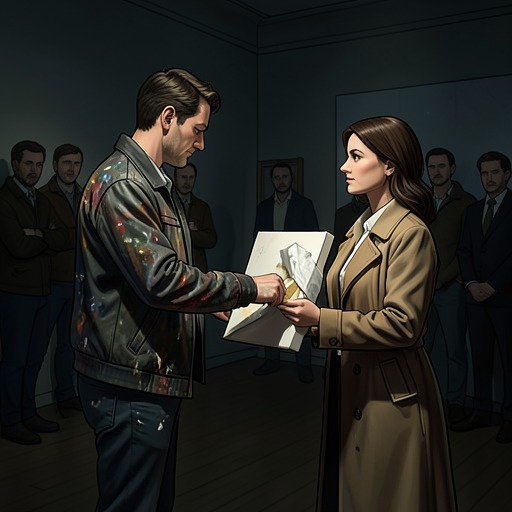
Blake signs Connie’s paintings
The light house: A love storyBlake McGrath’s signing of Connie Dixon’s paintings is a compact but decisive transaction in which artistic authentication, financial desperation, and personal trust become inseparable. Connie asks him to sign the two unsigned works she bought from Warren Ryan, knowing that his name will double their value; Blake agrees because the second painting can clear her debts and give her a fresh start, but he makes the favor conditional on her absolute silence about his location.
Request and Stakes
Before leaving Blake’s house, Connie raises the matter of the two paintings she purchased from Warren Ryan. Their lack of signatures leaves their authorship and value uncertain, and she asks Blake directly to authenticate them. Blake immediately identifies the commercial consequence: signing them will double their value. Connie confirms that she understands, but the request is not merely speculative. She is in financial trouble, and the second painting’s increased worth is necessary to clear her debts and begin again.
That desperation has a larger history. Connie’s artistic dream had been destroyed during the four years in which Duncan Cartwright promised recognition and exhibitions but instead used financial support, sexual access, and threats to control her. She has also been helping Jean support their mother’s nursing-home care, with the bank releasing a monthly payment from their joint account to a facility outside Exeter. The paintings therefore stand at the intersection of several pressures: an art market that can suddenly multiply value through a signature, debts created by coercive dependence, and the ongoing cost of family care.
The Signing Process
Blake carries both paintings into his studio and clears a space on a wide countertop. He retrieves paint and a fine brush, then bends close over the first canvas, squinting before placing his trademark flourish in its lower corner. He repeats the procedure on the larger painting. The scene gives the act a physical precision: authentication is not an abstract declaration but a deliberate mark made on the surface of each canvas.
He chooses acrylic rather than oil because oil signatures would take a week or more to dry. After signing, he turns the paintings over and writes an inscription in pencil across the back of each. The inscription identifies Connie as “my good friend Connie,” a phrase that personalizes the works and, in Blake’s judgment, may help their value. The paintings thus receive more than a signature: they carry a connection to Blake’s living memory of Connie, while their backs preserve information that the market can use.
The act also contains a subtle physical warning. Connie notices Blake blink in a curious myopic gesture and rub his eyes with his knuckles. At this stage, the gesture does not interrupt the transaction, but it places his vision within the scene as a vulnerable condition rather than an invisible guarantee of artistic authority. His signature authenticates the paintings even as the narrative registers the bodily difficulty surrounding his continued relationship with art.
Privacy as the Price of Authentication
Blake refuses to date the inscriptions with the current day. He explains that the dates must remain those from when he made the paintings; otherwise, people will know that Connie has found him. His privacy is not a minor preference but a governing condition of his isolated life. The commercial usefulness of his name depends on keeping his present whereabouts concealed.
He tells Connie that she must reveal nothing about where he is and let him maintain his privacy. Connie gives her word. The exchange reverses the usual direction of an art transaction: Connie receives valuable authentication, but Blake receives protection from exposure. His signature enters the public market while his identity in the present remains deliberately withheld. The paintings can circulate as evidence of his authorship without directing the public toward the secluded artist himself.
The promise also tests the difference between Connie’s earlier relationships and this new alliance. Duncan Cartwright turned money, career promises, and dependency into ownership, insisting that Connie owed him for everything he had done. Blake’s assistance is likewise connected to material value, but he does not claim her body or future in return; he asks for a boundary, and Connie accepts it as a promise rather than a debt.
Financial and Artistic Consequences
The signed works give Connie a route out of immediate financial danger. When she later approaches Warren Ryan, she reveals that the three thousand dollars she originally paid was based on her impression of the paintings’ value and offers him an additional forty thousand dollars once she understands their true worth. The signing therefore converts Blake’s concealed authorship into recognizable market power, enabling Connie to acknowledge Ryan’s underestimation while retaining the larger gain created by authentication.
The transaction is also an early instance of Connie turning artistic knowledge into agency. She recognizes the distinctive brushwork of Blake’s oils, understands that the paintings are valuable, and secures the one person whose signature can make that value legible to buyers. Her composure and commercial calculation contrast with the vulnerability that brought her to Blake. What begins as a plea for help becomes a practical act of self-reconstruction.
Its consequences extend beyond the sale. Connie keeps Blake’s location secret while building a future in the art world, eventually finding a possible studio site on the main street of Hoyt Harbor and later opening the Connie Dixon Gallery of Fine Art. Blake’s authorization of the two paintings anticipates his broader return to public artistic life: years later, he allows Connie to exhibit his lost works and his new portrait, and he announces that he will return to the easel to paint emotion after believing that blindness had ended his career. The original signatures therefore belong to a transitional period in which Blake’s art begins moving from concealment toward renewed circulation.
Trust, Concealment, and Redemption
The signed paintings embody a reciprocal arrangement. Connie needs Blake’s name to recover financially; Blake needs Connie’s discretion to preserve the solitude he has chosen. The works become material proof that trust can produce value without reproducing Duncan Cartwright’s coercive logic. Their value rises because Blake marks them, yet the mark is carefully separated from the revelation of where he now lives.
The episode also joins artistic authentication to emotional repair. Connie is not simply acquiring commodities; she is being recognized by an artist whose work she can genuinely understand. Blake is not merely endorsing canvases; he is allowing a part of his former public identity to pass through Connie’s hands. That limited act of authorization helps her escape exploitation and helps prepare the conditions for his later reconciliation with art, with public life, and with the possibility of a future beyond grief.