Blake's blindness
The light house: A love storyBlake's blindness is the central physical and artistic crisis of Blake McGrath's later life. A hereditary, progressive condition first appears as gradually blurred vision and lost close-up focus, but eventually becomes total darkness on the last day of summer. The event brings terror, rage, and renewed grief for Chloe, yet it also compels Blake to disclose his secrets, accept Connie Dixon's presence, and imagine a return to painting through emotion rather than sight.
Diagnosis and the Hidden Deadline
Blake has known for years that his sight was failing. The condition is hereditary and progressive, with no available treatment. At first he noticed blurring but dismissed it, believing himself too young and invulnerable to take the warning seriously. Later, his close-up focus deteriorated while his long-range vision remained comparatively clear. He describes the process as though his eyes were dying from the inside out, a bodily decline that turns every remaining act of seeing into a deadline.
That deadline explains why Blake wants to paint Connie. He presents her portrait as his last chance to make a painting before blindness removes the possibility altogether, and as his last chance for redemption. The request is therefore not simply an artistic commission or a romantic gesture. It is a confession of impending loss: Blake is trying to complete one final work while he can still see, while also asking Connie to understand the fear, guilt, and private pain that have governed his isolation.
The Moment Sight Ends
On the last day of summer, Blake wakes and discovers that the anticipated darkness has arrived. Although he has always known blindness was coming, the knowledge does not protect him from shock. He tells Connie, “Connie, I’m blind.” The short declaration converts a long medical prediction into an immediate reality and leaves both of them in despair.
His first response is physical and violent. He rages through the house, overturning furniture, stumbling over the sofa, knocking a glass to the floor, and falling as he tries to reach the studio. In a closet he finds the cane given to him by eye specialists years earlier, but he does not yet use it calmly as an aid; he wields it like a sword. He strikes the porch railing, kicks open the screen door, and moves toward the beach while Connie remains behind him, crying and unable to stop the crisis.
The storm intensifies the scene without relieving its human cause. Blake repeatedly falls in the sand, drags himself upright, and walks along the deserted beach through rain, wind, lightning, and distant thunder. For a day and a night he continues wandering while Connie watches from the window. His blindness is thus narrated not as a quiet sensory adjustment but as a public bodily collapse before the sea and the woman who loves him.
Blindness and the Return of Chloe
The loss of sight reactivates the older trauma at the center of Blake's withdrawal from the world: Chloe's drowning. He believes that the sea first gave him his career and then turned cruelly against him by taking his daughter. He interprets both the loss of Chloe and the approach of blindness as punishment for failing to appreciate her and for becoming absorbed in art. His condition therefore acquires a moral and religious meaning in his own account, even though the diagnosis itself is hereditary and medically irreversible.
Before blindness, Blake and Ned go to the beach at sunset and send a rose into the sea, while Ned waits on the empty shore through the night for Chloe's return. Blake also leaves every light in the house burning, day and night. Local fishermen can see the Mason house for miles out to sea, which is why the locals call it the light house. The illumination is a continuing signal to Chloe, a promise that she can find her way home.
Blake's paintings extend the same continuing bond. He adds a beautiful raven-haired young woman to five paintings, imagining how Chloe might have looked if she had grown up, and sends the works into the world so that she might one day recognize herself and know that she was remembered and loved. Blindness threatens not only Blake's future work but also the visual medium through which he has preserved an imagined future for his lost daughter.
From Visual Art to Inward Feeling
The revelation of blindness initially seems to confirm Blake's belief that his career is over. At the gallery, however, he can already begin to function through adaptation: he carries his cane, moves slowly around the walls, counts his paces, and memorizes distances. The cane and the gallery's measurable space do not restore sight, but they make participation possible. Connie's practical presence likewise helps place Blake within a public art setting rather than leaving him confined to the house and beach.
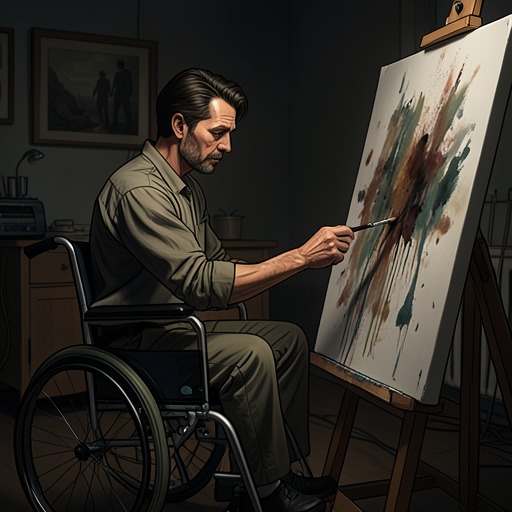
At the opening, Blake announces that blindness will not end his art. He explains that he had painted seascapes, sunsets, and other scenes that made people feel through nature, but he can no longer reproduce those visible images according to his former standards. What remains available to him is an inward practice: painting raw, shapeless movement and colors as the essence of feeling.
He names the new subjects as love, loss, hope, and sadness. The proposed work will not use recognizable images merely to evoke emotion; it will attempt to make shape and color carry emotional force in themselves. His blindness therefore becomes an artistic transformation rather than a simple recovery narrative. The condition removes the visual authority on which his earlier career depended, but it also gives him a new account of what painting can contain.
Farewell, Partnership, and Consequence
Blake's acceptance of blindness is inseparable from a final farewell to Chloe. At the shore, he kisses a rose, throws it into the foaming waves, and tells her goodbye, affirming that she will always be his beloved daughter. He calls her a painting in his heart, a masterpiece made perfect by memory, and declares that he can no longer continue waiting for her. Connie waits on the porch, embraces him, and weeps with him after the ritual. Together they then turn off the lights one by one, ending the light house's long vigil.
This ending does not erase Chloe or cancel Blake's grief. It changes the form of his relationship with her: the rose, the sea, the lights, and the imagined adult figure have carried the loss through repeated acts of remembrance, while the final farewell allows Blake to re-enter life with Connie. At the gallery, he credits Connie's love, laughter, passion, and persistence with lifting him from despair. He then states that he will return to the easel, not to paint seascapes or portraits, but to paint emotion. Blindness thus remains a permanent loss, yet its narrative consequence is a redefinition of artistic purpose, a renewed partnership, and the possibility of redemption through work that no longer depends on seeing the external world.