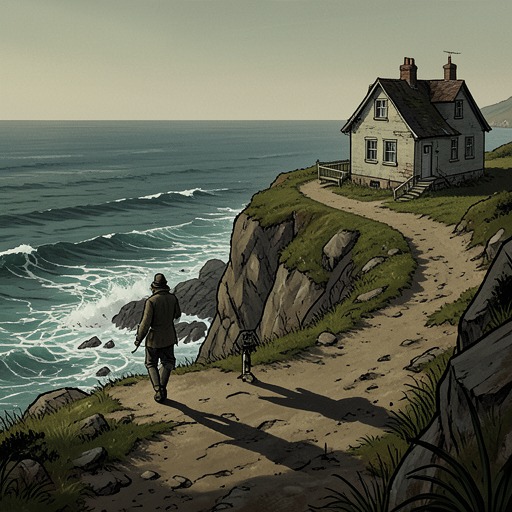
Blake's seaside house
The light house: A love storyBlake's seaside house is the central domestic and symbolic space of Blake McGrath's life in Hoyt Harbor. Set beside the lonely beach, it first appears to Connie Dixon as part of a coastal paradise and gradually reveals itself as a house organized around grief: its rooms contain the memory of Chloe, its studio holds Blake's interrupted artistic life, and its lights burn continuously as a signal to a dead child. By the end, the house is no longer merely a prison of mourning. Through Connie's arrival, Blake's final farewell to Chloe, and his decision to paint again, it becomes a threshold between the life he has lost and the life he may still choose.
Setting and Local Identity
Blake's seaside house stands apart from ordinary community life, yet it is visible from far out at sea. Thad explains that local fishermen call it the light house because every light inside remains on night and day; the house can be seen for miles across the water, although no one in the town knows why Blake keeps it illuminated. The nickname therefore begins as local description but carries the force of a legend. The building is both a private residence and an involuntary landmark, a fixed point in the coastal landscape whose meaning is supplied by rumor, observation, and distance.
Connie reaches Hoyt Harbor after coming to Maine for two weeks to escape despair, debt, lovelessness, and a future that seems to promise only depletion. She has come to make decisions while she still possesses the will to be free, and the town initially represents the possibility of a new direction. When she looks toward the beach and calls the place a piece of paradise, Blake answers that it is not paradise for him. He says that it may once have been paradise but now feels like a prison. The contrast establishes the house's divided geography: the same coast offers Connie openness and possibility while enclosing Blake within personal history.
Rooms of Memory and Grief
The house's meaning is inseparable from Chloe's drowning. Blake recalls that he came to Maine with Chloe and her mother because he wanted to live beside the sea and draw daily inspiration from the ocean for a new collection. The family bought a dog, and he began painting for an exhibition that would never take place. The house thus preserves the origin of the artistic life Blake lost alongside his daughter. It was intended as a place of creative renewal, but the beach outside became the site of catastrophe, and the domestic interior absorbed the consequences.
The lights are Blake's most direct memorial. He leaves them burning because he wants Chloe to find her way home, to find her way back to him. The welcoming glow is therefore also an expression of helplessness: the house offers a beacon to someone who cannot return. When Connie later walks down to the beach at night, she looks back and sees the blazing house as a sorrowful reminder of a little girl lost, its warmth disguising the pain beneath it. The architecture does not conceal grief so much as make it visible from the shore and from the sea.
Chloe's bedroom remains another sealed chamber of the past. When Connie needs a place to stay, Blake explains that Chloe's belongings have been packed into boxes and that the closet is empty; only five years of dust remain to be scraped away. He tells Connie that the room is hers for as long as she wants or needs it. This offer changes the room's function. It is not erased as Chloe's space, but its preserved absence becomes capable of accommodating a living person. The gesture marks Blake's first movement from guarding memory toward sharing the house and making new memories within it.
Daily Rituals at the House and Beach
The house is linked to a repeated movement between interior and shore. At a certain hour, a clock sounds through the closed rooms, Ned raises his head, and the Great Dane leaves the room on arthritic legs for the beach. Blake explains that he and Ned go down at sunset to send a red rose into the sea, while Ned remains on the empty beach through the night until sunrise, waiting for Chloe. The house is consequently not a self-contained refuge: its doors, lights, clocks, dog, and occupants all orient toward the water and toward the absent child.
This ritual gives the house a rhythm governed by loss. Sunset is not simply the close of a day but the appointed time for remembrance, and the night is not empty because the lights and Ned's vigil continue through it. The practice sustains Blake's bond with Chloe, but it also keeps him tied to the scene of her death. His house functions as a place of continued connection rather than uncomplicated recovery, holding both the comfort of ritual and the burden of repetition.
Connie's Arrival and the House's Transformation
Blake's invitation for Connie to stay in the spare room is practical on its surface: because he paints early and continues well into the night, lodging at the house will save her long drives. Yet Connie recognizes that the offer opens a solution to what her heart has been seeking. Once she accepts, the house becomes a shared space in which conversation, art, care, and emotional risk can develop. Connie's presence does not cancel the history held there; it introduces another form of life into rooms previously arranged around absence.
The change becomes especially clear after Connie leaves to collect her possessions from her rental house. The next morning, Blake dusts Chloe's bedroom and changes the sheets. He feels some of the burden lift after sharing the pain of Chloe's death, although the grief remains and will always remain. He opens the bedroom window and lets the ocean breeze enter, imagining the light driving away the room's ghosts and regret, before quietly closing the door. The action is neither a rejection of Chloe nor a claim that sorrow has ended. It is a controlled opening of a formerly closed space, allowing the house to acknowledge the past without remaining wholly governed by it.
The same restorative movement extends to Blake's work. In the house, he begins to feel enthusiasm for painting again, even while the threat of blindness hangs over him. He will never paint the ocean again, but he can attempt one last work, a challenge untainted by the memories that made the seascape impossible. The house therefore holds the tension between artistic hiatus and artistic return: it is where Blake's career stopped, and where the possibility of beginning again first becomes emotionally credible.
Farewell, Closure, and Renewed Life
The decisive transformation of Blake's seaside house occurs after Blake and Connie confront the need to say goodbye to Chloe. At sunset, Blake and Ned go to the beach with the last red rose. Blake kisses the flower, throws it into the waves, and speaks directly to his daughter, affirming that she is loved, beautiful, and permanently present in his heart. He calls her a masterpiece made perfect by memory and ends with the name of the little girl lost. The farewell does not destroy his continuing bond with Chloe; it gives that bond a form that can coexist with the present.
When Blake returns, Connie waits on the porch. They embrace and weep together, drawing strength from shared sadness. Then they enter the house, and Connie turns off the lights one by one until the old home sleeps and the light house is no more. This is the house's most important change in symbolic status. Its lights had previously served as an unending summons to the dead; their extinguishing signals not forgetfulness but the completion of a vigil. The house can finally become dark without becoming empty.
The domestic space also opens onto a future shared with Connie. Their life together includes a celebration on the beach, where they carry down a folding table, eat grilled steaks, watch the moon seem to rise from the ocean, and remain under the stars until mist turns the world pearlescent grey. The following morning Connie phones the landlord, and the Connie Dixon Gallery of Fine Art is born. The house and shore thus become the staging ground for a dream that began before Connie met Blake, while Blake's renewed participation in art gives the new enterprise emotional and creative substance.
Narrative Significance
Blake's seaside house concentrates the story's central contrasts: paradise and prison, beacon and enclosure, memory and possibility, artistic refuge and artistic paralysis. Its public visibility as the light house conflicts with Blake's private isolation; everyone can see the building, but only the people inside understand why its lights burn. Its proximity to the ocean likewise produces both inspiration and trauma. The house cannot be separated from the beach where Chloe drowned, yet it is also the place where Blake makes room for Connie, prepares to paint again, and discovers that grief need not be the sole structure of his remaining life.
At the gallery opening, Blake explains that blindness once seemed to him the end of his art career, and that he painted Connie's portrait because he wanted redemption. He then announces his return to the easel, not to paint seascapes or portraits but to paint emotion. That declaration completes the house's movement from mausoleum to threshold. The building has housed his silence, his ritualized mourning, and his fear of artistic extinction; it finally shelters the decision to re-enter life through art. Its extinguished lights do not mark the disappearance of Chloe's significance. They mark the moment when remembrance no longer requires the house to remain permanently awake.