Blake's return to painting
The light house: A love storyBlake's return to painting is the final artistic and existential reversal in Blake McGrath’s story. After Chloe’s drowning made the ocean both his professional subject and the source of his deepest trauma, he abandoned art and withdrew from the world. When progressive blindness finally became total, he believed that his career had ended; instead, the public presentation of his lost works and Connie’s portrait awakens a new possibility. He decides to paint again, not by recovering the sight-based art he once practiced, but by making blindness the condition for a different kind of work: painting emotion itself.
Causes and Background
Blake’s decision grows out of two losses that he has treated as inseparable. Chloe’s death destroyed his relationship with the sea. He and Ned continued to go to the beach at sunset to send a rose into the ocean, while Ned waited through the night for Chloe to return. Blake also kept every light in the house burning, creating the local landmark known as the light house because fishermen could see the Mason house for miles out to sea. These rituals preserved his bond with his daughter, but they also kept his grief active and his life turned toward the past.
The second threat was the gradual failure of his sight. Blake had noticed blurred vision several years earlier, first losing close-up focus while retaining apparently normal long-range vision. He described the deterioration as though his eyes were dying from the inside out, yet he had not expected the change to arrive with such finality. He wanted to paint Connie because he believed her portrait might be his last painting and called it his last chance for redemption. The project therefore began under the sign of an ending: he was trying to complete one meaningful work before blindness made further painting impossible.
His blindness also carried a moral interpretation for him. Blake believed that God had punished him first through Chloe’s death, because he had been immersed in his art and had failed to appreciate or love his daughter sufficiently. He then understood the loss of his sight as another punishment for having ignored his artistic gift. He said that after Chloe drowned he could never paint the ocean again, because the sea had given him a career and then taken his daughter. Connie’s insistence that he could still paint challenges the conclusion that grief and disability have already closed every future path.
The Turning Point at the Gallery
The immediate turning point occurs at the opening of the Connie Dixon Gallery of Fine Art. Blake enters the gallery blind, carrying his cane and moving slowly around the walls while counting paces and memorizing distances. His blindness changes how he participates in the space, but it does not remove him from it: he learns the room through sound, touch, movement, and spatial memory while Connie manages the practical demands of the opening.
The response of the collectors gives the displayed paintings a new life. Blake feels faces pressing close, hears admiration and congratulations, and experiences a satisfaction he has not known for years. He recognizes that the paintings had been dead objects without an audience and that they come alive through the perceptions and imaginations of people who have traveled thousands of miles to see them. The exhibition thus reverses his earlier isolation. Art is no longer only the private activity associated with his guilt and loss; it becomes a shared encounter, and the audience’s enthusiasm revives a hunger he had believed had withered in his heart.
Connie publicly thanks Blake for allowing her to show his lost works and his new portrait. Her gratitude places him at the center of the gallery’s success, but his response becomes more than a ceremonial acknowledgment. He credits Connie’s love, laughter, passion, and persistence with lifting him from despair and restoring his sense of life. The gallery’s public setting turns his private recovery into a declaration before witnesses, and the applause creates the pressure under which his unplanned decision becomes clear even to himself.
A New Theory of Art
Blake announces that he had painted Connie’s portrait because he wanted redemption and had assumed blindness meant the end of his career. He then declares that he will return to the easel on Monday. The announcement surprises Connie because he has not discussed it with her; it arises during the opening from a sudden rush of artistic passion rather than from a settled public plan.
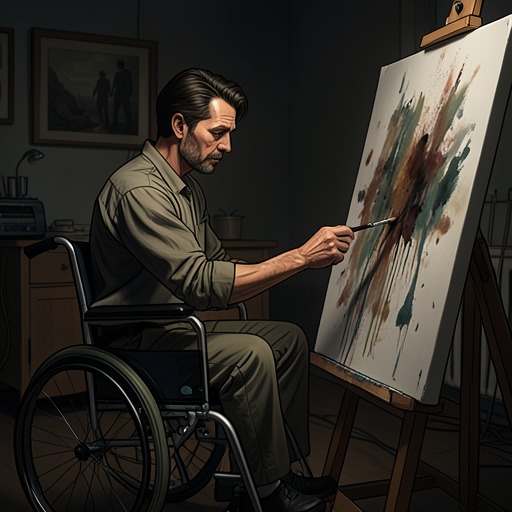
His proposed work will not repeat his earlier categories. He will not paint seascapes or portraits. Instead, he will paint emotion. Previously, his dramatic seascapes and beautiful beach sunsets evoked feelings through recognizable scenes in nature. Blindness prevents him from making such images to his own former standards, but it also directs him inward. He proposes to capture feelings on canvas as raw, shapeless movement and color, allowing the elements of painting to carry emotional force without visible images serving as emotional prompts.
The subjects he names are love, loss, hope, and sadness: experiences shared by people but not reducible to a particular landscape or face. His new method seeks to make shape and color carry their own power, with feeling no longer dependent on a visible scene. This is not presented as a return to the old Blake McGrath. It is a transformation of artistic purpose in which the loss of sight becomes a new perceptual and formal problem. He will attempt to paint what cannot be seen directly, using blindness not as proof that art has ended but as the reason to search for a different artistic language.
Disability, Practice, and Public Life
The narrative frames Blake’s blindness as a physical catastrophe and as a reorganization of ordinary action. When he first wakes completely blind on the last day of summer, terror and disbelief overwhelm him. He stumbles through the house, knocks over furniture, falls, and takes up the cane that eye specialists had given him years earlier, wielding it in anger like a sword. He finally makes his way to the beach through rain and physical collapse. His body initially experiences blindness as disorientation, dependence, and rage.
At the gallery, however, the cane and his practiced counting of paces become instruments of participation rather than symbols of defeat. Blake memorizes the distances around the art space and remains present while Connie handles the opening’s logistical problems. The contrast matters: blindness still imposes concrete limits, but the surrounding environment and the support of another person help him act within those limits. His future as an artist will require a new relation to space, materials, and audience rather than a denial that his sight is gone.
His return also emerges from a movement between grief-oriented and recovery-oriented actions. The sunset rose ritual, the empty beach, Ned’s nightly waiting, and Blake’s repeated memories of Chloe preserve an attachment that cannot simply be erased. Yet Blake also shares the story of his daughter’s death, permits Connie into the rooms and memories he had guarded, cleans Chloe’s bedroom, and allows his work to enter public life. The decision to paint again does not cancel Chloe’s memory or declare grief finished. It gives the surviving artist a way to carry that memory while re-entering time, work, and relationship.
Consequences and Significance
Blake’s announcement changes the meaning of the exhibition. What begins as the display of lost works and a portrait becomes the opening scene of a new career. The gallery validates the old paintings, but its audience also becomes the first public witness to the artist’s future direction. Connie’s dream of a gallery and Blake’s interrupted artistic life therefore meet in the same event: her institution supplies an audience, while his decision supplies the promise of new exhibitions.
The return to painting also completes the emotional movement initiated by the portrait. Blake had feared that he could make only one final image before blindness. By choosing to continue, he refuses to let the portrait remain merely a last testament. It becomes a threshold between the art shaped by sight and the art he hopes to create without it. Redemption shifts from recovering the past to accepting an unfinished future in which artistic desire still demands expression.
The final image is deliberately open. Blake tells the crowd that he will begin again on Monday and asks them to return to the gallery with their checkbooks when the new works are complete. The practical joke of selling future paintings places ambition, audience, and livelihood beside the language of grief. His statement that he has survived as a man and is about to make a comeback as an artist gives the return its double consequence: he has not been restored to his former life, but he has found a form of life after devastation. Blindness remains real, Chloe remains dead, and the ocean remains marked by trauma; nevertheless, painting once again becomes the means through which Blake can speak, work, and meet the world.