Blake's return to painting as a blind artist
The light house: A love storyBlake's return to painting as a blind artist is the story's final movement from artistic death toward renewal. His comeback does not restore the painter he was before Chloe's drowning or before his sight failed; it begins a different practice, one based on inward feeling rather than visible scenes. Announced unexpectedly at the opening of Connie Dixon Gallery of Fine Art, the decision turns blindness from a sentence of artistic extinction into the condition under which Blake discovers a new subject and method.
Causes and Background
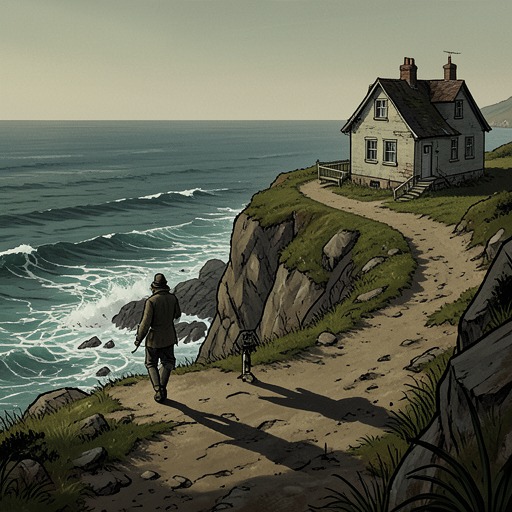
Blake's artistic crisis began with Chloe's drowning. The sea had made his career, but after it took his daughter's life he could no longer paint the ocean. He abandoned his art, turned his back on the world, and interpreted the loss through guilt and religious punishment, believing that he had not appreciated or loved Chloe enough because he had been immersed in painting. His grief remained active rather than resolved: he and Ned went to the beach at sunset to send a rose into the sea, while Ned returned each night to wait on the empty shore until sunrise. The lights of Blake's house were kept on day and night so that Chloe might find her way home, a local practice that caused fishermen to call the residence the light house because it could be seen for miles out to sea.
The second crisis was Blake's progressive loss of vision. He had first noticed blurring several years earlier but dismissed it when he was young and felt invulnerable; later he lost close-up focus even while his long-range vision remained usable, describing the process as though his eyes were dying from the inside out. He told Connie that he was going blind and that painting her was his last chance for redemption. The portrait therefore began as an act under a deadline: Blake expected that sooner or later he would wake up blind and wanted to complete at least one final painting before that happened.
Painting Connie also opened a path through grief. After he shared the pain surrounding Chloe's death, Blake felt a burden lift and sensed an older self rising from the darkness of despair, although the sorrow itself did not disappear. His recovery was consequently double-sided. The beach, the rose, Ned's vigil, and the light house preserved his continuing bond with Chloe, while Connie, the gallery, and the prospect of new work drew him back toward ordinary human participation. The movement is not a clean replacement of mourning with happiness; it is an oscillation between memorial devotion and renewed activity.
The Return and Its Public Announcement
The immediate public setting for Blake's comeback is the successful opening of Connie's gallery. Blind and carrying a cane, he moved slowly around the walls, counting paces and memorizing distances while Connie handled practical arrangements with the catering staff. His blindness altered how he occupied the exhibition space: he could not survey the room visually, but he learned it through movement, sound, and touch-like spatial memory. Inside the gallery, however, the collectors supplied another form of perception. He felt their faces close around him, heard their enthusiasm and congratulations, and experienced the paintings as objects becoming alive in the minds and imaginations of people who had traveled thousands of miles to see them.
The exhibition gave Blake vindication and satisfaction, while Connie's excitement rewarded his decision to allow the lost works and the new portrait to be shown. The public response also revived a hunger he had believed had dried up in his heart. The paintings had seemed dead without an audience, but the collectors' attention returned them to circulation and made Blake newly aware of his own unfinished artistic desire. The narration pauses over the possibility that the exhibition is not an ending after all, turning the gallery's success into the threshold of a second career.
Connie's speech formally credits Blake with making her dream possible, thanking him for permitting her to display his lost works and his new portrait. Blake then speaks from the heart, acknowledging that Connie entered his world during a difficult period and lifted him from despair through her love, laughter, passion, and persistence. He says he doubts he would be present without her. His return is therefore presented not as an isolated triumph of will but as the consequence of restored relationship, public recognition, and a willingness to let another person witness what he had kept private.
Painting Emotion
Blake had previously thought blindness marked the end of his art career. At the gallery, he reverses that judgment publicly and declares that he will begin painting again, not because he has recovered his sight, but because some part of him will always yearn to be heard without art. He specifies that he will return to the easel on Monday, establishing an immediate future beyond the closing scene and making the comeback a practical commitment rather than a momentary emotional promise.
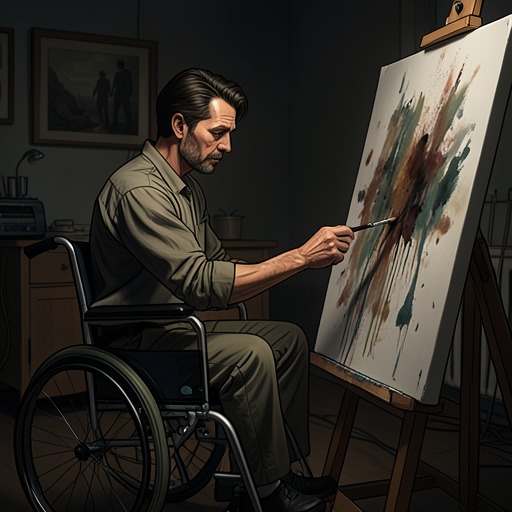
His new subject will not be seascapes or portraits. Before blindness, he painted scenes that evoked emotion through nature, including dramatic seascapes and beautiful sunsets across a beach. He now believes that he cannot recreate those visible effects to his own standards. What remains available to him is an inward mode of seeing: he can look inside and attempt to capture feelings on canvas as raw, shapeless movement and colors that embody feeling rather than merely illustrate an external scene.
Blake names love, loss, hope, and sadness as the materials of this new work. He wants shape and color to possess their own emotional power, without visible images being used to intensify or explain the response. The change is therefore both technical and philosophical. Blindness removes the visual reference system on which his earlier reputation rested, but it also forces him to distinguish between painting an image that produces emotion and painting emotion in a more direct, abstract form. His artistic comeback is a redefinition of the work's purpose, not an attempt to imitate his former paintings without sight.
Consequences and Significance
The collectors applaud Blake's announcement, and Connie responds with excited kisses, telling him that she knew he would paint again. The audience's disbelief gives way to sustained applause, making the private decision publicly ratified. Connie's gallery becomes more than a venue for selling old work: it becomes the institutional space in which Blake's future is announced and supported. Her dream and his vocation converge there, each making the other's renewal possible.
The event also changes the meaning of Blake's blindness. Earlier, blindness appeared to confirm his fear that punishment had followed artistic neglect and that his career had ended. At the gallery, he narrates it instead as an altered condition of creation. He remains blind, and the loss is not denied, but the disability no longer has the final word about what he can make or contribute. His cane, careful pacing, and memorized distances show the practical labor of adapting to blindness, while his proposed art shows a parallel adaptation of the imagination.
The comeback completes a chain of reversals. The ocean that once gave Blake his career and then became inseparable from Chloe's death no longer dictates that painting must cease. The house lights that once expressed a father's impossible hope that his daughter might return are joined by a gallery filled with living spectators. The rose ritual and farewell to Chloe do not erase the past; instead, saying goodbye allows Blake to carry the memory without remaining entirely imprisoned by it. His return to art thus grows out of mourning rather than denying it.
The closing judgment is deliberately twofold: Blake has survived as a man and is about to make a comeback as an artist. That distinction matters because his recovery is not simply romantic happiness or a miraculous restoration of sight. It is a renewed capacity to act, speak, work, and create within permanent loss. By choosing to paint emotion, Blake makes the inner realities that shaped his life—love for Connie, grief for Chloe, hope, fear, and sadness—the raw material of a future that blindness cannot extinguish.