Blindness
The light house: A love storyBlindness is the defining physical and existential crisis in Blake McGrath’s later life. It is not sudden at first: he has known for years that he has a progressive hereditary condition, and he has watched his close-up focus deteriorate while his long-range vision remains comparatively intact. Yet the diagnosis becomes more than a medical fact. For Blake, it threatens the artistic identity built through vision, intensifies his guilt over Chloe’s drowning, and forces him to decide whether art depends on sight or can survive through memory, feeling, discipline, and human connection.
Diagnosis and Concealment
Blake tells Connie Dixon that he is going blind only after she asks why he wants to paint again and why he has chosen her as his subject. He describes the disclosure as his last chance for redemption, joining the threatened loss of his sight to the moral burden he has carried since Chloe’s death. The hereditary nature of the condition gives it a fixed, frightening logic: there is nothing to be done medically, and its progress cannot be halted. Blake has noticed blurred vision for several years, but when he was younger he dismissed the warning, believing himself invulnerable. By the time he speaks to Connie, the deterioration has become unmistakable.
His fear is organized around a specific future moment: waking one day unable to see. He has begun reading extensively because he expects blindness to arrive, and he has brought canvases close to his face when signing them, gestures that retrospectively reveal how carefully he has been measuring the decline. He does not want Connie’s pity. Her sympathy feels constricting because it risks reducing him to a damaged man rather than recognizing the artist and grieving father struggling to remain intelligible to himself. His silence is therefore not simple secrecy; it is a form of control over a threatened identity.
Blindness, Grief, and the Sea
Blake interprets his worsening vision through the language of punishment. After Chloe drowned, he stopped painting the ocean, the subject that had given him his career, because the sea had become both his artistic source and the force that took his daughter. He then turned away from art and the world, believing that he had failed Chloe by being too absorbed in his work. When blindness begins to close in, he imagines that the same power is punishing him again for abandoning his gift. The physical condition thus becomes entangled with complicated grief, religious guilt, and the sea’s double role as muse and destroyer.
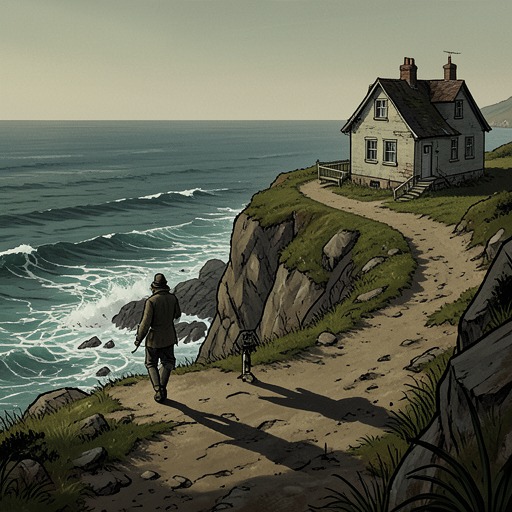
This connection is embodied in the rituals surrounding the house and beach. Blake and Ned go to the shore at sunset to send a rose into the sea, while Ned remains on the empty beach through the night, waiting for Chloe. Blake keeps every light in the Mason house burning day and night, so that fishermen can see it for miles and, in his imagination, Chloe can find her way home. The locals call the place the light house not because it is an actual lighthouse, but because its constant illumination turns private mourning into a visible landmark. Blindness gives this image additional force: as Blake’s own sight fails, he creates light for the daughter he can no longer recover.
The Moment of Total Loss
The anticipated catastrophe arrives on the last day of summer, when Blake wakes and realizes that the world has become completely dark. The event is shocking even though he has always known it was coming. His progressive loss has allowed him to prepare intellectually, but not emotionally; the actual blindness produces terror, disbelief, and an almost physical collapse of the world shared with Connie.
He announces the fact plainly: “Connie, I’m blind.” Then anger overtakes him. He moves blindly through the house, overturning furniture, stumbling over the sofa, breaking a glass, slipping on a rug, and crashing to the floor. In a closet he finds a cane that eye specialists gave him years earlier. Instead of treating it calmly as an aid, he wields it like a sword, striking the porch railing as he demands to know why this has happened to him. He kicks open the screen door, leaves Ned and Connie trembling, and makes his way toward the beach, falling repeatedly beneath a storm-dark sky.
The scene makes blindness a concrete alteration of bodily life rather than merely a symbolic sign. Furniture, rugs, glass, stairs, doors, and the porch railing become newly consequential. The cane changes from an overlooked object into an essential instrument, but Blake initially experiences it as an extension of rage rather than adaptation. His environment has not changed, yet its ordinary arrangement has become an obstacle course. The crisis therefore exposes both the medical loss of vision and the social and material labor required to live within spaces designed for sight.
Separation and Adaptation
After reaching the beach, Blake returns gaunt, unshaven, and physically drained, with his eyes appearing as dark hollows. He tells Connie that he wants her to leave, attempting to isolate himself at the moment when he most needs support. The request continues his old pattern of privacy and self-protection, but blindness makes isolation more dangerous and more painful. Connie’s presence represents both the threat of being pitied and the possibility of being accompanied through a new life.
Adaptation begins in practical gestures. Blake uses the cane, and when Connie drives him to Hoyt Harbor, he sits tensely in the passenger seat, unable to see the speed or gestures that once made the journey familiar. At the gallery, he moves slowly along the walls, counting paces and memorizing distances while Connie manages the practical demands of the opening, including an argument with the catering staff. His blindness does not remove him from public life; it requires him to learn a different map of that life. The gallery becomes a space he can inhabit through sound, measured steps, memory, and trust in Connie’s guidance.
The most important adaptation is emotional rather than logistical. Blake finally performs a last farewell to Chloe, kissing a rose, sending it into the waves, and telling her that she is loved and beautiful. He calls her a painting in his heart and says that he cannot continue grieving in the same way. When he walks back to the house, Connie embraces him, and they weep together. She then turns off the lights one by one, ending the light house ritual. This does not erase Chloe or sever Blake’s attachment to her; it changes the form of remembrance from an endless signal awaiting her return into a memory that can coexist with continued living.
Artistic Transformation
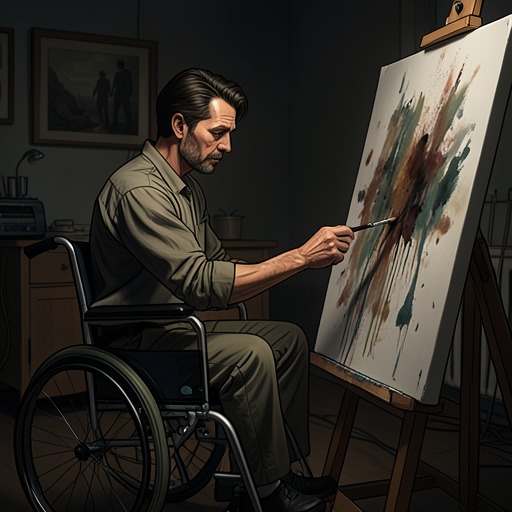
Before blindness, Blake believes that painting requires the visible world he once mastered, especially seascapes and portraits. He initially regards the loss of sight as the end of his career. Connie’s portrait begins under that pressure: it is his last chance to make a painting and to redeem himself before vision disappears. Yet the portrait also becomes the bridge between bodily loss and renewed artistic purpose, because Blake discovers that the work can be grounded in intimate knowledge and emotion rather than simple visual access.
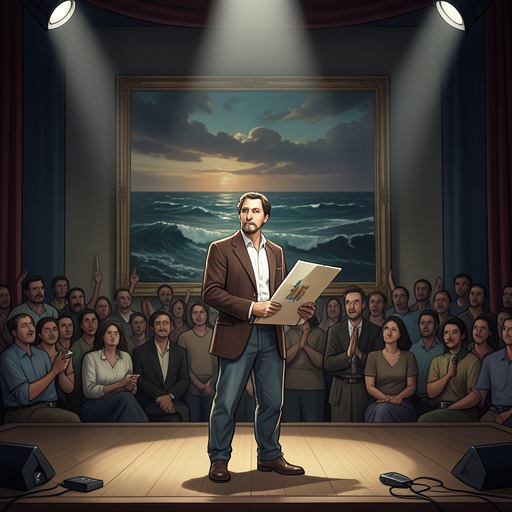
At the opening of the Connie Dixon Gallery of Fine Art, Blake publicly revises his understanding of what blindness means. He credits Connie Dixon with lifting him from despair through love, laughter, persistence, and passion, then announces that he will return to the easel. He will not attempt to reproduce seascapes or portraits according to his former standards. Instead, he will paint emotion: love, loss, hope, and sadness as raw movement and color, without visible images serving as the primary vehicle of feeling.
This declaration turns blindness from an ending into an artistic method. Blake does not claim that sight is irrelevant or that the loss is painless. He acknowledges that he can no longer paint the scenes he once created to evoke emotion through nature. What changes is the object of representation. The new work will seek feelings themselves, allowing shape and color to carry their own power. His public announcement therefore completes a movement from blindness as punishment, through blindness as devastation, toward blindness as the condition under which a different artistic language may begin.
Narrative Significance
Blindness gathers the novel’s central conflicts into one irreversible state. It exposes Blake’s dependence on the sea, his unresolved guilt over Chloe, his habit of isolation, and his fear that artistic worth is inseparable from physical ability. It also tests the relationship between Blake McGrath and Connie Dixon: her role is not to cure him or restore the sight he has lost, but to remain present while he learns new ways to move, work, remember, and speak.
The condition’s final significance lies in its paradox. It darkens Blake’s physical world while compelling him to look inward; it removes the medium through which he built his reputation while opening a new conception of painting; and it threatens to isolate him while making companionship indispensable. When Blake returns to painting as a blind artist, the story does not present blindness as magically overcome. It remains permanent, frightening, and materially demanding. Its transformation is instead ethical and creative: Blake stops treating the loss as proof that his life and art are finished, and begins to make a future from what remains.