Blindness as existential crisis and artistic transformation
The light house: A love storyBlindness as existential crisis and artistic transformation is the decisive arc of Blake McGrath’s late life. It begins as a hereditary, progressive physical condition and becomes, in his understanding, a moral judgment for Chloe’s drowning and his abandonment of painting. When sight finally disappears, the crisis destroys his former identity as a celebrated seascape painter; yet the same loss eventually gives him a new artistic purpose. The novel therefore treats blindness not as a simple defeat or a problem solved by courage, but as a rupture that forces Blake to renegotiate how he inhabits space, love, work, memory, and the future.
Diagnosis and Existential Meaning
Blake tells Connie Dixon that he is going blind and calls painting her his last chance for redemption. The disclosure explains why he has returned to the easel after years of silence and why the portrait carries stakes beyond professional recovery. His condition is hereditary and progressive, and he has known about it for many years. At first he dismissed the blurring of his vision because he was young and believed himself invulnerable; by the time he speaks to Connie, close-up focus is deteriorating even though his long-range vision remains comparatively intact. He describes the process as if his eyes were dying from the inside out, an image that makes the diagnosis feel both bodily and existential.
The predicted future is especially terrifying because it is definite but temporally uncertain. Blake does not know how long he has before complete blindness, only that sooner or later he expects to wake unable to see. He responds by reading extensively and by trying to make one final painting while visual precision remains available. His appeal to redemption also reveals the burden he has attached to art: painting is not merely employment or reputation, but the activity through which he might answer his guilt and prove that his gift has not been wasted.
Grief, Guilt, and the Loss of the Sea
Blake’s blindness is inseparable from Chloe’s drowning. After her death, he could no longer paint the ocean because the sea had first given him his career and then taken his daughter. He interpreted this reversal through a theology of punishment, believing that Chloe had been taken because he had failed to appreciate or love her sufficiently while absorbed in his art. His artistic hiatus thus becomes a form of self-sentencing: he turns his back on painting and withdraws from the world, treating creative silence as both grief and penance.
The house preserves that grief in repeated visual and spatial rituals. Local fishermen call the Mason house the light house because every light remains on day and night, visible for miles out to sea. Blake leaves the lights burning so Chloe might find her way home, while Ned, the Great Dane, goes to the beach at night and waits until sunrise. At sunset Blake and Ned send a rose into the waves, maintaining a continuing bond with the lost girl rather than allowing mourning to become a completed past. The rituals are directed toward the sea, the very force Blake both reveres as his muse and experiences as the source of trauma.
Blindness intensifies this moral and emotional structure. Blake fears that God is again taking revenge, this time making him blind because he has ignored his artistic gift. The condition becomes a cruel irony: the artist who abandoned the ocean is threatened with the loss of the sense through which he represented it. Connie’s response, that he can still paint, begins to separate physical sight from artistic possibility, though Blake cannot yet accept that distinction.
The Moment of Total Loss
On the last day of summer, the anticipated progression becomes an instantaneous catastrophe. Blake wakes and realizes that the world has turned to darkness; he is utterly blind. Although he has always known the loss was coming, knowledge does not soften the event. The certainty of the diagnosis becomes the shock of an accomplished fact, and his identity collapses with it. He tells Connie, “Connie, I’m blind,” then is overtaken by anger, terror, and grief.
His first response is physical and uncontrolled. He blunders through the house, overturning furniture, falling against the sofa, and knocking a glass to the floor. A rug slips beneath him, and he crashes painfully before forcing himself onward toward the studio. In a closet he finds a cane that eye specialists had given him years earlier; he wields it like a sword, an object intended to support navigation transformed into an instrument of rage. He kicks open the screen door, stumbles down the stairs, falls into the sand, and repeatedly drags himself toward the beach beneath a threatening storm sky.
The scene makes clear that blindness is not confined to the eyes. It reorganizes Blake’s relation to the house, the porch, the studio, the beach, and the people who inhabit those spaces with him. Connie is nearby but cannot reach him, while Ned cowers in confusion. Blake’s former mastery of the seascape gives way to uncertain movement through his own home. The cane, the counted distances, and the need for assistance later show the practical work of adapting to this altered environment, but the initial sequence presents adaptation as impossible because the emotional shock precedes any stable method of living.
From Dependency to Participation
After the crisis, Blake appears gaunt, unshaven, and drained of color. He turns away from Connie’s voice and asks her to leave, attempting to control the terms on which she will witness his damaged identity. His request is not merely rejection of companionship; it expresses fear that dependence and pity will replace the person he had been. Yet the later gallery scene shows a different relation to blindness. Blake carries his cane through the exhibition space, moves slowly along the walls, counts his paces, and memorizes distances. These actions convert an unfamiliar environment into a navigable one through touch, sound, memory, and deliberate spatial knowledge.
The gallery also reveals that blindness does not remove him from public artistic life. Connie leads him into the art space, where he listens to preparations and conversations while orienting himself physically. His inability to see the room does not prevent him from occupying it as an artist whose work is being shown. The environment becomes accessible through changed practices and through Connie’s assistance, not through the restoration of sight. The cane and the remembered layout function as practical means of participation, while the public event supplies a social setting in which Blake can redefine himself before others.
A small contrast sharpens this adaptation. During the drive to Hoyt Harbor, Blake senses that Connie is driving too fast and imagines her gesturing as she talks; he decides that it is a good thing he is blind. The thought is wry rather than triumphant, but it shows how blindness changes perception without eliminating Blake’s humor or intimacy with Connie. He can no longer share the visual world in the old way, yet he remains attentive to movement, voice, rhythm, and the personality of the person beside him.
A New Theory of Painting
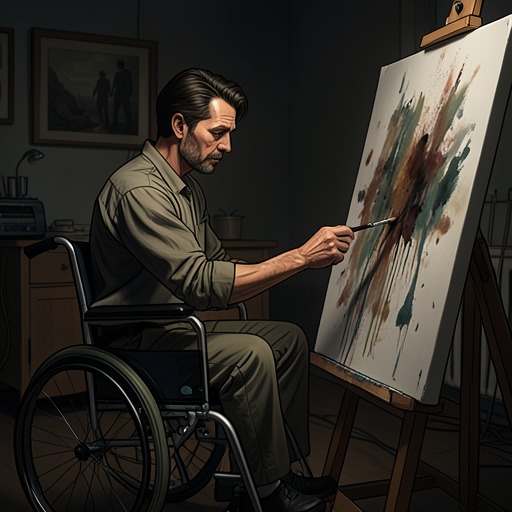
At the opening of the Connie Dixon Gallery of Fine Art, Blake publicly explains that he once thought blindness meant the end of his art career. He painted Connie’s portrait as an attempt at redemption, but the act leads beyond a final testament. He announces that he will return to the easel, not to repeat his former work but to pursue a new subject: emotion itself.
Before blindness, Blake painted scenes that evoked feeling through dramatic seascapes and beautiful sunsets across a beach. Those works made people feel through representations of nature. Once sight is gone, he believes he cannot reproduce such images according to his own standards. Instead, he proposes to look inward and capture love, loss, hope, and sadness as raw, shapeless movement and color. Shape and color will no longer serve chiefly as visible elements within a recognizable scene; they will carry their own emotional power.
This proposal is a transformation rather than a cure. Blake does not claim that blindness has improved his life or erased his grief. He accepts that the visual method central to his earlier career is no longer available, then asks what an artist without sight can make from the altered conditions of experience. His answer preserves the material practice of painting while changing its representational aim. The loss of external vision becomes an invitation to attend to inner feeling, though that invitation emerges only after terror, anger, and mourning have been fully confronted.
Resolution and Significance
Blake’s farewell to Chloe marks the emotional turning point that allows blindness and grief to coexist with renewed artistic purpose. At the beach he kisses a rose, throws it into the foaming waves, and tells Chloe that she is a masterpiece in his heart. He calls her his lost little girl, but also promises to stop waiting for her in the old manner and to celebrate her smile in sunshine and her laughter in the wind. When he returns, Connie embraces him, and together they weep. Inside the house, she turns off the lights one by one, ending the light house ritual that had kept the home permanently oriented toward a return from the sea.
The extinguishing of the lights does not erase Chloe. It changes the form of Blake’s continuing bond with her: from an active summons across the ocean to a memory he can carry while reentering life. In the same movement, blindness changes from an anticipated punishment into a condition within which Blake may still choose work, love, and public connection. His final declaration that he will paint emotion gives the crisis an artistic language, while his return to painting confirms that the career has not simply been restored but reimagined.
The narrative’s premise is consequently not that suffering automatically produces artistic insight. Blake’s blindness first deepens isolation and threatens to destroy him. Transformation becomes possible only through disclosure, shared grief with Connie, practical adaptation, farewell to Chloe, and a deliberate decision to make art under new conditions. By the end, Blake has survived as a man and is preparing to return as an artist. Blindness remains a permanent loss, but it no longer has the final word: it becomes the pressure through which a different practice, and a different self-understanding, comes into being.