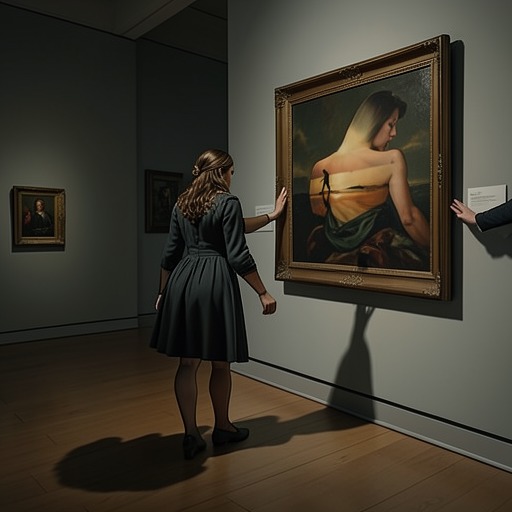
Connie Dixon
The light house: A love storyConnie Dixon is the story’s central transforming figure: a painter whose ambition has been suppressed by Duncan Cartwright, yet whose artistic intelligence, commercial skill, and capacity for emotional risk eventually help create a new life for herself and Blake McGrath. Her decisive significance lies in the way she converts escape into action. She comes to Hoyt Harbor carrying debt, disappointment, and a damaged dream, but leaves it not as someone rescued from passivity, rather as an artist, agent, gallery owner, and partner who has reclaimed the authority to choose what her life and work will become.
Identity and Background
Connie is introduced through a contrast between artistic vocation and social entrapment. At thirty, she had left Kansas for New York City with only a few months’ rent, an arts degree, and a desperate ambition to paint. Duncan Cartwright found her at a downtown studio and pursued her with the same ruthless determination he used to collect the beautiful possessions surrounding his flamboyant life. His attention initially appeared to offer entry into the art world, but the relationship gradually converted her talent and dependence into property.
Four years later, Connie’s dream has effectively been stolen. She has held no exhibitions, accumulated debt while Duncan continues to support her, and realized too late that he has bought her “body and soul.” The language of ownership defines the injury at the center of her character: her loss is not simply professional failure, but the erosion of self-determination. She remains connected to art, yet only through a life arranged by someone else.
She travels to Maine for two weeks, seeking escape and time to think while drowning in despair and debt, living without love, and fearing that her future will drain away the last of life’s mystery. Her arrival in Hoyt Harbor is therefore both geographical departure and moral threshold. She does not yet know what answer she seeks, but the sleepy coastal town diverts her toward Blake McGrath and an unexpected confrontation with the artistic life she believed she had abandoned.
From Escape to Agency
Connie’s first important act in Hoyt Harbor is an act of professional disguise. After seeing work associated with Bill Mason, she feels a thrilling recognition that she struggles to conceal, then gives the man her embossed business card and identifies herself as Connie Dixon, a representative of the Cartwright Gallery in New York. She claims to be in Maine looking for new artists, although this is a white lie. The deception is opportunistic, but it also reveals her genuine professional eye: she can recognize exceptional work before she understands the identity behind it.
Her controlled manners become part of her working method. She sits gracefully, smooths her dress over her knees, holds her handbag, and maintains a reserved expression even while excitement rises beneath it. This emotional discipline has a double meaning. It is a skill learned in the gallery world, where charm and composure carry commercial value, but it is also a survival strategy developed under Duncan Cartwright’s control. Connie repeatedly manages what she shows, what she conceals, and how much vulnerability a negotiation will permit.
The discovery that Bill Mason is really Blake McGrath changes the terms of her search. Blake’s concealed identity links the hidden paintings to a famous artist who has withdrawn from public life, and Connie’s attraction to both the work and the man intensifies her professional objective. She is captivated by what she sees, but the attraction is not merely romantic. Blake’s art gives visible form to the mystery and emotional force that her own life in New York has suppressed.
Connie’s return north becomes a conscious decision to start over. Her journey back to Maine is not simply a retreat from Duncan Cartwright or a return to a pleasant landscape; it is a movement toward a self she has not yet fully recovered. She negotiates over the two paintings she purchased for three thousand dollars, taking pleasure in the reversal of knowledge and power when their value proves very different from what she had believed. The transaction allows her to act with professional confidence, while also exposing the instability of an art world governed by reputation, secrecy, and possession.
Relationship with Blake McGrath
Connie’s relationship with Blake develops through a tension between desire and responsibility. She is bewildered by the request to remain near him, but secretly elated because the prospect promises more time together. At the same time, she recognizes that Blake has withdrawn into a darkness she may not be able to penetrate. She tells Ned that everything seems to advise her to leave because Blake has fallen too deeply into despair, yet she remains hopelessly attracted to him. Her conflict is therefore not between feeling and indifference, but between the wish to protect herself and the recognition that intimacy may require her to enter another person’s grief.
She gradually understands that Blake’s isolation is organized around Chloe. Blake and Ned go to the beach at sunset to send a rose out to sea, while Ned waits on the empty beach until sunrise for Chloe. Connie encounters grief not as a single confession that resolves the past, but as a repeated ritual involving the sea, the dog, the absent child, and the hours of darkness. Her response is compassionate without being naïve. She sees the depth of Blake’s tragedy and still chooses proximity, allowing attraction, sympathy, and professional purpose to become inseparable.
Connie also changes the emotional atmosphere of Blake’s house. When she leaves to collect the clothes and personal items left at the rental house, Blake dusts Chloe’s bedroom and changes the sheets; when Connie returns after lunch, she bursts through the door laughing, carrying a cardboard box and calling out that she is back. The contrast between the room’s memorial stillness and Connie’s noisy, delighted return marks her effect on Blake’s isolated world. She does not erase Chloe, but she introduces movement, interruption, and the possibility that the house can contain life as well as mourning.
Her professional proposal eventually becomes an intimate declaration. Connie tells Blake that she wants to exhibit his old paintings and wants to be his agent. The request offers him a route back into public artistic life, but it also gives Connie a legitimate way to remain beside him. Her business ambition and emotional desire are not presented as separate motives: she sees the exhibition as work, rescue, and a chance to build a shared future.
Confronting Exploitation and Recovering Art
Connie’s history with Duncan Cartwright must be spoken before her new relationship can become fully honest. She tells Blake that Duncan was her boss at the gallery where she worked and that, for four years, he also used her for sex. Her account identifies the relationship as sexual exploitation rather than a failed romance. Duncan’s support, professional authority, and possession of her work and body have been bound together, making independence difficult because the economic and sexual arrangements reinforce one another.
Her response to this history is neither immediate triumph nor simple confession. She weeps uncontrollably and, when Blake’s response threatens to turn the moment toward separation or judgment, says that she only wants him. The statement is emotionally exposed but also decisive. Connie chooses a relationship based on desire and mutual recognition rather than one imposed through money, status, and control.
The recovery of her own artistic identity begins when she realizes that her passion for painting never disappeared. The flame merely flickered beneath the damage Duncan Cartwright inflicted. She had substituted a new dream of owning an art gallery for the dream of becoming an artist because a gallery could keep her in the art industry without requiring her to make a living from her own work. The substitute dream is practical and intelligent, but its very practicality reveals how thoroughly coercion has narrowed her imagination.
Her first renewed painting becomes a concrete reversal. After a week, she steps back in astonishment, unable to believe the work came from her hand. It is not flawless, yet the leap between her earlier art and this new painting is so great that she cannot describe it. The importance of the work lies less in perfection than in recovered capacity. Connie discovers that the self Duncan tried to silence is not merely remembered; it can still produce something new.
The Gallery and New Beginning
Connie’s emotional energy soon becomes institutional action. After Blake’s studio work and their renewed closeness, she returns brimming with excitement, throws herself into his arms, and laughs. The following morning she phones the landlord, and the Connie Dixon Gallery of Fine Art is born. The gallery transforms a private hope into a public structure: Connie no longer depends on another person’s gallery, patronage, or permission to remain in the art world.
The gallery is also the practical form of her independence. It allows her to represent Blake’s work while creating a platform for other artists, and it turns the professional identity once attached to Duncan Cartwright into something bearing her own name. At its opening, Connie gives a speech thanking the attendees and describes opening the doors as the completion of a dream. She welcomes future exhibitions and insists that visitors will always be welcome. Her language presents the gallery not as a private collection or a monument to possession, but as an open social space built around access, continuity, and exchange.
That public welcome carries particular force because Connie’s earlier life has been defined by exclusion and control. Duncan’s world kept her economically dependent and artistically silent; the new gallery reverses that arrangement by making her the person who organizes opportunities. Her emotional labor remains visible in the event: she manages the crowd, speaks graciously, suppresses uncertainty, and creates a hospitable atmosphere. Yet this time the smiling composure serves an institution she owns rather than a man who owns her.
Connie’s achievement does not require her to abandon intimacy for independence. She builds a career while remaining emotionally involved with Blake, and she becomes his agent without reducing him to a commodity. Her agency is strongest when professional judgment, personal loyalty, and artistic conviction reinforce one another rather than being forced into competition.
Narrative Role and Significance
Connie functions as the story’s catalyst, investigator, negotiator, and witness. She identifies the value in hidden art, uncovers the connection between Bill Mason and Blake McGrath, challenges the conditions that kept Blake isolated, and converts private talent into public exhibition. Her actions repeatedly move the plot from concealment toward disclosure: she asks where the artist lives, pursues the truth behind the paintings, proposes an exhibition, reveals her own exploitation, and establishes a gallery under her name.
Her character also provides the clearest counterpoint to Blake’s paralysis. Blake experiences his seaside house as a prison even though Connie initially sees it as a piece of paradise. The opposing perceptions describe two different relationships to the same place: Connie reads the coast as an opening into possibility, while Blake reads it through grief as a confinement. Her presence does not magically dissolve his trauma, but it makes another interpretation of life imaginable.
Connie’s trajectory finally joins artistic recovery with ethical freedom. She begins as a woman whose dream has been bought, deferred, and nearly extinguished. She becomes someone capable of recognizing hidden value in another artist, choosing love without surrendering autonomy, recovering her own painting, and opening a gallery that completes a dream she had once treated as impossible. When Blake announces that he will begin painting again, his return is connected to the emotional and artistic world Connie has helped make possible, but the achievement remains reciprocal: she does not merely save him, and he does not merely restore her. Together, they turn damaged artistic lives toward work, relation, and a future that neither can possess through force.