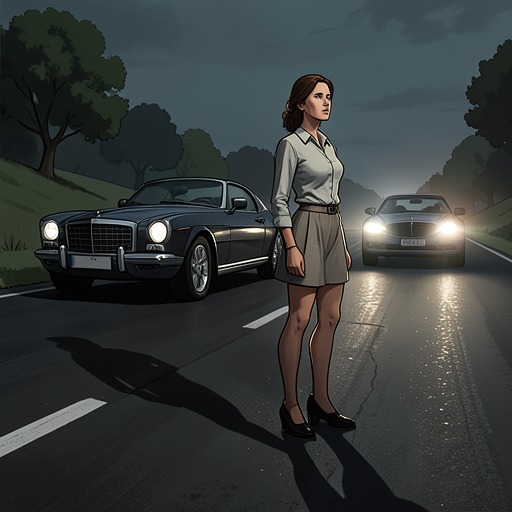
Connie Dixon throws away her phone
The light house: A love storyConnie Dixon throws away her phone at the point where psychological submission becomes an overt act of resistance. After reading three messages from Duncan without replying, she recognizes that his control has followed her ten hours from New York into Maine. The phone carries his reach, while her refusal to answer tests whether that reach still governs her. By hurling it from the moving car, she rejects the instrument through which his demands continue to enter her life and begins the break later identified with her escape from Duncan.
Causes and Background
Connie’s gesture is prepared by four years of domination rather than caused by a single quarrel. Duncan had promised to support her artistic career, arrange exhibitions, and make her famous, but he converted those promises into dependence. After taking her to bed, he continued to support her financially while her artistic ambitions withered; there were no exhibitions, only mounting debt and the belated realization that he had effectively bought her body and soul.
Her dependence was both professional and material. Connie worked at Duncan’s gallery, selling other artists’ work during the day, while surrendering herself to him whenever he demanded it. When she left the gallery the previous year, he forced her back by threatening to ruin her and to have her mother removed from the nursing home. His repeated accusation, “You owe me,” transformed assistance into a claimed debt and made her care for her elderly mother part of the mechanism binding her to him. The phone therefore represents more than communication: it is part of a continuing system of surveillance, guilt, financial leverage, and emotional possession.
What Happens
In the darkness of the car, Connie receives the soft chime of her cell phone and resists the instinct to snatch it up because she knows Duncan is calling. The messages produce a bodily response before she answers them: dread seems to wrap around her, her hands tremble, and she shuts the phone down without replying. Her silence is already an act of reckless defiance, but the device remains physically present, carrying the pressure of the man who has treated her as property.
Connie smudges tears from her eyes and sits in the dark, haggard and hollow, while the rising wind rocks the car and dirt rattles against the windshield. Seeing her pale reflection in the rearview mirror, she sets her jaw, lowers the window, and throws the phone into the night. The motion gives material form to a decision that had previously existed only as exhausted resistance. She then curses Duncan, but fear and regret arrive almost immediately. Before guilt can overwhelm her, she reverses the car, turns back onto the highway, and heads toward town.
Consequences and Aftermath
The discarded phone does not make Connie’s situation simple or safe. Her immediate return toward town shows how deeply Duncan’s threats and manufactured obligations have entered her behavior. The act is a rupture, not a completed escape: she still feels dread, still anticipates guilt, and still has to make decisions under the pressure of debt and her mother’s care. Its significance lies in changing the direction of agency. For once, Connie chooses an action that denies Duncan access instead of accommodating the demand he has imposed.
She has come to Maine for two weeks to escape and think because despair, debt, and the absence of love have made her future appear drained of mystery. She wants to make decisions while they are still hers and while she retains the last fragments of a will to be free. Her search takes her to the sleepy coastal town of Hoyt Harbor, where she does not yet know that fate will redirect her life. The phone’s destruction thus becomes the threshold between the controlled life she understands and the uncertain life she has not yet imagined.
Pattern of Liberation
The act gains its full force when set against the later escalation of Connie’s resistance. Duncan continues to use money, housing, and her mother’s nursing-home payments as threats, but she eventually refuses his demands directly. When he proposes that she work with him on a new Blake McGrath exhibition, she answers with loathing; when he strikes her after accusing her of lying, she returns to the briefcase and asks in an icy voice whether they have a deal for the painting. The phone is therefore the earliest visible instance of a pattern: fear remains, but compliance is no longer the only possible response.
The contrast with Blake McGrath’s later recovery also broadens the event’s meaning. Blake’s nightly descent to the beach with Ned and the red rose keeps him attached to Chloe’s death, while his eventual decision to say goodbye and return to painting converts grief into movement. Connie’s thrown phone similarly turns an instrument of control into a discarded object, creating space for a different future. At the public opening, Blake explains that blindness once seemed to end his art career, but that he will paint emotion again; Connie’s earlier gesture belongs to the same larger movement from imposed identity toward chosen action. The phone is gone, yet what it initiates is not silence for its own sake: it is the recovery of a voice and a life that Duncan had claimed as his own.