Connie asks to become Blake’s agent
The light house: A love storyConnie asks to become Blake McGrath’s agent at the moment when her personal escape from exploitation and her professional rebirth become inseparable. She returns to Blake’s home after leaving New York, losing her gallery job, spending much of the proceeds from two paintings on her mother’s care, and paying Warren Ryan an additional forty thousand dollars once she understands the paintings’ true value. Her proposal is therefore not a casual business arrangement: it is Connie’s attempt to follow her dream of owning a small gallery in Maine while seeking a relationship founded on candor rather than control.
Circumstances of the Request
Connie’s request follows a stark reversal in her life. Duncan Cartwright had once promised to support her artistic career and arrange exhibitions, but his promises became a means of possessing and controlling her. Over four years, her dream of recognition was replaced by gallery labor, debt, and coerced dependence. Against that history, her return to Blake carries a double purpose. She needs a client because she has chosen to build a new life around art, but she also wants to see the man whose paintings and emotional generosity have reopened a possibility she had nearly lost.
When Connie arrives, Blake is working beneath the open hood of an old truck, his hands black with grease. His transparent pleasure at seeing her again immediately complicates the supposedly professional nature of the visit. Inside the house, she pays back the five hundred dollars he had loaned her, making clear that she does not want their connection to rest on an unpaid debt. She also tells him that she has left New York and has effectively been fired from the gallery. Only five thousand dollars remain to her after caring for her mother and compensating Ryan for the paintings, and her rental in Hoyt Harbor will expire within a week. She admits that she may end up sleeping in her car, yet describes that possible hardship as the price of following her dream of owning a little art gallery somewhere in Maine.
The Proposal and Its Terms
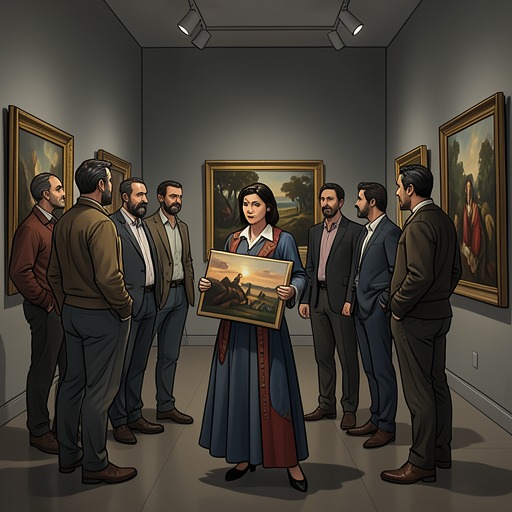
Connie finally states her plan directly: she wants to organize an exhibition of Blake’s old paintings and become his agent. Blake answers that he does not need an agent, a response that reflects both his withdrawal from the art world and his suspicion of professional motives. Connie counters that she needs a client. She reminds him that he had urged her to follow her dream and refuse anyone who tried to stop her, then asks him to give her the chance to turn that dream into reality.
The proposal is carefully limited. When Blake asks what she has in mind, Connie explains that she wants to show the paintings, not sell them and not profit from them, but exhibit them so that people can see them. This distinction matters because the paintings have already been entangled with money, secrecy, and unequal power. Connie presents exhibition as a form of public recognition rather than extraction. She wants Blake’s work to be seen, but she also wants to build a professional identity that is not dependent on an exploitative patron.
Her proposal also follows her conduct with Warren Ryan. After learning that the two paintings she had bought for three thousand dollars were worth far more than she had understood, Connie returns to Ryan’s office and offers an additional forty thousand dollars. The payment leaves her financially vulnerable, but it establishes a moral contrast between her dealings with Blake and the coercive transactions that shaped her earlier life. She will not claim ownership of another person’s labor merely because a bargain happened to favor her.
The Professional Mask Gives Way
Blake quickly suspects that business is not the whole reason for Connie’s return. He says that he had wondered why she came back and admits that he had hoped her motive was personal. Connie then acknowledges that she wanted to see him. When Blake questions whether she merely needed permission to show the paintings, she lowers her head before admitting the larger truth: she wanted to be near him. She still wants to exhibit his paintings because she believes the world deserves to enjoy them, but seeing him again matters most.
This confession transforms the request from an agency pitch into an act of emotional risk. Connie does not conceal the mixture of professional ambition and personal longing. Her words expose her to rejection on both levels: Blake can refuse the exhibition, and he can reject the intimacy that has brought her back. The request is powerful precisely because it refuses to separate the two parts of her life. Her dream is no longer an abstract ambition detached from feeling; it is bound to the people and place through which she has begun to imagine a future.
Blake’s reaction is guarded rather than decisive. He turns away so that Connie will not see the vulnerability in his expression and tells her to let him think. He then walks out with Ned, first down the porch steps and then toward the beach, pacing with his head bowed while the surf reaches his feet. His hesitation is not simple indecision. He recognizes that he has missed Connie and longed for her return, but he fears that grief and loneliness may have made his emotions unreliable. He also feels guilty because he encouraged her to pursue her dreams while the vow of secrecy surrounding his work contributed to her loss of employment.
Blake’s Grief and the Stakes of Trust
The request occurs within Blake’s continuing grief for Chloe. Ned’s nightly departure for the beach, prompted by the muted chiming of a clock, reveals how completely the household remains organized around mourning. Blake and the Great Dane go to the shore at sunset to send a rose into the sea, while Ned waits on the empty beach through the night for Chloe. Blake keeps the lights on in the lighthouse so that she might find her way home. These repeated actions show that his isolation is not emotional emptiness but an elaborate attachment to the dead.
Blake’s grief gives his decision about Connie unusual weight. Accepting her as an agent would mean allowing a stranger from the outside world into the protected space where he has concealed both his paintings and his identity. It would also mean risking a renewed attachment at the very point where his life has been structured around loss. Connie’s return forces him to move between two modes of existence: the solitary rituals of remembrance and the practical, social work required to bring art before an audience.
The next morning, while Connie retrieves her clothes and personal belongings from the rental house in Hoyt Harbor, Blake dusts Chloe’s bedroom and changes the sheets. Sharing his pain with Connie has not erased the grief, but it gives him an unexpected lightness and allows a sense of his former self to begin emerging. In this context, Connie’s proposal becomes more than a commercial plan. It offers a structure through which Blake may remain connected to Chloe without allowing remembrance to consume every possibility of living.
Consequences and Development
The request leads to a practical partnership as well as a deepening relationship. Connie begins planning a studio and gallery presence in Hoyt Harbor, eventually finding what she considers the perfect location: a shop on the main street, only a few doors from the grocery store. She returns to Blake overflowing with excitement, throws herself into his arms, and draws a map in the sand to explain the layout and her plans. Her enthusiasm becomes contagious; Blake studies the crude drawing and is drawn into imagining the project with her.
The partnership ultimately helps convert Blake’s concealed artistic past into a public future. At the opening of the Connie Dixon Gallery of Fine Art, Connie thanks Blake for allowing her to show his lost works and his new portrait, explicitly identifying his generosity as what made her dream possible. The exhibition therefore fulfills the promise implicit in her original request: she does not simply acquire a client, but creates a setting in which Blake’s work can return to public view and her own professional identity can exist independently.
Blake’s later speech confirms that the agency request has altered more than Connie’s career. He says that Connie entered his world during a difficult time and, through love, laughter, passion, and persistence, lifted him from despair. He explains that he had believed going blind marked the end of his artistic career, and that he painted Connie’s portrait in search of redemption. He then announces that he will return to the easel, not to repeat his old seascapes or portraits, but to paint emotion. Connie’s request thus becomes the first visible form of a mutual restoration: she gains a vocation and a gallery, while Blake regains an audience, a companion, and a reason to let the suppressed part of his art be heard.