Connie crashes while searching for Mason’s house
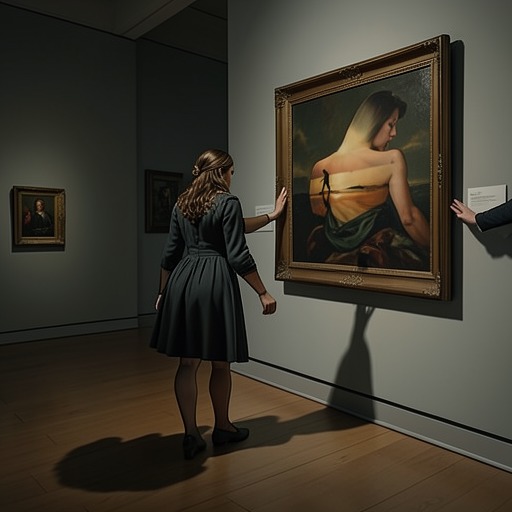
The light house: A love storyConnie crashes while searching for Mason’s house after choosing to trust her instincts and carry the hidden paintings toward an uncertain escape from Duncan Cartwright’s control. The journey begins with deliberate purpose: she packs the precious paintings into her suitcase between layers of clothing, emails their images to Duncan despite her reluctance, and drives south from the vacation rental while questioning whether the works are genuine masterpieces or merely the efforts of a talented amateur. The crash turns that gamble for freedom into an immediate struggle for survival and places Connie at the threshold of the discovery that will transform her life.
Causes and Background
Connie has come to Maine and to Hoyt Harbor seeking answers while drowning in debt, despair, and a life without love. She wants to make decisions while her will still belongs to her, and the paintings offer a possible solution: they may provide both financial independence and salvation from Duncan Cartwright’s obsessive hold. Her decision to follow the paintings rather than dismiss her intuition is therefore more than a business calculation. It is the first time she allows instinct and hope to lead her into the unknown, even while doubt follows her down the road.
The immediate destination is the isolated house associated with Mason, reached by way of Jellicat Road. Connie drives with one eye on the dashboard clock and the other on the road, mentally circling the unanswered questions surrounding the paintings and the mysterious man who created them. The journey’s emotional stakes are already divided between liberation and fear: the suitcase contains a possible future, but Connie cannot yet be certain that the art will bear the weight she has placed upon it.
The Storm and the Road
The weather changes abruptly as Connie drives. A cloud front passes overhead and plunges the road into eerie twilight; boiling black clouds gather, wind shrieks through the pine trees, and debris scatters across the blacktop. She switches on the headlights and reduces her speed as branches fall through the beams. Rain strikes the windshield, then becomes horizontal and forceful, making the road slick while the temperature drops sharply.
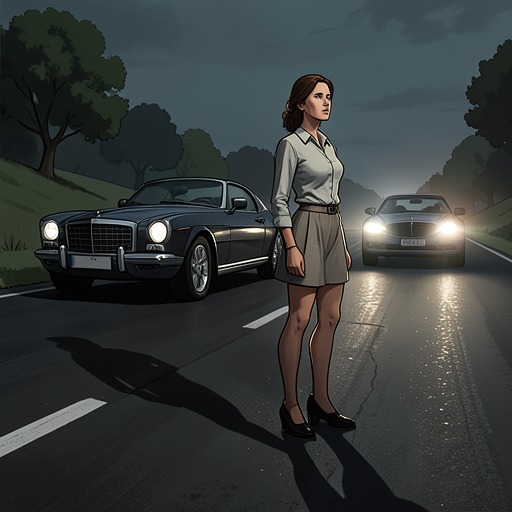
The storm also introduces a warning that Connie cannot fully interpret. She sees two hooded men beside a damaged vehicle, scraping shattered glass from the driver’s-side window, and wonders whether a fallen branch caused the damage. The sight foreshadows the road’s instability without giving her a clear explanation of what has happened. More than an hour of anxious driving follows before a bent sign emerges from the darkness. She reads “Jellicat,” recognizes the first turnoff, and continues into a night in which the rain finally becomes a torrential downpour.
Connie then realizes she has passed the turnoff by ten minutes. Searching for the green mailbox that marks the route, she brakes and feels the vehicle slide before the tires regain their grip. A tree branch drops from the darkness and crumples against the car’s trunk. She screams, clamps both hands around the steering wheel, and stamps on the brake pedal; the front end dips as the car loses speed. For a full minute she remains on the roadside with the engine idling, waiting for her trembling hands and shocked nerves to settle before attempting to move again.
The Collision
With no roadside lights to guide her, Connie nudges the car back onto the blacktop and soon identifies a clearing and a turnoff. She bumps onto a narrow, rutted track that twists through the storm. Rocky outcrops rise beside the vehicle, long grass and shrubs scrape along its sides, and the headlights bounce so violently that Connie is thrown about in her seat. Around her, the trees become stunted and the wind rises into a sustained, almost maniacal howl.
Somewhere beyond the roar of the weather, Connie thinks she hears the ocean. The sound draws the journey toward the coast even as it intensifies the sense of danger. She hunches over the wheel, takes a long curve cautiously, and then loses control: the car slides out from underneath her and crashes nose first into a ditch. The storm, the road, the darkness, and the unseen sea have combined into a force larger than her careful intentions.
The impact jars Connie’s back and snaps her head forward. Blood leaves a metallic taste in her mouth, and she finds herself trapped at an impossible angle, tilted forward and to the side, held in the seat only by the restraint. The crash changes the value at stake from professional opportunity and personal freedom to physical survival. The paintings that motivated the journey remain in the car, but Connie’s immediate problem is escape from the wreck.
Injury and Escape
Connie releases the seat belt and falls across the interior toward the passenger door. A white-hot pain shoots through her knee, making the injured leg useless. The passenger door is jammed against the side of the ditch, so she cannot leave through it. Crying from the pain, she pounds her fists against the door before forcing down the window and clawing her way through the narrow opening.
Her escape is both resourceful and desperate. She drags the damaged leg after her, tumbles onto her back in the mud, and looks up into the black, howling face of the storm. The effort exhausts the last of her strength, and she loses consciousness beside the wreck. The crash therefore ends not with rescue or revelation but with Connie physically removed from control of the car, the road, and the journey she had chosen for herself.
Consequences and Significance
Connie’s unconsciousness leads directly into the next threat: she awakens to the slobbering jaws and foul breath of a Great Dane hunched over her. The accident thus places her in the path of the animal associated with Blake McGrath’s isolated coastal life and brings her, through violence and vulnerability, to the hidden world she has been trying to locate. The crash is not merely transportation gone wrong; it is the threshold through which the mystery of the paintings becomes a lived encounter.
Its significance becomes clearer in retrospect. Connie’s decision to pursue the paintings eventually helps free her from Duncan Cartwright, but the route begins with uncertainty, material danger, and the possibility that her intuition may have betrayed her. The wreck makes that uncertainty bodily: her future is no longer an abstract gallery dream but a damaged knee, blood in her mouth, mud beneath her, and an unfamiliar animal over her face. Yet the accident also carries her toward Blake McGrath, whose grief is bound to the same coast. Blake later explains that he and Ned go to the beach at sunset to send a rose into the sea for Chloe, while Ned waits on the empty beach through the night; Connie’s arrival after the crash places her inside a landscape shaped by mourning as well as artistic concealment.
The journey’s aftermath ultimately contributes to a double movement of recovery. Blake later dusts Chloe’s bedroom and changes the sheets after sharing the pain of her death, sensing an old self beginning to rise from despair. Connie returns to Hoyt Harbor with a new life still without guarantees, carrying only her dream of a gallery, and eventually founds the Connie Dixon Gallery of Fine Art. At the gallery’s opening, Blake explains that he once believed blindness had ended his art career, but that Connie’s portrait gave him redemption and led him back to the easel. The Jellicat Road crash is therefore the story’s harshest early reversal: the failed car and injured body interrupt Connie’s controlled search, yet the wreck carries her toward the relationship, artistic truth, and renewed future that the journey was seeking before she understood their shape.