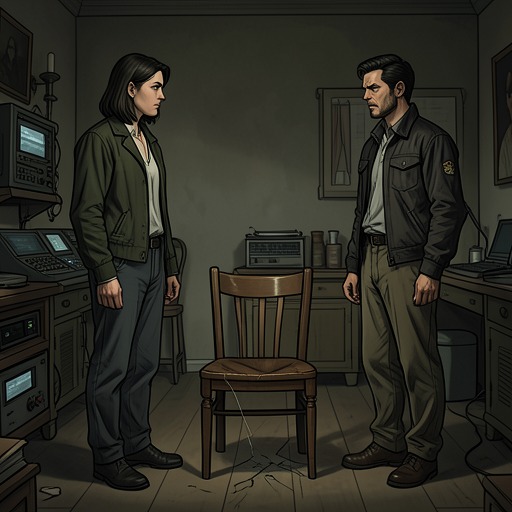
Duncan Cartwright's threatening call
The light house: A love storyDuncan Cartwright's threatening call is a pivotal act of coercive control in Connie Dixon's attempt to begin again with Blake McGrath. Duncan reaches her through the nursing home, weaponizes the early paintings she left behind, and uses sexual humiliation to remind her of the dependence he once imposed. The call fails to restore his authority: Connie refuses his version of their past, ends the conversation, and tells Blake the truth about the four years in which Duncan controlled her through money, employment, debt, threats, and sex.
Causes and Background
The call grows out of a four-year relationship in which Duncan promised Connie artistic recognition but never delivered the exhibitions he had used to attract her. Instead, he supported her financially until the support became debt, then demanded repayment through sex. Connie worked in his gallery selling other artists' work while surrendering herself to him on his whim; when she tried to leave, he threatened to ruin her and have her mother removed from the nursing home. His control therefore depended on more than personal desire. It joined economic dependence, professional authority, housing and care obligations, guilt, surveillance, and sexual coercion into a pattern that made resistance exhausting and escape seem impossible.
By the time of the call, Connie has begun building a different life with Blake at his home near Hoyt Harbor. After the first week there, she buys a new cell phone and gives the new number to Jean and to the nursing home. The replacement number is meant to mark a boundary between her former life and her present one, but Duncan defeats that boundary through deception. The threat begins not with a direct physical appearance but with the discovery that distance and a changed telephone number cannot by themselves end his reach.
What Happens
Connie is working at home when the phone rings. She runs to answer it, expecting the nursing home director and fearing news about her mother. Instead, Duncan greets her with sarcastic familiarity. When she asks how he obtained the number, he boasts that the people at the nursing home were gullible, making clear that he has exploited the institution responsible for her mother's care in order to locate her. Connie retreats to the kitchen while Blake's shadow moves in the studio, separating the threatening conversation from the man who is beginning to offer her safety.
Duncan says he wants to discuss Connie's paintings. He tells her that some of her early work remains in the basement of his gallery and claims that it is rubbish. He also says he has already thrown away the painting she once gave him as a birthday present. The contempt is calculated: the paintings represent Connie's former artistic ambition and the history Duncan helped suppress, yet he presents them as worthless objects under his control. He then changes from derision to command and tells her that he wants the remaining work removed or he will burn it.
Connie's response initially shows how effectively Duncan has trained her to manage threats. She agrees to come and collect the painting and the rest of the work, while thinking rapidly about arranging a courier from New York. Her concern is not merely financial. The paintings have little market value to her, but they function as landmarks along her life journey. Duncan's threat therefore attacks both her property and the fragile continuity of the self she is trying to recover.
Duncan then abandons even the pretense of discussing art. He says that he misses her in his bed and recalls her former sexual responses in deliberately degrading language. The move reproduces the old structure of his power: he treats coerced intimacy as mutual desire and attempts to force Connie to inhabit his account of the relationship. Connie rejects it without qualification. She says that she submitted because she had to, not because of love or passion, and that she went through the motions to survive while feeling revolted. She ends the call by hanging up and throwing the phone across the table.
Immediate Consequences
The call reactivates the misery Connie believed she had left behind, but it also produces a decisive act of verbal resistance. Duncan has tried to make her return physically for the paintings, psychologically to the role of his sexual possession, and emotionally to the guilt through which he once controlled her. Connie refuses each demand. Her promise to retrieve the work is a practical concession made to protect her paintings, not an acceptance of his authority, while her final answer strips his eroticized memory of its claim to truth.
The threatened destruction of the paintings also exposes the continuity between Duncan's earlier exploitation and his present intimidation. In the past he undermined Connie's career by promising exhibitions and withholding them; now he threatens the surviving evidence of that career. His violence toward art echoes his violence toward the artist, reducing both her work and her body to things he believes he can possess, judge, dispose of, or summon at will.
Disclosure to Blake McGrath
The call cannot remain a concealed burden. Connie tells Blake that Duncan was her boss at the gallery and that, for four years, he also used her for sex. She explains that she moved to New York to become an artist, had no money, and was discovered by Duncan, who told her she had talent and encouraged her to continue painting. He paid her bills until she was indebted to him, then began seeking repayment through sex. When he eventually told her she was not good enough to exhibit, he redirected her into work as a dealer for the gallery, turning the failed promise of artistic independence into another mechanism of dependence.
Connie's account also clarifies why she had been unable to leave. Duncan's support paid for necessities, including the care of her elderly mother, while his employment and threats narrowed her alternatives. She acknowledges that she was desperate enough to do whatever seemed necessary to fulfill her dream, but the disclosure does not treat that desperation as genuine consent. It identifies the circumstances in which economic vulnerability, professional hierarchy, fear of retaliation, and sexual demands were made to appear as a debt she owed.
Blake's reaction is silent and physical: he hears his own breathing, feels his pulse at his temples, and watches his hateful expression begin to crack. The scene changes the meaning of the call. What Duncan intended as a private reminder of possession becomes the occasion for Connie's honest testimony and for Blake's knowledge of the forces that shaped her past.
Narrative Significance
Duncan Cartwright's threatening call is the last major intrusion of his control into Connie's new environment, and its failure helps establish the conditions for her later independence. The episode contrasts two uses of communication. Duncan uses the telephone to bypass distance, deceive the nursing home, revive shame, and issue a threat; Connie uses the same exchange to name coercion, deny his false account of desire, and close the channel. Her thrown phone gives the scene a concrete image of a boundary being reasserted.
The episode also connects artistic recovery with the recovery of personal history. Connie wants the paintings because they mark stages of the life Duncan tried to take from her, not because they are valuable commodities. By preserving them and speaking openly to Blake, she begins to reclaim both her work and the meaning of her past. The threatened call thus stands between two gallery worlds: Duncan's gallery, where art and intimacy were folded into ownership, and the future Connie builds with Blake, where her artistic dream can become visible without being purchased through submission.