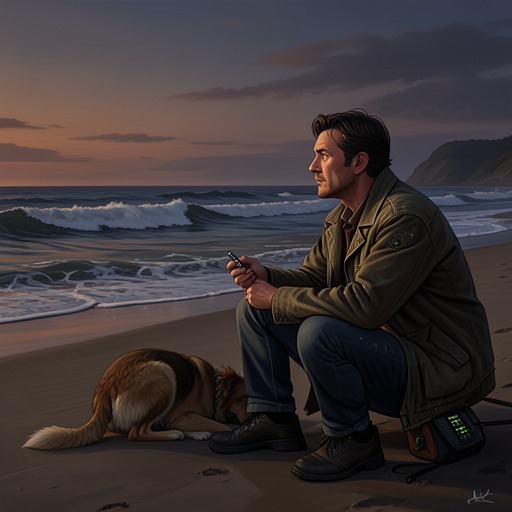
Great Dane
The light house: A love storyThe Great Dane is the huge black dog who first appears as a frightening presence over the injured Connie Dixon and then becomes the immediate agent of her rescue, companionship, and return to spontaneous pleasure. Known as Ned, the dog belongs to Blake McGrath and occupies more than a decorative place in the narrative: his alertness detects the crash, his obedience makes the dangerous encounter safe, and his later prank draws Blake McGrath and Connie Dixon into laughter and movement together.
Appearance and First Encounter
The Great Dane is introduced through Connie Dixon’s terror. After her car crashes during the storm and she crawls from the wreck with an injured knee, she loses consciousness in the mud. When she wakes, the dog’s slobbering jaws, foul breath, and foaming mouth fill her immediate field of vision. In the darkness, his massive body hangs over her with the menace of a black avalanche, so that an animal who is actually approaching as a rescuer is initially experienced as another danger.
The transformation comes through Blake McGrath’s command. When he reaches Connie Dixon with a flashlight, he tells the dog, “Back off, Ned,” and the Great Dane immediately takes two steps away and sits. Blake McGrath then praises him as a good dog, establishing both the animal’s responsiveness and the trust between them. The command changes the scene from apparent attack to controlled protection: the dog is powerful enough to terrify an injured stranger, but disciplined enough to yield instantly when Blake McGrath speaks.
Guardian and Rescuer
The Great Dane has already acted before Connie Dixon understands what is happening. Ned was walking with Blake McGrath along the beach when the sound of the crash sent him bounding into the woods. His movement leads Blake McGrath to Connie Dixon’s wreck, making the dog the first link in the chain that brings human help to her. Blake McGrath explicitly directs Connie Dixon’s gratitude toward Ned, explaining that the dog was the one who found her.
The dog’s size is repeatedly emphasized. He is a giant black Great Dane with a huge head and body, brown soulful eyes, and enough weight to make his presence physically unmistakable. Yet the narrative places that scale beside gentleness. Blake McGrath calls him “A gentle giant,” and the dog sits obediently beside him while Blake McGrath scratches behind his ears with casual affection. Ned’s strength therefore has two faces: it is alarming when Connie Dixon first wakes, but dependable when she is helpless in the mud.
Companion at Blake McGrath’s Home
Ned participates in Connie Dixon’s first fragile connection with Blake McGrath. After Blake McGrath carries her from the wreck, the Great Dane is present in the room, sitting on a mattress and watching her with brown, soulful eyes. Connie Dixon addresses him by name and thanks him softly; Ned responds by thumping the end of his tail, recognizing the sound. The exchange gives her a safe object of attention while she is still recovering from shock and pain, and it confirms that the dog recognizes her voice rather than merely tolerating her presence.
The dog’s relationship with Blake McGrath is likewise conveyed through routine and touch. Blake McGrath explains that he and Ned always walk along the beach at sunset, a habit that places the animal inside the secluded rhythm of the seaside household. Ned is not simply a guard stationed at the residence. He is Blake McGrath’s walking companion, sufficiently trusted to roam ahead, react independently to danger, and return to obedience when called. Their partnership helps define the isolation and self-contained order of Blake McGrath’s life.
Mischief and Emotional Release
Ned’s most memorable later action reverses the frightening impression of his first appearance. When Connie Dixon prepares to leave, the Great Dane comes down the porch stairs and leans against her. Blake McGrath says that Ned wants a pat and seems unhappy that she is going. Connie Dixon scratches behind his ears affectionately; the dog closes his eyes, stretches his hind legs, and accepts her touch with enormous relaxed weight. Her laughter at the sheer mass of him marks a small but important release from the fear, coercion, and exhaustion that have defined her recent life.
The tenderness abruptly becomes mischief. Ned snatches Connie Dixon’s purse from her fingers and runs toward the beach. His action is not described as aggression: he holds the purse lightly in his mouth, keeps his head high, and moves with prancing pride. He crosses the dry sand, reaches the tideline, turns with an excited wag, and continues south while Connie Dixon and Blake McGrath chase him. The dog’s great weight makes the ground seem to drum beneath his running legs, but the scene is comic rather than threatening.
The pursuit changes Blake McGrath as much as it entertains Connie Dixon. Blake McGrath loses his footing and rolls in the sand before getting up to continue the chase. Connie Dixon laughs beside him, and then Blake McGrath begins laughing too, startled by the unfamiliar sound of his own laughter. Ned’s theft thus creates an unplanned shared episode in which the guarded artist abandons composure, Connie Dixon runs ahead through the foaming wash, and both are temporarily released into bodily play. The Great Dane becomes the catalyst for a form of intimacy neither character could have produced through deliberate conversation.
Narrative Significance
Ned’s function is grounded in action rather than symbolism alone. He finds Connie Dixon after the crash, obeys Blake McGrath when her fear is at its highest, recognizes her when she thanks him, seeks her affection before her departure, and then engineers a comic chase that draws her and Blake McGrath closer. Across these moments, the same animal moves from apparent monster to gentle companion to mischievous participant, and the progression mirrors Connie Dixon’s changing understanding of Blake McGrath’s world.
The Great Dane also gives the secluded household a living social presence. His routines with Blake McGrath, independent response to the crash, sensitivity to Connie Dixon’s departure, and willingness to provoke play make him an active participant in the plot rather than a passive emblem of protection. His physical enormity repeatedly contrasts with his softness: the jaws that horrify Connie Dixon are controlled by a quiet command, the huge body that seems threatening becomes a source of comfort, and the animal’s strength finally produces laughter. Through Ned, danger and safety, isolation and companionship, and solemnity and joy are allowed to occupy the same figure.