Jellicat Road
The light house: A love storyJellicat Road is the isolated coastal route leading from Hoyt Harbor toward Blake McGrath’s property, a setting whose practical directions, local naming, and storm-darkened appearance turn an ordinary road into a threshold between Connie Dixon’s former life and the unknown future awaiting her. It is where curiosity becomes commitment, danger interrupts travel, and later memory transforms the same route into a test of whether the past still possesses the power to control her.
Route and Local Geography
Jellicat Road lies south of Hoyt Harbor, reached by following the coast for about an hour before turning off the main road. Thad Ryan gives Connie Dixon a sequence of precise landmarks: she must find the turnoff, drive another ten minutes, and look for an old green mailbox. The mailbox marks the track through the pine trees toward Blake McGrath’s property, whose gate begins land running directly down to the coast. The directions make the road feel less like a public thoroughfare than an access route into a hidden domain, one that locals know but outsiders must be taught to read.
The road’s remoteness also reflects the larger geography of the novel. Connie Dixon has come to the sleepy coastal town of Hoyt Harbor to escape despair and debt, reconsider her future, and recover the last fragments of her freedom. Jellicat Road extends that movement away from the town’s visible, social world and toward Blake McGrath’s private seclusion. Its destination is not simply a house but a place shaped by isolation, grief, and secrecy.
The Storm Journey
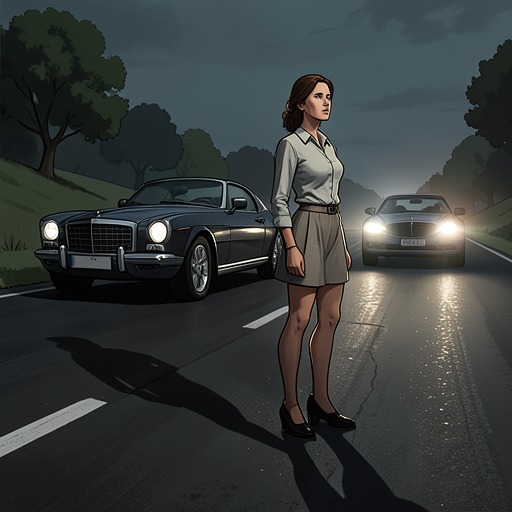
Connie Dixon first travels along Jellicat Road while pursuing information about Mr. Mason and the mysterious coastal property known locally as the light house. The journey becomes perilous as the weather changes: wind buffets the car, branches fall through the headlights, rain strikes the windshield, and the road turns slick beneath the tires. After more than an hour of anxious driving, she sees a bent sign bearing the name Jellicat and recognizes it as the first turnoff. Almost immediately, however, torrential rain reduces the world to a grey blur.
She realizes that she has passed the turnoff by ten minutes and brakes near the green mailbox. The car slides before gripping the road, while a falling branch crumples against its trunk and forces her to stop. For a full minute she remains in the idling vehicle, listening to the rain while her fear subsides enough for her hands to stop trembling. Darkness has erased the roadside lights, leaving only the road, the storm, and the uncertain turn into the trees. Jellicat Road therefore becomes the physical form of Connie Dixon’s decision to proceed despite incomplete knowledge: the route is dangerous precisely because she has chosen to enter a world whose rules and truths have not yet been disclosed.
Mystery, Memory, and Return
The road’s importance is intensified by the local story surrounding its destination. Thad Ryan explains that the residents call Blake McGrath’s house the light house because every light remains on day and night, allowing fishermen to see it for miles out to sea. No one knows why the lights are always burning. The unexplained landmark gives Jellicat Road an almost legendary endpoint, and the road becomes the path toward a mystery that is spatial before it is emotional.
After Connie Dixon has begun a new life, the same road changes meaning. Returning south along the coast in clear midday weather, she passes trees that were felled after the storm and recalls the night of her earlier journey. Even though the road is dry and the weather perfect, the memory makes her cautious for more than an hour. When she finally sees the sign for Jellicat Road and pulls off at the green mailbox, fear and panic overwhelm her again; she drives only a hundred yards along the dirt track before stopping. The road thus preserves trauma in its physical details. The sign, mailbox, trees, and turnoff are not neutral landmarks for her anymore but triggers linking the present to the terror of the first approach.
The Light House and Its Hidden Meaning
Jellicat Road leads to the house whose lights initially seem eccentric and whose isolation seems romantic from the outside. Connie Dixon describes the coastal setting as a piece of paradise, but Blake McGrath rejects that description, saying that the place feels like a prison. The contrast clarifies the road’s double character: to Connie Dixon it appears to lead toward escape, beauty, and possibility; to Blake McGrath it leads into a confinement built from grief.
The explanation of the lights transforms the entire route retrospectively. Blake McGrath reveals that he leaves them on so Chloe can find her way home. He and Ned go to the beach at sunset to send a rose into the sea, while Ned waits on the empty beach through the night for Chloe. The light house is therefore not merely a local nickname attached to a conspicuous building. It is a memorial beacon, and Jellicat Road is the landward approach to a system of continuing attachment composed of lights, beach, sea, dog, and rose. What first appears to Connie Dixon as an obscure destination becomes the center of Blake McGrath’s unresolved relationship with his dead daughter.
Narrative Significance
Jellicat Road operates as a threshold location rather than a passive backdrop. It separates the town where Connie Dixon is trying to begin again from the secluded house where Blake McGrath has suspended his life. Her first passage moves toward revelation through physical danger; her later passage forces her to confront the fear and memory left by that movement. The route’s recurrence gives the novel a clear spatial structure: the same landmarks remain, while Connie Dixon’s understanding of them changes.
The road also links private memory with communal naming. Local residents know the house as the light house, fishermen read its constant illumination from the sea, and Connie Dixon learns that its apparent strangeness is an expression of Blake McGrath’s grief. Jellicat Road carries her from public rumor to private truth. By the time Blake McGrath shares Chloe’s story and begins to imagine a future beyond the prison of the house, the road has come to signify not only arrival but the difficult passage from secrecy and traumatic repetition toward recognition, love, and a life that can continue without erasing the dead.