Ned
The light house: A love storyNed is Blake McGrath’s Great Dane and one of the most important nonhuman presences in the story. Initially introduced as a terrifying beast looming over Connie Dixon after her crash, he quickly becomes something more complex: a gentle giant, an intelligent responder to danger, a source of comic mischief, and the living companion through whom Blake McGrath’s grief for Chloe remains active. Ned’s loyalty gives the novel’s mourning its physical form. He waits, follows, nudges, retrieves, and returns to the sea, turning devotion into repeated action rather than abstract sentiment.
Identity and Introduction
Ned first appears through Connie Dixon’s fear. She awakens to slobbering jaws, foul breath, and a large dog hunched over her, its jaws foaming as she screams. The frightening image is immediately revised when Blake McGrath quietly tells him, “Back off, Ned,” and the animal obeys, taking two steps away and sitting. Blake calls him a “Good dog,” establishing that the apparent threat is governed by discipline and trust rather than aggression.
Ned’s size remains part of his presence. Blake McGrath describes him as a “gentle giant,” and the dog responds to a snap of the fingers by leaving his bed and sitting obediently beside him. Blake explains that Ned heard the crash while the two of them were on the beach; the dog bounded into the woods, where Blake saw Connie Dixon’s headlights. Ned therefore enters the plot as the agent of discovery who makes Connie Dixon’s rescue possible before Blake McGrath fully knows who she is or what she will mean to his life.
Rescue, Protection, and Mischief
After finding Connie Dixon, Ned contributes to her rescue in a practical and intimate way. Blake McGrath places the strap of her handbag over the dog’s head, lifts Connie Dixon into his arms, and carries her while Ned accompanies him. The sequence distributes protection between man and animal: Blake McGrath supplies physical strength and human care, while Ned’s intervention has brought the injured stranger to him.
Ned’s behavior also prevents him from becoming merely solemn or symbolic. When Connie Dixon scratches behind his ears, he closes his eyes and stretches out his hind legs; his enormous weight makes her laugh, and she runs her hand down his back while his jaws hang slack. Then the dog abruptly snatches her purse and runs toward the beach. He crosses the dry sand, reaches the tideline, turns with an excited wag, and trots south with the purse lightly held in his mouth, his head raised in prancing pride. Connie Dixon’s judgment that “Your dog is the devil” records the comic counterweight to his mournful loyalty.
The household treats Ned as a familiar emotional presence. He sleeps on his bed, thumps his tail when Connie Dixon scratches him, and rolls over so that she can scratch beneath his chin while his huge brown eyes turn upward with pleasure. At other moments his aging body is unmistakable: he rises stiffly through his hind legs, and later walks on arthritic legs. His physical decline makes his persistence more consequential, because the vigil he undertakes is not effortless instinct but a costly expression of attachment.
Companion to Blake McGrath’s Grief
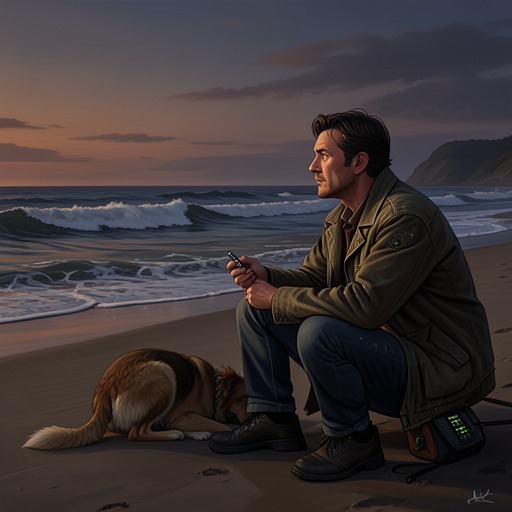
Ned’s deepest relationship is with Blake McGrath, whom he accompanies in the rituals surrounding Chloe. At sunset, when Blake McGrath recognizes the changing sky and takes a single red rose from the house, Ned rises from his bed and waits. Connie Dixon watches the man and dog cross the sand together toward the water, their shared solitude appearing to surround them like a cloak of grief.
Blake McGrath wades into the surf, kisses the rose, and throws it beyond the first breaking wave. He and Ned then stand beside one another until the tide carries the flower away. The ritual is not Blake McGrath’s alone. Ned’s presence makes it a shared observance, and his repeated participation joins animal fidelity to human remembrance. Blake McGrath later explains that he and Ned send a rose into the sea at sunset because they are waiting for Chloe; Ned goes to the beach each night and sits until sunrise, expecting her return.
The house itself extends this waiting. Blake McGrath leaves every light on so that Chloe can find her way home, while Ned keeps watch outside. The local explanation for the house’s name, the “light house,” is that fishermen can see its lights for miles out to sea. What begins as a community nickname becomes, through Blake McGrath’s explanation, a private signal of hope. Ned’s vigil and the illuminated house form parallel gestures: one waits on the shore, the other calls from land toward the absent child.
Ned’s loyalty is explicitly resistant to weather and reason. At nine o’clock he rises and goes onto the porch to begin his nightly watch, appearing docile and unmoving “as a sphinx.” When a storm comes, Blake McGrath says that Ned will not move because his loyalty will not permit him to forsake Chloe, even on such a night. The dog’s stubbornness is therefore both bodily and ethical within the story. He cannot be persuaded by evidence that Chloe is absent; fidelity has become his way of remaining attached to her.
Relationship with Connie Dixon
Ned’s relationship with Connie Dixon changes from terror to affection. He first confronts her as a nightmare at the moment of greatest vulnerability, yet he is also the creature responsible for finding her after the crash. Once she is safe in Blake McGrath’s house, he accepts her touch and begins to lean against her. He recognizes her when she walks toward him on the beach, and she comes to understand that the apparently frightening animal is grieving alongside Blake McGrath rather than threatening her.
This recognition becomes especially important when Blake McGrath lashes out during his crisis. He kicks open the screen door and cries, “Why me?” while Ned cowers, confused by the anger. The Great Dane then slinks toward Connie Dixon with his head lowered, and both woman and animal tremble. Ned is not a passive emblem in this scene: he registers Blake McGrath’s violence, retreats from it, and seeks proximity to Connie Dixon. His movement helps expose the emotional damage produced when grief turns outward, while his vulnerability allows Connie Dixon to see him as a fellow sufferer rather than as an instrument of Blake McGrath’s household.
Vigil, Farewell, and Narrative Significance
Ned’s vigil persists until Blake McGrath is finally able to change its meaning. At the last sunset, Blake McGrath and Ned walk forlornly to the beach with the final red rose. Blake McGrath walks stiffly, and Ned nudges him with his shoulder whenever he veers, physically guiding the man toward the water. The dog is now both mourner and guide, assisting Blake McGrath as Blake McGrath approaches the farewell he has been unable to speak.
Blake McGrath tells Chloe goodbye and assures her that her father loves her, that she is beautiful, and that she has been loved deeply. He ends by calling her his “little girl lost.” Ned’s presence beside him gives the farewell a continuity with the earlier rituals, but the spoken goodbye introduces a decisive difference: the rose is no longer only an attempt to summon Chloe home. It accompanies an acknowledgment of loss. Ned does not abandon Chloe; rather, his companionship allows Blake McGrath to transform waiting into remembrance.
Ned also helps define the novel’s larger movement from isolation toward renewed life. He shares Blake McGrath’s periods of withdrawal, accompanies him to the beach, and remains attached to the dead, yet he accepts Connie Dixon’s touch and becomes part of the household’s emerging intimacy. His conduct embodies grief as a repeated oscillation between loss and continued participation: he keeps watch, returns from the shore, sleeps, plays, comforts, and guides. In that sense, Ned is not simply a symbol of Blake McGrath’s sorrow. He is an active companion whose loyalty makes survival possible while preserving the bond with Chloe that Blake McGrath must finally learn to carry into the future.