Redemption through art
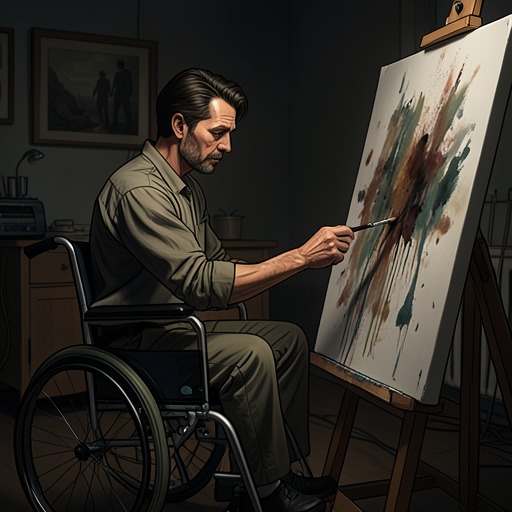
The light house: A love storyRedemption through art is the novel’s central account of how making an image can become an act of moral reckoning rather than merely a professional achievement. Blake McGrath turns to Connie Dixon’s portrait while facing progressive blindness and the unresolved guilt surrounding Chloe’s drowning; the painting is first conceived as a final act of atonement, then becomes the threshold through which grief, love, and artistic identity can be reorganized.
The Portrait as a Last Chance
Blake offers Connie an exhibition of his old paintings, but the offer carries a condition: he wants to paint her. Connie recognizes that the request cannot be separated from the private pain Blake has kept sealed away. He remains still while considering what would be risked by exposing his grief and secrets, and finally tells her, "Connie, I’m going blind," before identifying the portrait as his last chance for redemption. The proposed work therefore has two immediate stakes. It must preserve something of Blake’s artistic vision before his sight disappears, and it must force him to confront the history he has treated as a private burden.
Blake explains that his vision first began to blur several years earlier and has progressively deteriorated, with close focus failing even while long-range sight remains comparatively clear. He fears waking one day blind. His reading and his effort to bring his face close to canvases are practical signs of this narrowing future, while the portrait becomes a race against the loss of the faculty on which his career was built. The work is not undertaken because he has recovered confidence. It is undertaken because time is running out.
Grief, Guilt, and the Sea
The redemption Blake seeks is inseparable from his belief that he may have failed Chloe. He wonders whether he loved or cherished her sufficiently, whether turning away from his gift repeated the same moral failure, and whether blindness is connected to that abandonment. He cannot establish that this is true, but the uncertainty itself governs his interpretation of his life. The portrait is consequently described as his salvation: not a medical cure and not a promise that the past can be reversed, but a desperate attempt to make his damaged inner life morally coherent.
His grief is enacted through recurring rituals at the sea. At sunset, Blake and Ned go to the beach and send a rose into the water; Ned then remains on the empty shore through the night, waiting for Chloe. The house’s lights are kept burning day and night, so local fishermen can see the Mason house for miles out to sea. Blake explains that he leaves them on so Chloe can find her way home. The light house thus embodies a continuing bond with the dead: it is a beacon of welcome, but also evidence that Blake has not permitted the absence to become final.
The paintings extend that bond into the public world. Blake added a beautiful raven-haired young woman to five works, imagining how Chloe might have looked if she had grown up, and sent the paintings into the world in hope that she might one day recognize herself and know that she had been remembered and loved. Art preserves a possible adult Chloe where life cannot. At the same time, it keeps Blake inside an imagined encounter with a daughter who cannot return, making creation both memorial and repeated exposure to loss.
From Repetition to Farewell
Blake’s movement toward redemption does not proceed in a straight line. While Connie is away collecting her clothes and personal belongings from the rental house, he dusts Chloe’s bedroom and changes the sheets. The act gives him an unexpected sense of lightness: the grief remains, but an older self begins to surface from despair. This domestic act marks a recovery-oriented movement alongside the loss-oriented rituals at the beach. He does not abandon Chloe; he begins to make room for life without treating that room as betrayal.
The decisive separation comes after Blake’s sight fails completely. He reacts with rage, crashes through the house, takes up the cane stored in a spare-room closet, and wields it like a sword before stumbling into the rain and making his way toward the beach. The cane is at once an aid to navigation and an emblem of the new bodily condition he cannot yet accept. His blindness exposes the limits of a redemption founded only on the completion of one final portrait: the work may be finished, but the wound remains.
Connie’s presence makes another form of testimony possible. At dawn, after they cling to one another in the water, Blake says that he must tell Chloe the one thing he could never say: goodbye. At sunset he carries the last red rose to the shore, kisses it, and throws it into the foaming waves. His farewell acknowledges Chloe as his beloved daughter, affirms that he has loved her deeply, and declares that he will no longer wait for her return. He will instead celebrate her smile in sunlight and listen for her laughter on the wind. The ritual does not cancel memory; it changes memory from an instruction to remain suspended in grief into a relationship that can coexist with continued living.
When Blake returns, Connie waits on the porch and the two weep together. Inside, she turns off the lights one by one until the old home sleeps and the light house is no more. The extinguishing reverses the earlier signal to Chloe, but it is not a denial of love. It is the material sign that Blake has relinquished the vigil and accepted that farewell must replace perpetual summons.
Public Reawakening
At the gallery opening, Blake initially treats blindness as the end of his artistic career. With his cane in hand, he moves slowly around the walls, counting paces and memorizing distances while Connie manages the practical disorder of the event. His navigation shows that participation now depends on adaptation, spatial memory, and assistance rather than on the disappearance of impairment. The gallery is therefore not simply a place where his former identity is displayed; it is the environment in which a changed artistic life becomes possible.
Blake’s public speech changes the meaning of the portrait. He explains that Connie entered his world during a difficult period and that her love, laughter, passion, and persistence lifted him from despair. He then admits that he believed blindness marked the end of his art career and that he painted Connie’s portrait because he wanted redemption. Yet the public declaration produces an unexpected reversal. He announces that he will return to the easel, not because he has recovered his old career and not to resume seascapes or portraits, but because without art a part of him will always yearn to be heard. His new subject will be emotion.
This decision does not erase the original motive. Blake has not discovered that blindness was harmless, nor has he ceased to mourn Chloe. Instead, redemption evolves from a final accounting into an ongoing practice. The portrait allows him to face the possibility of loss; the farewell allows him to release the vigil; and the gallery gives the result a communal form. What was once a private plea for salvation becomes a renewed commitment to make art under altered conditions.
Artistic and Ethical Significance
The concept joins three forms of recovery that the plot keeps in tension: recovery from complicated grief, recovery of a relationship with the living, and recovery of artistic speech. Blake’s old paintings and the new portrait connect private suffering to public exhibition, but the narrative refuses to define redemption as commercial success or restored physical ability. His first motive is explicitly not a new career. He seeks to square his soul, and only later recognizes that art remains necessary even when its former methods and expectations have become impossible.
The concept also depends on the contrast between concealment and disclosure. Blake’s isolated house, permanently lit for Chloe, protects his grief by turning it into ritual. Connie’s request for an explanation makes the hidden logic of the portrait speakable. Once Blake tells her about his blindness, guilt, and the beach ceremonies, the portrait becomes an act witnessed by another person rather than a solitary bargain with the dead. Connie does not redeem him by replacing Chloe; her persistence enables him to re-enter relation, and their shared mourning gives the farewell a human witness.
Finally, the novel presents art as a form of continued connection rather than simple closure. Blake imagines Chloe in the paintings as the young woman she might have become, and later describes her as a painting in his heart, a masterpiece perfected by memory. Such imagery keeps loss aesthetically present even after the lights are turned off. Redemption therefore means neither forgetting Chloe nor declaring the wound cured. It means carrying love forward without allowing the dead to dictate every future action, and allowing artistic creation to transform grief from a closed room into a language capable of reaching other people.