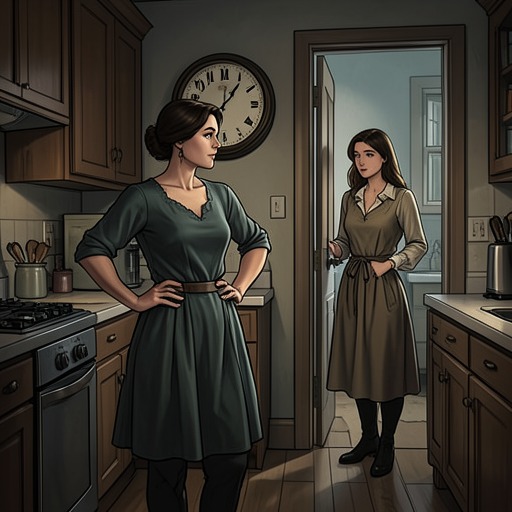
Ruth Dixon
The light house: A love storyRuth Dixon is Connie Dixon’s elderly mother, a physically fragile but fiercely vivid woman whose care gives the novel’s struggles over money, coercion, and artistic freedom their most immediate human stakes. Confined to a nursing home after a fall at Jean’s home, Ruth depends on regular payments that Connie and Jean can barely sustain; yet she is not presented as a passive burden. Her humor, defiance, and instinctive reading of Connie’s unhappiness make her both a vulnerable dependent and a source of emotional truth.
Identity and Circumstances
Ruth lives in a nursing-home facility outside Exeter, Maine, supported by a monthly withdrawal from the joint account shared for her care. The bank explains that the account has instructions for that payment and no other withdrawals, while warning that another payment is due soon and that insufficient funds would produce additional charges. Connie and Jean have been contributing every week since Ruth fell at Jean’s home three years earlier. Their deposits cover the facility’s fees with little left over, making Ruth’s continued care a persistent financial pressure rather than an abstract family obligation.
The nursing home itself carries an unsettling emotional atmosphere. Set beneath leafy trees, with manicured gardens and a duck pond, it appears idyllic from outside; inside, Connie experiences it as suspended between a hospital and a funeral parlor. Ruth’s placement therefore embodies the uneasy boundary between care and decline. The setting promises safety and companionship while reminding visitors that its residents are approaching the end of life.
Character and Conduct
Ruth’s body is described as tiny and withered, with arthritic hands, a stooped frame, and a face marked by the creases of a long life. Her bright, glittering eyes behind steel-framed glasses contradict the apparent weakness of the rest of her body. When Connie arrives, Ruth lifts her arms joyfully for an embrace, then thrusts a gnarled middle finger at the receptionist. The gesture immediately establishes her refusal to let frailty become submission.
The nursing-home director reports a catalogue of Ruth’s misconduct: she pinched a male nurse, was found with a can of beer in her room, and attacked the facility’s cat, Mr. Snuggles. Ruth responds to the cat with continuing hostility, threatening to kick it if she catches it. These incidents give her a comic, unruly vitality, but they also show how she preserves agency within an institution that regulates nearly every part of her life. Her resistance is mischievous rather than organized, yet it keeps her from being reduced to an obedient patient.
Ruth’s humor also distinguishes the nursing home from Jean’s household. When Connie suggests that Ruth might return to live with Jean, Ruth reacts with horror, saying that Jean has no sense of humor and recalling that she might have thrown herself down the stairs had she not already fallen there. The remark is exaggerated and darkly comic, but it communicates a genuine preference: Ruth would rather remain in an institution than surrender the irreverent companionship that defines her relationship with Connie.
Relationship with Connie Dixon
The bond between Ruth and Connie is expressed through physical tenderness and easy banter. Connie hugs her mother, kisses her cheek, and feels the weakness of her body beneath the dress and cardigan. Ruth, in turn, clasps Connie’s hand. Their hour together consists largely of purposeless conversation, but that lack of practical aim is itself significant: after Connie has endured manipulation, debt, and sexual exploitation by Duncan Cartwright, simple companionship with Ruth offers a relationship not organized around payment or possession.
Ruth nevertheless sees through Connie’s efforts to conceal her distress. She asks whether Connie is still involved with Duncan Cartwright and dismisses him as no good for her. When Connie says that the relationship is over, the admission comes out with surprising ease and carries resentment rather than regret. Ruth does not force a confession or demand an explanation; her importance lies in recognizing the truth that Connie has been struggling to articulate. She reads the relationship through Connie’s face and eyes, insisting that the way a man treats a woman becomes visible in the woman herself.
This intuition makes Ruth an ethical counterweight to Duncan Cartwright. Duncan defines his connection with Connie through ownership, reminding her that she owes him for everything he has done and threatening to cut off Ruth’s nursing-home money and remove Connie from the apartment he pays for. Ruth’s care is therefore made into an instrument of coercion. The mother whom Connie loves becomes the leverage by which Duncan maintains control, while Ruth’s recognition of the damage helps Connie separate genuine filial responsibility from the abuser’s manufactured debt.
Financial Stakes and Consequences
Connie’s decision to withdraw two thousand dollars from the nursing-home joint account in Maine marks the dangerous intersection of Ruth’s care and Connie’s attempt to escape. Connie uses the money to buy two paintings, believing that the purchase will eventually ensure that Jean and Connie will never again have to worry about their mother’s care. Jean initially reacts with horror because the money is needed for the next payment, and the beauty of the painting cannot immediately cancel the practical danger.
The gamble succeeds when Connie sells one of the paintings to Duncan Cartwright for two hundred ninety thousand dollars transferred to the account for Ruth’s ongoing care, plus five thousand five hundred dollars in cash. The transaction transforms art from a private risk into a means of securing familial survival. Connie later arranges for Jean to transfer forty thousand dollars into her own account, leaving a quarter of a million dollars to cover Ruth’s continuing nursing-home expenses. Jean’s burden of work and worry is lifted, and the money that Duncan once used as a threat becomes a resource placed beyond his control.
Ruth does not personally direct this financial reversal, but her need gives Connie’s defiance its concrete urgency. Connie is not merely reclaiming a career or rejecting an abusive relationship; she is trying to protect her mother without remaining economically captive to Duncan Cartwright. The story consequently frames care as both an ethical obligation and a site vulnerable to exploitation.
Narrative Significance
Ruth Dixon’s limited physical power contrasts with her emotional authority. She cannot protect Connie through force, and her dependence on institutional care makes her vulnerable to decisions made by others. Yet she retains the ability to judge character, puncture false respectability, and give Connie a space in which affection is not conditional on artistic success or sexual availability.
Her presence also clarifies the novel’s wider contrast between market exchange and human attachment. Duncan Cartwright treats support as a purchase that entitles him to Connie’s body and obedience. Connie, by contrast, turns the value of art toward sustaining Ruth’s care, while Blake McGrath later offers Connie his portrait as a gift that she refuses to sell, calling it a shared memory. Against the logic of possession, Ruth’s relationship with Connie represents care as intimate continuity: imperfect, funny, burdensome, and loving.
By the time Connie’s financial maneuver has secured the nursing-home payments, Ruth’s vulnerability no longer functions solely as Duncan Cartwright’s weapon. It becomes part of the foundation on which Connie rebuilds her independence, returns to Maine, and develops a new life connected to Blake McGrath and the gallery. Ruth thus remains physically confined, but her care helps propel the decisive transfer of power away from coercion and toward family security and chosen work.