The opening of the Connie Dixon Gallery of Fine Art
The light house: A love storyThe opening of the Connie Dixon Gallery of Fine Art is the decisive public turning point in Connie Dixon and Blake McGrath’s intertwined recoveries. What begins as Connie’s attempt to escape debt, despair, and a life shaped by other people’s demands becomes a functioning gallery in Hoyt Harbor; what begins for Blake as the guarded release of paintings from a vanished career becomes an unexpected return to artistic purpose. The opening therefore joins commercial success, emotional recognition, and artistic rebirth in one crowded room.
Causes and Preparation
Connie’s gallery grows out of the two-week stay in Hoyt Harbor during which she seeks answers and tries to reclaim the last shreds of her freedom. She is drawn to Blake’s unsigned work before she knows where he lives or even whether her intuition is correct. The painting’s mastery—its waves, solitary sea, threatening sky, and haunting girl—persuades her that she has encountered something more than the work of a talented amateur. Her effort to photograph the picture, investigate its maker, and carry paintings back toward New York turns private conviction into the first material step toward an exhibition.
The discovery gains weight when Connie learns from Duncan Cartwright that Blake was once called America’s Rembrandt. His exhibitions had received international acclaim, including special exhibitions at the Louvre and the National Gallery in London, and his last major New York exhibition had sold out before he disappeared from public life. Duncan also explains the extraordinary market value of Blake’s seascapes: the final exhibition contained twenty-four works, with the largest selling for 1.6 million and even a small study of shells and rocks fetching several hundred thousand. When Duncan confirms that the photographed painting is genuine, Connie’s private certainty becomes an opportunity within the art world—and also a source of danger, because authentication, ownership, and price can be controlled by dealers as much as by artists.
Connie’s plan is not merely to display Blake’s old work. She proposes a high-end gallery distinct from the local tourist gallery on the foreshore, one that will attract major artists, collectors, and the art media. She imagines an opening night attended by the mayor, local dignitaries, and international observers, using Blake’s long-lost paintings to establish her own professional profile. Blake agrees to let her show the works, while the portrait he is making of her remains outside ordinary commerce: Connie calls it their shared painting and refuses the possibility of selling it.
The enterprise becomes concrete after a night of celebration on the beach, where Connie and Blake eat grilled steaks beneath the moon and stars and talk until midnight as mist rolls in from the ocean. The following morning Connie phones the landlord, and the Connie Dixon Gallery of Fine Art is formally born. Preparation then becomes relentless labor. Connie paints under Blake’s painstaking tuition each morning, photographs his old seascapes in the afternoons, and organizes the building’s transformation while tradesmen repaint the space and install new lighting. Catalogues are printed and circulated to galleries and collectors in Europe and Asia, turning Blake’s secluded work into a carefully mediated public event.
The Opening Event
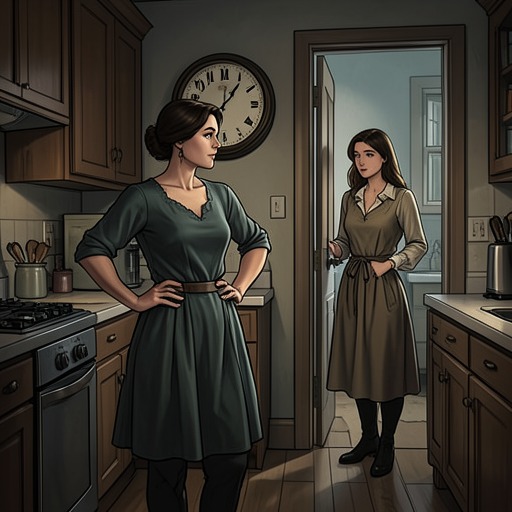
Two hours before the exhibition, Connie arrives at the house flustered and panicked, checking the time while calling for Blake to get dressed. The drive to Hoyt Harbor takes a little over fifty minutes rather than the usual hour because she is rushing and talking through the minor problems that have troubled her during the day. Blake sits tensely beside her, aware of the speed even though his blindness prevents him from seeing Connie’s gestures. His blindness is thus present not as an incidental condition but as part of the practical choreography of the event: once at the gallery, he uses his cane to move slowly around the walls, counting paces and memorizing distances so that he can orient himself inside the new space.
The gallery is barely ready when they arrive. Catering staff are waiting, and Connie is still arguing with a man in broken English about the food while Blake maps the room by sound and movement. She forces calm into her response when he asks whether everything is all right, then leaves him to drive the remaining caterers out through the door. Her frantic efficiency exposes the emotional labor beneath the polished opening: she must manage suppliers, timing, guests, food, and Blake’s access to the space while maintaining the appearance of control.
The scale of the response immediately exceeds a small local opening. Connie’s mother and Jean are staying at a motel because the town’s lodging is entirely booked, an unusual condition remembered as extending well beyond the summer tourist season. Connie expects almost two hundred invited guests. When the doors open, at least a hundred people surge inside, many having flown from across the globe, followed by collectors and investors who spill onto the sidewalk. The crowd includes people who had invested in Blake’s work during his earlier career, especially representatives of the major art money now coming from Asia and Europe. Their recognition confirms that the missing artist’s reputation has survived his isolation.
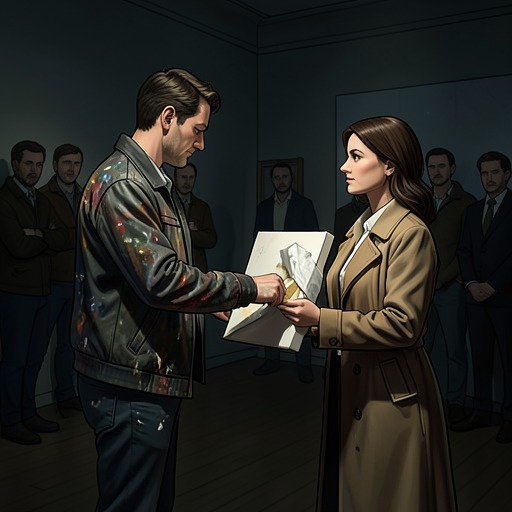
The room becomes a press of bodies moving from one image to the next. Connie greets visitors while Blake shakes hands until he is numb and reeling, recalling familiar names as echoes from the career he had abandoned. She clings to his hand, reports which works are drawing attention, and fends off a dozen purchase offers within the first few minutes. The event is therefore both an exhibition and a market in motion: the paintings are being looked at, authenticated by public response, priced through demand, and claimed by collectors almost as soon as they become visible.
The portrait of Connie becomes the room’s central visual event. She tells Blake that visitors are four deep around it, unable to move past, staring as though hypnotized. The old seascapes also attract immediate buyers, but the portrait changes the terms of Blake’s return. It is not simply a recovered artifact from his celebrated past; it is a new work born from his relationship with Connie and placed at the center of his public reappearance. Her dream of a gallery is consequently fulfilled through an exhibition in which his history and their shared present are displayed together.
Public Recognition and Private Meaning
Connie gives a speech in which she describes opening the gallery as the completion of a dream. She welcomes the guests as future visitors to exhibitions by some of the finest artists in the world and presents the gallery as a place where they will always be welcome. Her language converts private ambition into an institutional promise: she is no longer merely searching for Blake’s hidden work or negotiating access to it, but defining a cultural space with an ongoing future.
She then thanks Blake for allowing her to show his lost works and his new portrait, explicitly linking his generosity to her opportunity to meet the assembled art world and make her dream come true. The applause that follows is not only for a successful business launch. It publicly acknowledges the exchange between them: Blake supplies the paintings and the reputation, while Connie has built the conditions in which both can be seen again.
For Blake, the applause is difficult because it returns him to the position of being watched. He stands at the center of attention, senses the eyes of the crowd, and is expected to speak even though he has not prepared anything. His response becomes the emotional core of the opening. He explains that Connie entered his world during a difficult time and that her love, laughter, passion, and persistence lifted him from despair and restored his sense of life. The public speech gives words to a transformation that the exhibition itself has made visible.
Consequences and Artistic Renewal
Blake’s speech reveals that he once believed going blind had ended his art career. He says that he painted Connie’s portrait because he wanted redemption, then announces that he will begin painting again—not for acclaim or market value, but because without art some part of him will continue to yearn to be heard. The declaration astonishes the crowd and surprises Connie because he had not discussed it with her. The opening thus produces an outcome beyond the plan advertised in its catalogues: it does not merely resurrect lost paintings; it creates the conditions for new work.
The event also completes Connie’s movement away from the life she entered under debt, coercion, and artistic frustration. She once wanted the acclaim of a famous artist but changed her dream after believing she lacked Blake’s talent. In Hoyt Harbor she finds a different form of authorship, one based on selecting, presenting, promoting, and sustaining art. The packed gallery, international attendance, rapid offers, and press of collectors confirm that her ambition has become an institution rather than a private fantasy.
Yet the success retains an undertow of uncertainty. Connie returns to Hoyt Harbor aware that a new life offers no promises or guarantees and that her only support is the dream of her own gallery. The opening answers that uncertainty without erasing it: the gallery is a hit, but its future depends on continued work, Blake’s renewed production, and the fragile balance between art as personal redemption and art as public commodity. The event’s lasting significance lies in that double movement. Blake’s lost works re-enter the world, Connie enters the art system on her own terms, and the gallery becomes the shared structure through which love, memory, reputation, and renewed artistic purpose can continue.