The painting of Connie's portrait
The light house: A love storyThe painting of Connie's portrait is the central act through which Blake McGrath converts an approaching physical loss into an artistic and emotional reckoning. He asks to paint Connie not merely as a model but as his last chance to create, to expose the grief he has kept private, and to discover whether art remains possible when sight itself is failing. The finished work, titled “Lady of the Light House,” joins Connie's image to Blake's ritual of mourning for Chloe and becomes the public sign of his return to painting.
Causes and Conditions
Blake first offers Connie an exhibition of his old paintings, but immediately qualifies the offer with a condition: he wants to paint her portrait. The request unsettles Connie because Blake has abandoned painting and has never painted portraits. Its real urgency emerges when he tells her, “Connie, I’m going blind,” and describes vision that has blurred progressively over several years. His close-up focus is deteriorating even though his long-range vision remains comparatively clear; he feels as if his eyes are dying from within and expects that he will eventually wake up blind.
The portrait is therefore shaped by several pressures at once. Blake has stopped painting the ocean since Chloe drowned. The sea once gave him his career, but he now experiences it as the force that took his daughter, and he interprets both his artistic withdrawal and his impending blindness as punishment for having failed Chloe and neglected his gift. His nightly descent to the beach with Ned, where they send a rose into the sea and Ned waits for Chloe until sunrise, shows that mourning still governs his life. Against this ritual of continued loss, the portrait offers a different form of attachment: instead of looking backward toward the drowned child, Blake will concentrate on Connie, the living person who has entered his isolated world.
The Making of the Portrait
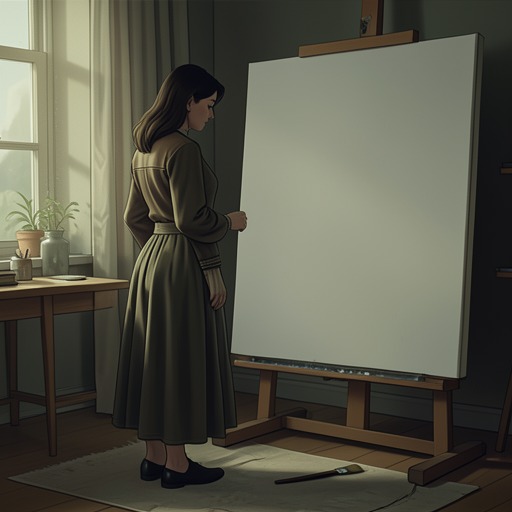
The work begins methodically. Connie recreates the pose Blake has chosen at the studio window, while he prepares a camera and explains that he will take reference photographs before projecting the final image. For a realist painter, the projector is a practical device: it gives him a detailed image and saves the time that would otherwise be spent struggling through a preliminary sketch. The method also reflects the pressure of his failing sight, allowing him to preserve visual information while he still can.
The first photographs do not satisfy him. Only after examining Connie isolated within the camera's display does Blake understand that the pose is not working. His response is not simply technical. He leaves the room, returns with a fresh rose brought by Thad Ryan with the weekly groceries, and hands it to her without explanation. The flower carries the private meaning of his beach ritual and Chloe's memory, but it also deepens the trust between Blake and Connie. When he then asks Connie to remove her shirt, the photographic session shifts from professional preparation toward intimate exposure.
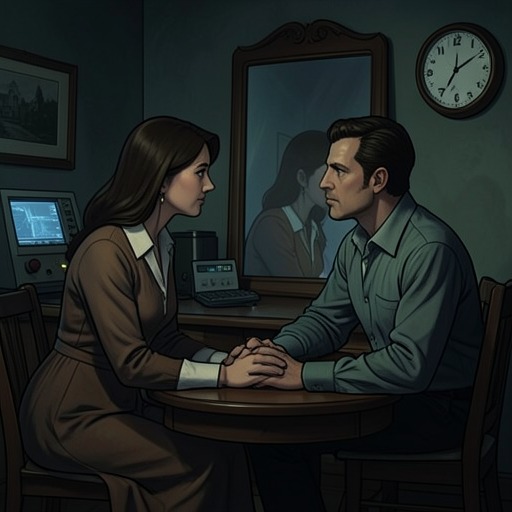
That intimacy culminates when Blake touches Connie's cheek, recognizes desire in her eyes, and kisses her. The kiss makes explicit the attraction that has been gathering beneath the language of art and obligation. Their physical closeness does not interrupt the portrait's purpose; it supplies the emotional intensity that Blake wants to preserve. The painting will be based on a visible likeness, but its subject is already becoming the charged relation between them: longing, vulnerability, and the risk of being seen by another person.
For fourteen days Blake works on the canvas. At first his progress is deliberate and laborious, but his old skill returns, sharpened by practice and emotion. Each brush stroke carries both technical mastery and passion. He covers the painting after every session, refusing Connie's requests to see it before completion, as though the image must remain protected while it develops. Outside the studio, Connie draws him back into ordinary life: they run through the surf, laugh on the hot sand with Ned circling them, and explore the rocky cliffs. The portrait is thus made during a period in which artistic labor and renewed physical life continually reinforce each other.
The Finished Work and Its Name
When the portrait is complete, Blake signs his name across the bottom of the canvas. He considers the result beautiful and takes pride in the dedication and talent invested in it. The image presents Connie with an expression of longing, a secret sadness seemingly awakened by the rose she holds. The detail is exquisite, especially the light across her face and arms, which gives the painted surface an almost translucent vitality.
Blake reveals the work to Connie with her eyes covered. He tells her that he is proud of it and that the result has reached the image he hoped to create, but Connie interrupts his speech and asks him to remove the blindfold. When she finally sees the canvas, she is overwhelmed by its beauty. The painting captures longing and yearning with such force that it seems to possess life, energy, and dimension; she experiences it as an ideal twin of herself rather than a merely competent likeness. The rose appears so real that she feels the impulse to breathe in its fragrance, while the clarity of her eyes intensifies the realism of the whole image.
Connie proposes a title centered on the light house, but Blake suddenly chooses “Lady of the Light House.” The title connects the portrait to the lights he leaves burning so Chloe can find her way home, and it gives the canvas a symbolic position between mourning and renewal. Connie is the visible subject, yet the painting also contains the absent daughter, the waiting beach, and Blake's hope that someone lost might still be guided back. The work's emotional power comes from this layered presence: a living woman bears the sign of a dead child and becomes part of Blake's attempt to return from grief.
Consequences and Reversal
The portrait changes Blake's understanding of what art can do. He had treated blindness as the end of his career and described painting Connie as his last chance for redemption. Yet the act of painting proves that his artistic ability has not simply disappeared; it returns through concentrated labor, intimacy, and the pressure to work before sight fails completely. The portrait is not a recovery of the old life in uncomplicated form. It is a work made under the knowledge that the visual world is becoming inaccessible, and its emotional intensity arises partly from that threatened ending.
The reversal becomes stark when Blake's blindness arrives. He moves helplessly through the house, knocks over furniture, falls, and searches for a cane kept in a spare-room closet by eye specialists years earlier. He wields the cane in rage, cries out against the injustice of what has happened, and stumbles down to the beach in rain and anguish. The cane is at once a practical aid and an emblem of the altered conditions under which he must now live. His blindness does not erase the portrait, but it exposes the physical cost that the painting had temporarily held at bay.
Even after this collapse, the portrait's meaning continues into Blake's public return. At the opening of the gallery, he uses the cane to move carefully around the walls, counting paces and memorizing distances while Connie manages the practical disorder of the event. He cannot participate as a conventionally sighted painter, but the gallery is arranged so that he can enter it, orient himself, and stand before an audience. The work made for private redemption becomes part of a public artistic future.
Artistic Transformation and Significance
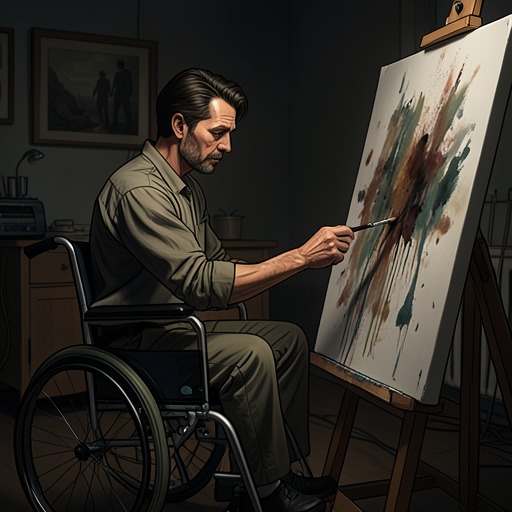
At the gallery, Blake explains that he had believed blindness would end his art career and that he painted Connie's portrait in search of redemption. He then announces that he will return to the easel, not to paint seascapes or portraits, but to paint emotion. He distinguishes his earlier practice, in which dramatic seascapes and sunsets evoked feeling through visible nature, from the new work he imagines creating without sight. He will attempt to look inward and place love, loss, hope, sadness, raw movement, and color directly onto canvas, without visible images serving as intermediaries.
The portrait therefore functions as both culmination and threshold. It completes Blake's first sustained act of painting after Chloe's drowning, but it also teaches him that artistic identity need not depend entirely on sight or on the seascapes that made his reputation. His blindness changes the medium's terms, while the portrait supplies the evidence that a new practice may be possible. The event joins the personal and the formal: desire becomes composition, grief becomes symbol, disability becomes a condition requiring new methods, and the finished painting becomes the bridge from isolation to renewed participation in art and life.