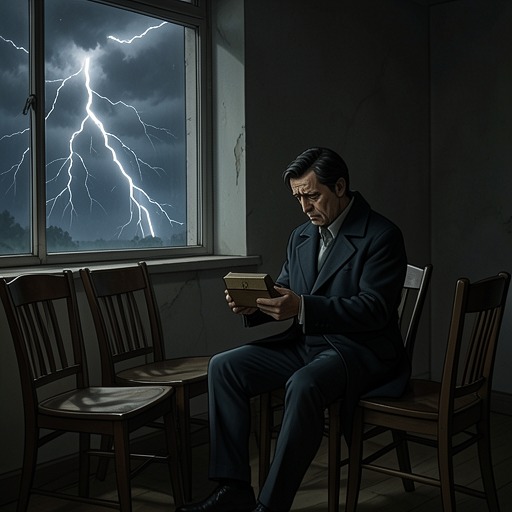
The sunset rose ritual
The light house: A love storyThe sunset rose ritual is the daily memorial practice through which Blake McGrath and Ned mourn Chloe at the edge of the ocean. At sunset, Blake takes a single red rose to the beach, kisses it, wades into the surf, and throws it beyond the breaking wave; he and the Great Dane then remain beside the water until the tide carries the flower away. Repeated at the same hour, the act gives physical form to grief while preserving an emotional connection that Blake cannot yet surrender.
The Ritual and Its Setting
Sunset interrupts an ordinary afternoon whenever Ned rises from his bed, stiff through his hind legs, and waits for Blake to recognize the changing sky. Blake retrieves one red rose from the kitchen and invites Connie Dixon to accompany him, explaining that the beach visit is a private moment shared by man and dog. Connie follows at a distance, observing their intimacy rather than entering it. The cold breeze, slate-grey ocean, hissing surf, and fading tangerine light make the walk feel less like recreation than a formal passage out of ordinary time.
At the water’s edge, Blake lifts his face toward the last color of the sun, lowers his head to the rose, and kisses its crimson petals before wading into the surf. He throws the flower beyond the first breaking wave and returns to stand beside Ned until the tide draws it away. Ned barks once and falls silent; Blake pats the dog’s head, and the two come back only when darkness has nearly settled. The ritual therefore depends on a precise sequence of gestures, a fixed hour, the presence of the dog, and the sea’s final removal of the rose.
Grief, Memory, and the Light House
The ceremony is inseparable from Chloe’s drowning. Blake explains that he and Ned send the rose into the sea because Ned still goes out each night to wait on the empty beach until sunrise, as though expecting Chloe to return. Blake’s grief is similarly organized around waiting. He has kept every light in the Mason house burning day and night, creating the local landmark called the light house because fishermen can see it for miles out to sea. The lights are his helpless signal to Chloe: a path home for a child who can no longer find it.
The ritual also explains the recurring young woman in Blake’s paintings. Blake has imagined Chloe as a beautiful raven-haired woman who might have grown up, added that imagined figure to five paintings, and sent the works into the world in the hope that Chloe might one day recognize herself and understand that she had been remembered and loved. The rose, the lights, the paintings, and the vigil all sustain the same continuing bond. None brings Chloe back, but each converts absence into a visible message.
Connie’s Witness and the Turning Point
Before its meaning is disclosed, the ritual appears mysterious and even ominous to Connie. She has come to Hoyt Harbor seeking answers while drowning in despair, debt, and emotional exhaustion, and she initially experiences the coastal town as a possible paradise. Blake rejects that description, calling the place a prison instead. His response gains its full force when Connie witnesses the sunset ceremony and later learns that the beach is the site of Chloe’s death and of Blake’s repeated attempts to remain close to her memory.
Connie’s presence changes the ritual’s function without erasing it. By allowing her to see the ceremony, Blake exposes the private structure of his grief, and by listening to his account she shares a burden that had previously been carried only by Blake and Ned. The next morning, while Connie retrieves her belongings, Blake dusts Chloe’s bedroom and changes the sheets. The action does not mean that sorrow has disappeared; it signals that grief has begun to coexist with renewed participation in the present. The movement alternates between loss-oriented remembrance at the beach and restoration-oriented acts inside the house.
The Final Farewell
The ritual reaches its decisive transformation after Blake and Connie acknowledge their future together. Blake tells Connie that he only needs to say to Chloe the one thing he could never bring himself to say: goodbye. At the next sunset, he and Ned walk to the beach with the last red rose. Blake kisses it, throws it into the foaming waves, and finally addresses Chloe directly, affirming that her father loves her and that she will always be his darling girl.
He then declares that Chloe is a painting in his heart, perfect through memory, while also recognizing that he has cried enough and cannot continue waiting for her. Instead of remaining fixed at the shoreline, he resolves to celebrate her smile in sunlight and listen for her laughter in the wind until they meet again. The farewell does not cancel his love or demand that memory be abandoned; it changes the relationship from an expectation of return into a form of remembrance compatible with life.
When Blake walks back up the beach, Connie waits on the porch and embraces him as they weep together. Inside the house, Connie turns off the lights one by one until the light house is no more. This closing gesture ends the public signal and the nightly vigil at the same time. The darkness is not presented as another descent into despair but as the completion of a mourning act: Blake can stop calling Chloe home because he has finally spoken the goodbye that grief had withheld.
Narrative Significance
The sunset rose ritual gives the novel’s treatment of complicated grief a repeated visual structure. Each evening joins the human world to the ocean, but the sea functions both as the source of Chloe’s death and as the medium through which Blake sends his love. The rose is therefore simultaneously an offering, a farewell, and a test of whether he can allow something beloved to pass beyond his control.
The ending places the ritual beside Blake McGrath’s artistic renewal. At the opening of Connie Dixon’s gallery, he explains that he once believed blindness had ended his art career, but that he will return to painting emotion. The emotional release achieved through the final rose does not sever Chloe from his art; it frees the memory from the compulsive repetition of waiting. The ritual’s significance lies in that conversion: a private cycle of mourning becomes a completed farewell, and the man who once treated the coast as a prison can begin to inhabit a future shaped by love, memory, Connie Dixon, and renewed creation.