To Paint Emotion
The light house: A love story“To Paint Emotion” names Blake McGrath’s post-blindness artistic project and the decisive transformation of his career. Rather than attempting to reproduce the seascapes and portraits that once made him successful, Blake proposes to make feeling itself the subject of painting. The expression therefore joins bodily loss, grief, love, and artistic renewal: blindness appears first as the end of his vocation, then as the condition that forces him to discover another way to work.
From Despair to a New Artistic Purpose
Blake’s declaration emerges from a history of withdrawal. After Chloe drowned, he could no longer paint the ocean, the source of his career and the medium he associated with his daughter’s death. He gave up art and turned his back on the world, interpreting his later loss of sight as another punishment for having neglected his gift. When his vision began to fail, he initially dismissed the blurring because he believed himself young and invulnerable; eventually, however, his close-up focus deteriorated while his long-range vision remained comparatively strong, and he feared that he would wake blind.
That fear becomes immediate on the last day of summer, when Blake wakes in total darkness. He tears through the house in rage and terror, finds the cane once given to him by eye specialists, and swings it like a weapon before stumbling down to the beach beneath a threatening sky. The scene makes blindness a physical crisis as well as an existential one: furniture, rugs, stairs, and the open shore become obstacles, while his familiar world loses its visual order. Yet the later formulation of “To Paint Emotion” refuses to leave blindness as mere devastation. Blake’s changed body becomes the starting point for a changed practice.
The Meaning of the Expression
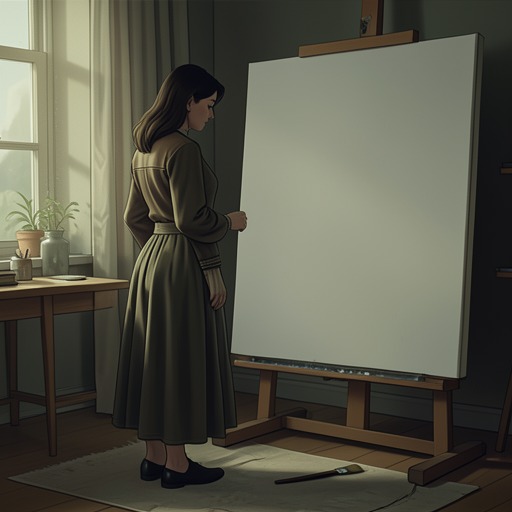
At the opening of Connie Dixon’s gallery, Blake explains that he had once believed blindness meant the end of his art career. He had painted Connie’s portrait as his “last chance for redemption,” but the portrait ultimately becomes a threshold rather than a final work. He announces that he will return to the easel not because sight has been restored, and not because he can resume his old career unchanged, but because art remains an inner demand that cannot be silenced.
Blake distinguishes his new purpose from his earlier paintings. He had formerly created dramatic seascapes and beautiful sunsets that evoked emotion through visible scenes in nature. After losing sight, he no longer believes he can make such images according to his own standards. Instead, he will look inward and attempt to capture feeling on canvas as raw, shapeless movement and color. His method replaces external representation with an effort to make visual elements carry emotional force in themselves.
The expression is consequently both precise and expansive. Blake lists love, loss, hope, and sadness as the experiences he wants to portray, but he does not reduce them to recognizable illustrations. He wants to paint without visible images that explain or intensify the feeling in advance. Shape and color are to be “infused with their own power,” so that the painting communicates through its formal elements rather than through a pictured event, landscape, or face. The proposed art is sightless, but not empty of vision; it seeks a different access to experience.
Grief, Ritual, and the Recovery of Work
The new method grows out of Blake’s long encounter with grief rather than replacing it. He and Ned go to the beach at sunset to send a rose into the sea, while Ned remains on the empty beach through the night waiting for Chloe. Blake leaves the lights on in the house so that she might find her way home. These repeated acts preserve a bond with the dead, but they also keep Blake fixed within the scene of loss, where the ocean is at once memorial, muse, and destroyer.
Speaking about Chloe’s death and his guilt allows Blake to share the burden that had kept him isolated. The next morning, while Connie is away collecting her clothes and belongings, he dusts Chloe’s bedroom and changes the sheets. The grief does not disappear, but he feels some of the burden lift and senses an old self rising from despair. This movement is not a clean departure from mourning. The beach ritual continues: after Blake regains direction, he still walks with Ned carrying the last red rose and recognizes that he must finally say goodbye to Chloe. The artistic return grows from this altered relationship to grief, not from its denial.
Practice Under Changed Conditions
Blindness also changes how Blake moves through practical spaces. When he comes to Connie’s gallery, he carries his cane, walks slowly along the walls, counts his paces, and memorizes distances. The gallery must be learned through touch, sound, and spatial memory rather than assumed as a visual environment. His remark that it is fortunate he is blind when Connie drives too quickly carries a muted irony: blindness limits him, but it also shields him from witnessing the frantic gestures and hazards he imagines around him.
Within this altered sensory world, “To Paint Emotion” becomes a program for artistic adaptation. Blake does not claim that blindness makes creation easy or automatically superior. He acknowledges that he cannot again paint seascapes or portraits to his former standards. His proposal is instead an act of disciplined redefinition: the artist accepts a changed medium of perception, translates feeling into movement and color, and treats sightlessness as an advantage only in the specific sense that it may compel him to look inward.
Public Commitment and Narrative Significance
Blake reveals the project publicly without having discussed it with Connie beforehand. The announcement arrives as a sudden rush of passion, surprising both the audience and Connie, and changes the atmosphere of the gallery from expectation to astonishment and then applause. He asks the audience to return when the new works are complete, even inviting them to bring their checkbooks. The practical appeal links emotional renewal to a future professional life: the new art is not merely private therapy but a work intended to enter the world.
Connie’s response confirms the expression’s relational meaning. She knows Blake will paint again, kisses him with joy, and stands beside the artist whose future had seemed lost. Her gallery provides the public setting in which his private recovery becomes visible, while his declaration gives her dream of presenting his lost and new works a larger purpose. “To Paint Emotion” thus marks a double return: Blake survives as a man through love and renewed connection, and he re-enters artistic life by accepting that his blindness has made his old way of seeing impossible. The final significance lies in that refusal of simple restoration. He does not recover the career he had before Chloe’s drowning and blindness; he commits to an art built from what remains, and from what can still be felt.