Uncertainty is just another word for adventure
The light house: A love story“Uncertainty is just another word for adventure” is the phrase Connie Dixon tells herself when she returns to Hoyt Harbor and commits to a future she cannot control. It is not a claim that uncertainty is harmless; it is a chosen way of interpreting risk, allowing her to treat an unpromised life as an opening rather than another form of entrapment.
Origin in Crisis
Connie arrives in Maine after a period of despair, debt, lovelessness, and diminished freedom. She has come to Hoyt Harbor for two weeks to escape and think while she can still make decisions for herself, seeking answers without knowing that fate will redirect her life. The phrase therefore emerges from a situation in which uncertainty is already unavoidable: remaining where she is would mean the continued suffocation of her old life, while leaving offers no guarantee beyond the possibility of change.
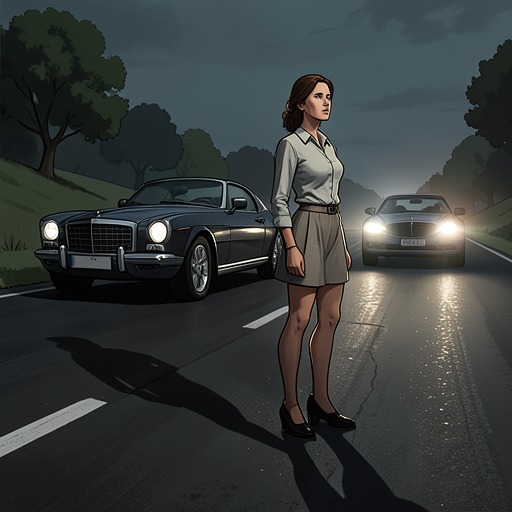
That crisis has a physical as well as emotional dimension. At the lonely promontory, Connie watches darkness spread across the land until the ocean becomes a black, seething void. She returns to the rental car, sits with a salty film across the windshield and the engine idling, and suddenly breaks down. Her tears become anger and impotent loathing, ending in her striking the steering wheel and hissing, “Damn him!” The maxim later answers this despair by changing the emotional charge of the unknown: what first appears as helpless exposure can be named as an adventure if she acts rather than submits.
The Phrase as a Decision
The expression is spoken after Connie has crossed back into Hoyt Harbor at night. The waterfront promenade is bright with strings of colored lights, vacationers gather along the foreshore beneath the stars, and the harbor’s atmosphere lifts her spirits even as fear remains beneath the elation. She is paid for another week at the vacation house, but the emotional meaning of the place has changed. She is no longer merely hiding there for a temporary escape; she is beginning again.
The new life is explicitly precarious. Connie has no promises or guarantees to carry her forward, only the dream of opening her own small gallery. She tells herself, “Uncertainty is just another word for adventure,” bravely converting the absence of security into a reason to continue. The wording is important because it is self-addressed rather than offered as advice to someone else. It functions as a compact act of self-persuasion, a sentence Connie uses to hold fear and hope in the same frame.
Place, Memory, and Contrasting Meanings
The maxim depends on Connie’s developing relationship with Hoyt Harbor. She calls the coastal setting “a piece of paradise,” seeing in its beach, harbor, lights, and open air the possibility of a life remade. Blake McGrath sees the same place through an entirely different history. He says that the seaside house may once have been paradise but now feels like a prison. For him, the coast is inseparable from Chloe’s drowning, grief, and the nightly rituals that keep the loss present.
This contrast prevents Connie’s phrase from becoming a simple celebration of travel or scenery. A place does not possess one stable emotional meaning. Hoyt Harbor can be Connie’s threshold into freedom and Blake’s enclosure within trauma. Its significance is made by memory, attachment, and choice. When Connie later celebrates with Blake on the beach, eating grilled steaks at a folding table beneath the moon and stars, the coast begins to hold a different memory for both of them: not only death and isolation, but shared happiness and a possible future.
From Escape to Construction
Connie’s adventure is ultimately practical rather than merely psychological. She wants her own gallery, a place for great art that is not pretentious but is something she can be proud of. After the beach celebration, she phones the landlord the following morning, and the Connie Dixon Gallery of Fine Art is born. The phrase thus marks the point at which a private emotional resolution becomes an undertaking in the world.
Its meaning also remains compatible with danger. Connie’s new direction includes the risk of loving Blake McGrath, whose life is shaped by blindness, isolation, and complicated grief. Blake’s pain is not erased by companionship: he continues to carry Chloe’s death, sends a rose into the sea at sunset, and leaves the lights on so that she might find her way home. Yet the later cleaning of Chloe’s bedroom and changing of its sheets gives Blake an unexpected sense of lightness, allowing a buried version of himself to begin rising from despair. Uncertainty becomes adventure not because the past disappears, but because life can make room for grief and renewed purpose at once.
Narrative Significance
As an expression, the maxim condenses the book’s movement from coercion and paralysis toward agency. Connie’s old life has been governed by debt, exploitation, and fear; her return to Hoyt Harbor accepts that freedom cannot come with complete protection. The sentence gives language to a value shift from uncertainty as threat to uncertainty as possibility.
The phrase also carries an important limit. Connie’s courage does not guarantee a painless future, and the story repeatedly shows that transformation requires confronting what has been hidden. She must face her own traumatic history with Duncan Cartwright, while Blake must speak of Chloe’s death and the ritualized grief that has made the coast feel like a prison. When Connie runs after the sightless Blake and insists that his real disability is the hollowed heart created by grief, the novel clarifies the maxim’s deepest implication: adventure is not blind optimism but the willingness to move into an unknown future after truth has been acknowledged. Through that choice, uncertainty becomes the condition of a life that is genuinely her own.