Warren Ryan
The light house: A love storyWarren Ryan is the Hoyt Harbor grocer whose knowledge of Bill Mason makes him the first practical link between Connie Dixon and the secluded artist’s hidden work. He owns two paintings obtained through years of supplying Mason, and his reluctant sale places rare art, personal debt, and family responsibility in the same precarious bargain. Although he initially treats the paintings as a means of rescuing his business, his later dealings with Connie show that he can recognize the difference between an enforceable price and a morally fair one.
Identity and Introduction
Warren Ryan appears when Connie Dixon follows a lead from the waterfront gallery. The gallery owner tells her that Ryan may know more about Mason and may be willing to sell paintings, though the recommendation is delivered with guarded ambiguity. When Ryan finally comes through the crowded grocery store, he is tall, stooped, visibly uncertain, and physically ill at ease; he hitchs up his sagging trousers and wipes his palm on his shirt before introducing himself. His awkward presentation establishes him as a local tradesman rather than a polished figure from the metropolitan art world.
Ryan immediately assumes that Connie may be in trouble, but she corrects him and explains that she wants information, access to Mason, and possibly works for future exhibitions. He listens from a cramped office whose heat, sweat, squeaking chair, and filing cabinets place the conversation firmly inside the ordinary pressures of small-business life. The setting matters: Ryan is not an abstract broker of culture but a shopkeeper whose knowledge of a celebrated yet hidden artist has accumulated through routine service and local proximity.
Connection to Bill Mason
Ryan tells Connie that he has possessed two paintings for five years, since he first met Bill Mason and began taking care of his needs. His relationship with Mason is primarily practical. Ryan supplies groceries and other necessities to Mason’s home, while his son Thad Ryan has handled the regular weekly deliveries since Ryan’s single personal meeting with the artist. Ryan therefore knows Mason through a chain of provisions, silence, and repeated access to an isolated property rather than through artistic conversation or public recognition.
Ryan is careful about what he claims to know. When Connie asks whether Mason is strange, Ryan answers that Mason is no stranger than anyone else and emphasizes that he himself met him only once. This restraint preserves Mason’s privacy while also heightening the mystery surrounding the house and its unseen occupant. Ryan can confirm the continuity of the deliveries, but he cannot offer Connie a conventional biography or arrange an immediate introduction. His knowledge is valuable precisely because it is partial.
The Sale of the Paintings
Ryan’s decision to sell is driven by financial pressure. He explains that the winter has been poor for business and that, despite the strength of the summer tourist season, he is already far behind on bank payments. The two paintings have sentimental value because Mason gave them to him during the first grocery delivery, but sentimental attachment does not eliminate economic vulnerability. Ryan initially keeps the cloth-wrapped bundle closed while admitting that the paintings are for sale if the price is right, allowing the material suspense of the bundle to mirror his hesitation.
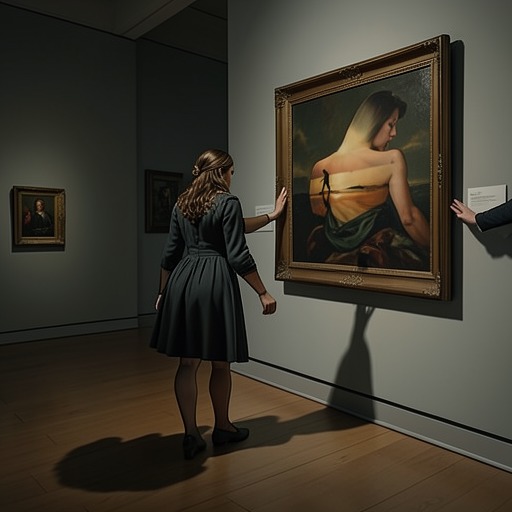
When the paintings are revealed, Connie sees two unframed oil seascapes. One is smaller; the larger work depicts a lonely beach, a boat drawn onto the sand, and the same young woman turned enigmatically away while reaching toward an angry ocean beneath a thunderous sky. Ryan watches Connie’s intense response and understands that she needs the works more deeply than an ordinary buyer would. Connie offers one thousand dollars in cash, but Ryan counters with three thousand for both paintings, a sum he believes will relieve his immediate business crisis. The negotiation exposes the collision between his survival needs and the works’ hidden artistic importance.
Connie obtains money from the joint account used to fund her mother’s nursing-home care, an act that places Ryan’s sale within a larger economy of strained caregiving. The bank warns her that a further monthly payment is due soon, while Connie and Jean Dixon have been contributing to their mother’s care since her fall at Jean’s home. Ryan does not create this burden, but his price becomes one of the choices through which Connie temporarily transfers it. He counts the three thousand dollars with miserly precision, then slides the paintings across the desk and gives Connie directions toward Mason’s property.
The Additional Payment
Ryan’s transaction does not end when Connie discovers the paintings’ true value. After selling one work to Duncan Cartwright for two hundred ninety thousand dollars, Connie returns to the grocery store the next morning. Ryan is waiting with apprehension because he has already spent her original payment on suppliers and banks. He expects a complaint or an attempt to reverse the bargain, and his fear reflects the distance between the local cash sale and the artwork’s suddenly revealed market significance.
Connie tells him that she bought the paintings without understanding their fair value and offers an additional forty thousand dollars. Ryan first defends the original agreement, insisting that both parties had seen the works and been satisfied with the price. When Connie clarifies that she is not demanding restitution but is voluntarily correcting the imbalance, his resistance collapses. He drops into his chair and wipes away tears. The payment does not erase the economic pressures that shaped the first sale; instead, it transforms the exchange from a lucky exploitation of scarcity into an act of retrospective fairness.
The sum also carries a practical consequence for Ryan. His original three thousand dollars had been used to settle urgent debts, so the additional payment acknowledges both the value of the paintings and the precariousness of the grocer’s position. Connie’s decision contrasts with Duncan’s possessive response to the art: Duncan accepts an enormous price because he must own the painting, whereas Connie uses her unexpected gain to redistribute money toward care and to repair the advantage she held over Ryan.
Narrative Role and Significance
Warren Ryan functions as a threshold figure between Hoyt Harbor’s everyday economy and the concealed world of Bill Mason’s art. He does not understand the full significance of the paintings, yet he preserves them, receives them from Mason, and makes their circulation possible. His grocery store becomes an unlikely archive, while his son’s delivery route connects the public town to the artist’s private residence.
His role also sharpens the novel’s moral economy. The paintings pass through several forms of valuation: Mason gives them away in a private exchange, Ryan prices them according to immediate need, Connie recognizes their artistic importance, Duncan prices one according to acquisitive desire, and Connie later returns to Ryan with money that acknowledges a value he could not calculate. Against this chain of transactions stands the cost of caring for Connie’s mother, which initially threatens to consume both Connie and Jean’s lives. Ryan’s character is therefore small in narrative scale but central to the book’s argument that art is never separated from the material conditions under which people work, owe, provide, and survive.
Ryan’s final significance lies in his capacity to accept correction. He begins as a desperate seller who notices Connie’s hunger for the paintings and raises his demand, but he does not cling to the windfall once Connie offers a more equitable settlement. His tears register relief as much as surprise. Through him, the novel presents a modest alternative to the coercive dealings associated with Duncan Cartwright: an imperfect market participant can still become part of an exchange shaped by recognition, generosity, and responsibility.