Warren Ryan—Bill Mason·Blake McGrath relationship
The light house: A love storyThe Warren Ryan—Bill Mason/Blake McGrath relationship is built on a quiet exchange of necessities for trust. Warren Ryan, a grocery-store owner under financial pressure, supplies the reclusive Bill Mason with weekly groceries and other household needs. In return, Mason gives Ryan two seascapes, not as ordinary merchandise but as personal gifts whose sentimental value initially outweighs their uncertain market value. The relationship keeps the artist supplied and concealed, while placing Ryan in the position of caretaker, custodian, and eventual intermediary between Mason’s hidden work and the public art market.
A Private Supply Arrangement
Warren Ryan describes the arrangement as a long-standing but limited connection. He has known Bill Mason for five years, ever since he began taking care of Mason’s needs, and the practical service consists of a weekly delivery to Mason’s home: groceries and “those kinds of things.” Ryan’s contact with him is deliberately sparse. Ryan himself met Mason only once, while his son Thad Ryan subsequently made the regular deliveries to the Mason property. The artist’s isolation is therefore maintained even while his basic needs are met through a dependable local service.
The arrangement also depends on discretion. Ryan says Mason keeps private and keeps to himself, appears in town perhaps once a year, and is otherwise unseen and unbothered. When Connie Dixon asks whether Mason is strange, Ryan refuses to turn the recluse into a local spectacle, answering that Mason is no stranger than anyone else. His guarded manner suggests that the supply relationship is not merely commercial. Ryan understands that access to Mason’s home and knowledge of Mason’s circumstances belong to a private sphere that should not be casually disclosed.
The Paintings as Gifts and Property
The two paintings enter Ryan’s possession through the first delivery he made to Mason’s home. Ryan emphasizes that Mason gave them to him, and that they were a gift to him and Mable. The distinction matters: Ryan initially treats the works as objects carrying the memory of his relationship with Mason rather than as stock held for resale. The gift creates a personal bond and gives the paintings a value that cannot be measured by price alone.
Yet the paintings also become vulnerable to economic necessity. Ryan admits that the works are for sale only after Connie Dixon presses him, and even then he does so reluctantly and conditionally, saying they can be sold if the price is right. The winter has been lean, and the strength of the summer season has not erased his debts to banks and suppliers. His decision is therefore shaped by survival rather than by a sudden change in feeling. The paintings remain sentimental objects, but his financial position forces him to convert that sentiment into cash.
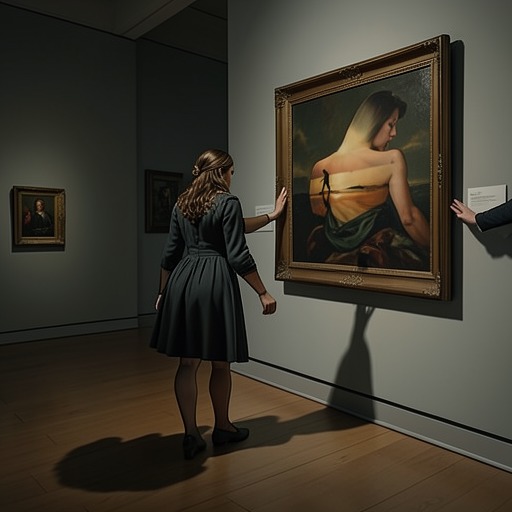
When Ryan unwraps the bundle, the works reveal why the transaction carries such weight. The first painting moves Connie to raw emotion, while the larger second canvas presents another lonely beach, a small boat, and the same beautiful young woman standing with her back to the artist as the ocean boils beneath a thunderous sky. Ryan’s ownership has concealed works of major artistic importance, although he does not appear to understand their full significance. His role is consequently both intimate and accidental: he preserves the paintings because they were given to him, then releases them because circumstances make retention impossible.
Thad Ryan and the Maintenance of Secrecy
Thad Ryan extends his father’s service without becoming a confidant of Mason. Warren introduces Thad as the son who makes the weekly deliveries, and summons him to give Connie directions to the Mason home. The younger man functions as the practical link between the grocery store and the isolated property, but the evidence does not show him entering Mason’s inner life or learning the secrets behind the paintings.
This division of labor protects Mason’s privacy. Warren possesses the history of the original gift and the fact of Mason’s withdrawal; Thad possesses the route and the routine of delivery. Neither appears to act as an art dealer or public representative. The relationship remains local, bodily, and repetitive: food and supplies travel toward the hidden house, while knowledge of the artist remains largely contained within the Ryan family’s limited service network.
From Care to Commercial Circulation
Connie’s purchase changes the meaning of Ryan’s relationship with Mason. She pays Ryan three thousand dollars for the two paintings, and he uses the money immediately to clear pressing debts with suppliers and placate the banks. The transaction therefore carries Ryan from private custodian to seller, while allowing Mason’s hidden work to leave the closed circuit of the property for the first time in years.
The initial sale is not the final measure of value. After Connie learns that the paintings are worth vastly more, she returns to Ryan’s grocery store and offers an additional forty thousand dollars. She explains that the original price was based on her incomplete understanding of the works’ fair value. Ryan is stunned and moved to tears because the extra payment arrives after he has already spent the first sum on urgent business obligations. Connie’s decision acknowledges that the paintings’ market value should not be separated entirely from the circumstances that brought them to market, including Ryan’s financial vulnerability and years of service.
The same ethics of care appear in the broader chain surrounding the sale. Connie uses the proceeds to address her mother’s nursing-home costs, gives Ryan the additional forty thousand dollars, and leaves a quarter of a million dollars to cover ongoing care. The paintings therefore pass through several forms of value at once: Mason’s gift, Ryan’s sentimental possession, Connie’s artistic discovery, a source of business relief, and finally a means of sustaining family care. Their circulation is commercial, but it is never merely commercial.
Relationship to Blake McGrath’s Hidden Life
The supply arrangement becomes more poignant once Blake McGrath’s concealed identity and history are understood. The man known locally as Bill Mason is the isolated artist whose seascapes have been kept from public view. Ryan’s weekly deliveries sustain the outward conditions of that retreat without challenging it. He does not bring Mason back into town, promote his work, or demand an explanation. His service allows the artist to remain absent from public life while continuing to live and work beyond ordinary social contact.
At the same time, Ryan’s practical assistance unintentionally preserves the material evidence of Blake’s artistic life. The paintings remain wrapped in his office for years, hidden but not destroyed, until Connie’s curiosity and financial desperation bring them into view. Ryan’s hesitation, his somber manner, and his awareness of the paintings’ sentimental value show that he is not simply exploiting a vulnerable customer. Nevertheless, the arrangement exposes an unequal economy in which one person’s isolation, another person’s debt, and a third person’s need for care determine when art becomes property.
The relationship ultimately belongs to neither friendship nor conventional patronage. It is a recurring act of supply shaped by privacy, obligation, and local trust. Warren Ryan keeps Bill Mason connected to ordinary life through food and necessities; Bill Mason repays that service with works whose importance Ryan cannot fully recognize; Thad Ryan maintains the routine after his father’s initial contact; and Connie Dixon transforms the hidden exchange into a larger artistic and ethical reckoning. Through them, the novel shows how an artist’s work can survive in the margins of the market until an act of need, curiosity, and conscience brings it into the world.