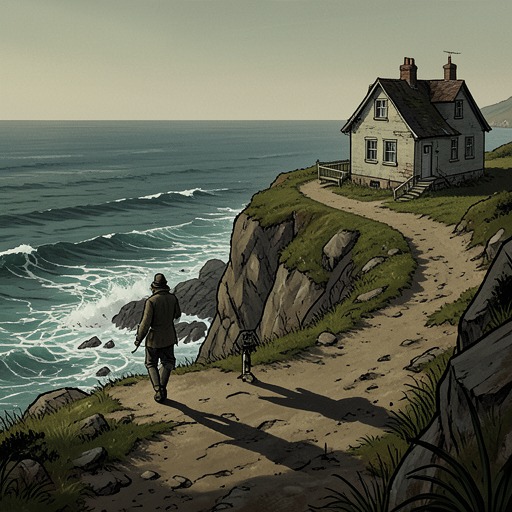
the canceled Blake McGrath exhibition
The light house: A love storyThe canceled Blake McGrath exhibition is not merely an abandoned commercial event but the material record of a decisive artistic retreat. Thirty-one finished paintings survive in Blake McGrath’s house, wrapped and shelved as though an entire public future had been packed away. The exhibition’s cancellation is later connected to his withdrawal from exhibiting and painting, to the private memorial life he built around Chloe, and finally to the possibility that the lost works can re-enter the world through Connie Dixon’s gallery.
The Exhibition as a Buried Career
When Connie Dixon enters the color-corrected studio, she finds more than three dozen upright canvases stored like books, each wrapped in cloth and differing in size and shape. Blake McGrath clarifies the exact number: thirty-one. They constitute everything he created for an exhibition, not a random accumulation of unfinished experiments. Their careful storage gives the canceled show a physical presence; although the public event never occurred, its paintings remain as a complete, concealed body of work.
The paintings are kept under specialized conditions. A complex grid of tracks and globes produces constant, natural-looking daylight, avoiding the yellow cast that might alter colors while Blake McGrath worked. The room’s artificial daylight and the canvases’ protective cloths suggest an artist who preserved the integrity of the work even while abandoning its public destination. The exhibition was canceled after the paintings had already been made, so the decisive rupture lies not in a failure to complete the art but in Blake McGrath’s decision to stop presenting it.
Cancellation and Withdrawal
Connie Dixon is puzzled by the contradiction: Blake McGrath possesses the paintings, yet he canceled the show. He confirms that the paintings themselves were not the reason. He also states that the cancellation was not the reason he stopped exhibiting and painting. The event therefore functions as a visible symptom of a deeper break rather than as its complete explanation. The exhibition marks the moment when an accomplished artistic production became inaccessible to the public, but the narrative withholds the full cause until Blake McGrath’s history of loss is disclosed.
The withheld explanation is bound to Chloe’s drowning and to the grief that follows it. Blake McGrath later describes how he and Ned go to the beach at sunset to send a rose into the sea, while Ned waits on the empty beach through the night. The canceled exhibition belongs to the same emotional structure: public art is suspended while private mourning becomes ritualized repetition. The canvases remain available as objects, but Blake McGrath’s life is organized around the absent daughter whom he continues to await.
From Public Art to Private Memorial
The exhibition’s paintings are connected to Blake McGrath’s attempt to keep Chloe present. He explains that five paintings were altered by adding a beautiful raven-haired young woman, an imagined version of Chloe had she grown up. He sent those works into the world so that she might one day recognize herself, understand that she had been remembered, and know that she was loved. This practice turns painting into a message addressed to the dead or impossibly absent child, while the canceled exhibition represents the point at which artistic circulation could no longer be separated from personal devastation.
The same logic explains the house known locally as the light house. It is not an actual lighthouse; every light in the Mason residence remains on day and night, making the house visible to fishermen for miles out to sea. Blake McGrath leaves the lights burning so Chloe can find her way home. The canceled exhibition is thus surrounded by a system of signs—covered paintings, perpetual illumination, roses released into the ocean, and nightly waiting—that converts artistic and domestic space into a memorial landscape.
Reopening the Lost Works
The buried exhibition eventually becomes part of recovery rather than permanent concealment. Connie Dixon returns to Hoyt Harbor to collect her belongings while Blake McGrath dusts Chloe’s bedroom and changes the sheets. His grief does not disappear, but he senses an old self beginning to rise from despair. This movement matters for the canceled exhibition because the stored paintings can be approached only as Blake McGrath begins to move between loss-oriented rituals and renewed participation in ordinary and artistic life.
At Connie Dixon’s gallery, Blake McGrath arrives with his cane and slowly maps the walls by counting paces and memorizing distances. His blindness changes how he can enter the exhibition space, but it does not remove him from the event; the environment and Connie Dixon’s assistance allow him to participate as an artist. The suppressed works consequently return not through a restoration of the past exactly as it was, but through a new arrangement in which Blake McGrath navigates art publicly as a blind man.
Consequences and Artistic Transformation
At the gallery opening, Connie Dixon thanks Blake McGrath for allowing her to show his lost works and his new portrait. His response gives the canceled exhibition its final significance. He says that he once believed blindness had ended his art career, and that he painted Connie Dixon’s portrait because he wanted redemption. He then announces that he will begin painting again, not because the old career can simply be recovered, but because art remains an inner part of him that demands to be heard.
Blake McGrath distinguishes this future work from the seascapes and portraits associated with his earlier practice. Since blindness prevents him from producing those visible scenes according to his former standards, he proposes to paint emotion itself: love, loss, hope, and sadness expressed through raw movement and color rather than through recognizable images. The canceled exhibition therefore becomes a hinge between two artistic identities. Its thirty-one paintings preserve the work Blake McGrath made before his withdrawal; their public showing helps make possible a return to the easel founded on a transformed, inward conception of painting.